How a 401(k) loan actually works
A 401(k) loan isn’t really a loan in the ordinary sense — it’s borrowing from yourself. Your plan sells investments inside your account, hands you the cash, and you repay it through automatic payroll deductions, usually over up to five years (longer is allowed if the money buys your primary home). The interest rate is typically the prime rate plus 1–2%, and every dollar of it is deposited back into your own account rather than paid to a bank.
Because there’s no lender taking risk, there’s no credit check, no application underwriting, and no entry on your credit report — approval is essentially automatic if your plan offers loans, and even a default never touches your credit score. The IRS caps the amount at the lesser of $50,000 or 50% of your vested balance, and your plan can be stricter. Fast, cheap-looking, invisible to credit bureaus: it’s easy to see the appeal. The catch is that the cost is real — it’s just hiding somewhere most calculators never look.
What does a 401(k) loan really cost?
The interest is a distraction: you pay it to yourself. The true cost is opportunity cost — the market growth the borrowed dollars miss while they’re out of the account. This calculator measures exactly that. It runs your account twice, month by month: once untouched, growing at your assumed return, and once with the loan amount removed on day one and each monthly repayment (principal plus interest) deposited back and growing from then on. The difference between the two ending balances is the true cost, net of all the interest you paid yourself.
True cost = account if untouched − account with the loan repaid
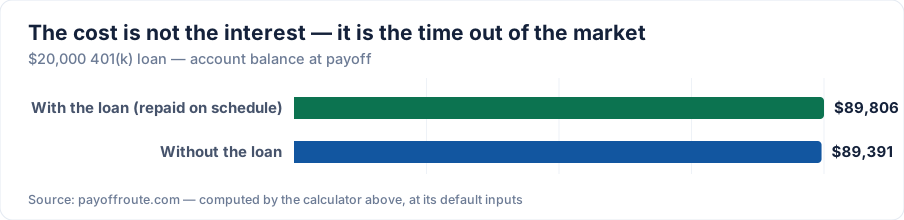
That subtraction is the whole model, and it makes the answer hinge almost entirely on one assumption: the return you think the money would have earned. Below is the default loan — $15,000 at 8.5% over 5 years from a $60,000 account, a $307.75 monthly repayment and $3,465 of interest paid to yourself in every row — with only the assumed market return changing:
| Assumed return | Account untouched | Account with the loan | True cost |
|---|---|---|---|
| 4% | $73,260 | $75,416 | -$2,156 (ends larger) |
| 6% | $80,931 | $82,277 | -$1,346 (ends larger) |
| 8% (the default) | $89,391 | $89,806 | -$415 (ends larger) |
| 10% | $98,719 | $98,069 | $650 |
A negative true cost looks like a free lunch and isn’t. Whenever your loan rate (8.5%) beats your assumed return, the account does end larger — but only because you shovelled $3,465 of after-tax paycheck into it as interest. Those dollars had to come from somewhere, and they could have been invested anywhere else. Flip the assumption to 10% and the disguise falls away: the same loan now leaves the account $650 smaller. The lesson isn’t “borrow when the market is weak” — nobody knows that in advance — it is that this number is an assumption, not a measurement, so run it across a range before you decide.
The same effect explains the strangest case of all: in a genuinely falling market, a 401(k) loan can accidentally “win,” because the borrowed money sat out the decline and the repayments bought back in at lower prices. That is luck, not strategy — nobody knows the next five years in advance — and it is precisely why the honest move is to test several return assumptions and read the range rather than a single hopeful number.
The double-taxation debate, honestly
You’ll read that 401(k) loans are terrible because you “repay pre-tax money with after-tax dollars and then get taxed again in retirement.” That version is overstated. The loan principal is not double-taxed: you received untaxed dollars when you borrowed and repaid them with taxed dollars — exactly the same trade as repaying a bank loan, where you also use after-tax money. The retirement-age tax on that principal was always going to happen, loan or no loan. Calling it double taxation counts the same tax twice.
But there’s a true kernel: the interest portion genuinely is taxed twice. You earn it, pay income tax on it, deposit it into the pre-tax account as loan interest — and then pay income tax on it again when you withdraw it in retirement. On the default loan that’s double tax on about $3,465 of interest, not on the whole $18,465 you repay. Real, worth knowing, and far smaller than the scare version — for most loans it amounts to a few hundred dollars of extra lifetime tax, well below the opportunity-cost and job-change risks that actually deserve your attention.
The job-change trap
This is the risk that turns a mediocre deal into a genuinely bad one, and it’s the part people skip. If you leave your job — quit, laid off, or fired — with the loan outstanding, most plans require repayment in full, typically by the due date of your federal tax return for the year you leave. Whatever you can’t repay is declared a “deemed distribution” (or a loan offset): the plan treats the unpaid balance as money you withdrew. You owe ordinary income tax on it, plus a 10% early-withdrawal penalty if you’re under 59½. The calculator above shows an illustrative version of this bill at the midpoint of your loan.
The cruel mechanics: the moment you most need to not owe a surprise tax bill — right after losing a job — is exactly when the bill arrives. There is a rescue hatch worth knowing. Since the 2018 tax law, a plan loan offset can be rolled over: deposit the outstanding amount into an IRA from other savings by your tax-filing deadline (extensions included) and the distribution, tax, and penalty all disappear. It works — if you have that much cash sitting elsewhere, which most people repaying a 401(k) loan do not. So price the risk honestly before you borrow: how secure is this job, really, for the full term of the loan?
When a 401(k) loan beats the alternatives
None of the above makes a 401(k) loan always wrong — it makes it a tool with a specific price, and sometimes the alternatives cost more. The clearest case is high-interest credit card debt. Swapping a balance at 24% APR for a loan at 8.5% paid to yourself can be entirely rational: the card interest is a pure outflow to a bank, while the loan’s cost is mostly foregone growth, partially offset by interest you recapture. Run your card balance through our credit card payoff calculator, compare a personal loan quote at your actual credit tier, and stack both against the true cost above — for many borrowers the 401(k) loan wins that three-way comparison, provided the card spending actually stops and the job is stable.
The other clean win is against a hardship withdrawal. A withdrawal is permanent: income tax now, usually the 10% penalty now, and the money never returns to compound. A loan of the same size costs a fraction of that if repaid on schedule, because the dollars come back. If the choice is loan versus hardship withdrawal for the same genuine emergency, the loan is almost always the better instrument.
When it’s a mistake
Three patterns turn this tool against you. First, shaky job security: if there’s a real chance you’ll leave — or be asked to leave — before the loan is repaid, the deemed-distribution math above stops being hypothetical. Second, chronic borrowing: taking a second loan before the first is done, or re-borrowing the moment one is repaid, means the loan is papering over a spending gap that a retirement account can’t fix and will eventually stop covering.
Third — the hidden killer — cutting contributions to afford the payments. The repayment comes out of the same paycheck as your contributions, and the quiet, common move is to dial contributions down “temporarily.” Pause $500 a month of contributions for the five-year term at an 8% return and you end roughly $36,700 behind — several times the loan’s modeled true cost — before counting any employer match you forfeited, which is a 50–100% instant loss on those dollars. This model assumes your contributions continue unchanged in both scenarios; if taking the loan means they won’t, the real cost is far larger than any number on this page. If the payment only fits by shrinking contributions, the honest conclusion is that the loan doesn’t fit.
Frequently Asked Questions
How much can I borrow from my 401(k)?
IRS rules cap a 401(k) loan at the lesser of $50,000 or 50% of your vested balance. Two wrinkles: the $50,000 ceiling is reduced by your highest outstanding loan balance over the previous 12 months, and your plan can set stricter limits — or not offer loans at all. Check your plan document or ask your administrator for the exact number.
Does a 401(k) loan affect my credit score?
No. There is no credit check to get one, the loan never appears on your credit report, and even defaulting does not hurt your score — a default becomes a taxable distribution instead of a collections event. That makes it one of the only loans where the downside shows up on your tax bill rather than your credit file.
Can I keep contributing to my 401(k) while repaying the loan?
Usually yes, and you should — at minimum enough to capture your full employer match. A minority of plans suspend contributions during repayment (check yours), but for most people the real risk is voluntary: cutting contributions to afford the loan payment. That quiet cut usually costs far more than the loan itself.
What happens if the market drops while I have a 401(k) loan?
You can come out ahead. The borrowed dollars were out of the market during the decline, and your repayments buy back in at lower prices. In that scenario the loan beats leaving the money invested — but only with hindsight. It is luck, not strategy: nobody reliably knows in advance when the market will fall, so it is not a reason to take the loan.
Can I pay off a 401(k) loan early?
Generally yes, with no prepayment penalty. Most plans accept a lump-sum payoff at any time, and many now allow extra or accelerated payments. Paying early puts your money back in the market sooner, which shrinks the opportunity cost this calculator measures. Confirm the mechanics with your plan administrator — some only accept full payoffs, not partial extras.
Can I take more than one 401(k) loan at a time?
Only if your plan allows it — many limit you to one outstanding loan. Even when multiple loans are permitted, the combined balance must stay within the IRS cap, and the $50,000 limit is reduced by your highest outstanding balance in the prior 12 months. If you find yourself wanting a second loan before the first is repaid, treat that as a budget warning sign, not a paperwork problem.
Does this calculator store my information?
No. All calculations run entirely in your browser. Nothing you type is saved, stored, or sent to any server.
Related calculators
Personal Loan
Monthly payment and true total cost of a personal loan, including the origination fee most calculators ignore.
Open calculator →Loan Payoff
See how much sooner you’ll be debt-free and how much interest you save by adding extra monthly or one-time payments to any loan.
Open calculator →Student Loan Payoff
See when your student loans actually end — and how extra payments or one-time windfalls move the date and shrink the interest.
Open calculator →Disclaimer: This calculator is for educational purposes only and provides estimates based on the numbers you enter. It is not financial, legal, or tax advice. Actual loan terms, rates, and payments depend on your lender and personal circumstances. All calculations run in your browser — nothing you enter is stored or sent anywhere.