Which loans this models (and which it doesn’t)
This calculator assumes one thing about your loan: the payment is fixed. That covers the federal Standard plan (the default 10-year schedule most borrowers land on), the federal Extended plan, and essentially every private student loan. If your bill is the same dollar amount every month until the loan dies, you’re in the right place.
What it deliberately does not model is income-driven repayment (IDR) — SAVE, IBR, PAYE, and whatever plans succeed them. IDR payments are recalculated from your income and family size every year, so there is no fixed schedule to simulate: your payment can rise with a raise, fall after a job loss, and the loan’s end date moves with it. A fixed-payment simulation of an IDR loan would simply be wrong, and we’d rather tell you that than show you a confident-looking wrong answer.
There’s a bigger fork here than just math. Borrowers on an IDR plan who are working toward forgiveness — Public Service Loan Forgiveness after 10 years of qualifying payments, or IDR’s own 20–25 year forgiveness — generally should not prepay at all. Any balance remaining at forgiveness is wiped out, so every extra dollar sent early is a dollar the program would have erased for free. If that’s your track, the winning move is the minimum payment, on time, every time. If you’re not sure which plan you’re on, log in to your servicer’s site and check the plan name before you send a single extra dollar — it changes the entire strategy.
How much do extra payments save on student loans?
Your required payment does two jobs each month: it pays the interest your balance just generated, and whatever is left over reduces the balance. Early in a loan, interest eats a large share. An extra payment skips that first job entirely — the month’s interest is already covered, so every extra dollar goes 100% to principal, and every dollar of principal removed stops generating interest for the loan’s entire remaining life.
One line of arithmetic, repeated every month, is the entire model:
Principal paid this month = (payment + extra) − (balance × APR ÷ 12)
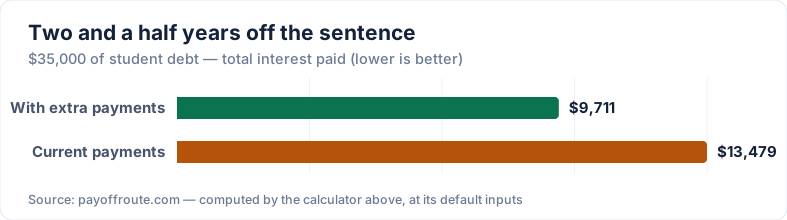
The defaults above show what that means on a typical balance. A $35,000 loan at 6.8% APR with a $400 payment takes 10 yr 2 mo to pay off and costs $13,479 in interest on its own. Add just $100 a month and the loan ends in 7 yr 6 mo — 2 years 8 months sooner — while total interest drops to $9,711, a saving of $3,769. That’s the return on an extra $100 that most budgets can find. Drop a one-time windfall on top — a tax refund is the classic — and the date moves again; the calculator applies it next month and shows exactly what it buys.
Here is the full ladder on that same $35,000 balance at 6.8% with a $400 required payment — the exact figures the calculator above produces:
| Extra per month | Payoff time | Total interest | Interest saved |
|---|---|---|---|
| $0 (required payment) | 10 yr 2 mo | $13,479 | — |
| $50 | 8 yr 7 mo | $11,280 | $2,199 |
| $100 | 7 yr 6 mo | $9,711 | $3,769 |
| $200 | 6 yr | $7,612 | $5,868 |
Note what that extra money actually buys. An extra $200 a month for the 6 years the loan survives is $14,400 — but every dollar of it goes to principal you owed anyway, and along the way it cancels $5,868 of interest and ends the debt more than four years early, freeing the $400 required payment for those 50 months too. Long-dated loans like student debt are exactly where prepayment has the most time to work.
One student-loan-specific wrinkle: most borrowers don’t have a loan, they have a group of loans — one or two per semester, often at different rates — that the servicer displays as a single balance and a single payment. When you’re prepaying, that grouping matters. Direct your extra money at the highest-rate loan in the group first while paying minimums on the rest; each dollar there cancels the most interest. Run this calculator on that one loan’s balance and rate to see its individual payoff, or on the blended whole for the big picture.
The federal wrinkles worth knowing
Student loans come with a few rules of their own, and knowing them makes your extra payments work harder:
- There is never a prepayment penalty. Federal law bans them on all federal student loans, and virtually no private student lender charges one. You can prepay any amount at any time, and the only cost is interest accrued to date. Anyone telling you otherwise is wrong.
- Tell the servicer where the money goes. Left to their defaults, many servicers treat an overpayment as an early next payment — you get marked “paid ahead” and your due date advances, but your interest barely changes. Instruct them, in writing or via the payment portal’s settings, to apply extra amounts to principal, on the highest-rate loan in your group. Then check the next statement and confirm that loan’s balance fell by the full extra amount.
- Watch interest capitalization events. When federal loans exit certain deferments or forbearances, or when you leave some repayment plans, unpaid accrued interest can be capitalized — added to your principal, where it starts generating interest of its own. If you have accrued interest sitting on your account and a capitalization event is coming, paying that interest off before it capitalizes is one of the highest-value payments you can make.
- Don’t keep the loan for the tax deduction. The student loan interest deduction is capped at $2,500 a year, phases out at moderate incomes, and only refunds a slice of the interest at your tax rate — perhaps a few hundred dollars a year at best. Paying thousands in interest to recover a few hundred in taxes is a bad trade every time. Take the deduction while you have the loan; never let it slow the payoff.
Prepay or invest (or emergency fund)?
Honest answer: prepaying is not always the best use of the money, and the triage is simpler than it looks.
- Emergency fund first. Extra loan payments are a one-way door — once sent, you can’t get the money back without borrowing again. Before accelerating anything, keep several months of expenses in savings. A paid-down loan doesn’t cover a broken transmission.
- High-rate private loans are a guaranteed win. Prepaying an 8%, 10%, or 12% private loan is a risk-free, tax-free return at that rate. No savings account and no predictable investment matches it, so high-rate balances deserve every spare dollar after the emergency fund.
- Low-rate federal loans are genuinely arguable. If your rate is under roughly 5%, money in a high-yield savings account or a diversified retirement account may reasonably earn more than the loan costs — especially if you’re leaving an employer 401(k) match on the table, which beats any prepayment. Plenty of people prepay anyway for the peace of mind of owing nothing; that’s a legitimate choice, just know it’s an emotional return, not a mathematical one.
- Forgiveness chasers should pay the minimum on purpose. If you’re credibly on track for PSLF or IDR forgiveness, extra payments shrink a balance that was going to be erased anyway. Pay exactly what’s required and put the spare money toward the emergency fund or investments instead.
Two neighboring tools round this out. For any other fixed-rate debt — auto, personal, or a blended view of everything — the generic loan payoff calculator runs the same math. And if the real problem is the rate on private loans rather than the balance, refinancing may beat brute-force prepayment; our debt consolidation calculator shows whether a lower-rate loan actually saves money after fees. One firm warning applies there: refinancing federal loans into a private loan is permanent and forfeits income-driven repayment, forgiveness programs, and federal hardship protections — refinance private loans freely, but think hard before privatizing federal ones.
Frequently Asked Questions
Should I pay off my student loans early or invest instead?
Compare your loan rate to what you could reasonably earn elsewhere. Prepaying a loan is a guaranteed, tax-free return equal to its rate, so an 8%+ private loan is almost always worth attacking. A sub-5% federal loan is genuinely arguable — a high-yield savings account or diversified investing may earn more. Build an emergency fund first either way, since extra loan payments cannot be taken back.
Does paying off student loans early hurt my credit score?
It can cause a small, temporary dip. Closing an installment account ends its stream of on-time payments and slightly changes your credit mix, but the effect is minor and fades within months. The interest you stop paying is real and permanent — almost no one should keep a loan open to feed a credit score.
Can I prepay federal student loans without a penalty?
Yes. Federal law prohibits prepayment penalties on all federal student loans, and virtually all private student lenders have none either. You can pay extra every month, send a lump sum, or pay the whole thing off tomorrow — the only cost is the interest accrued to date.
What if I am pursuing loan forgiveness?
Then extra payments usually work against you. Under PSLF or income-driven-repayment forgiveness, any balance left at the end is wiped out — so every extra dollar you send is a dollar the forgiveness program would have erased for free. Borrowers on a credible forgiveness track should deliberately pay the minimum required amount and put spare money elsewhere.
Should I refinance my federal loans to a lower private rate?
Be very careful. Refinancing federal loans into a private loan is permanent and forfeits income-driven repayment, generous deferment and forbearance options, PSLF and other forgiveness programs, and death-and-disability discharge. It can make sense for a high, stable income with no forgiveness plans — but refinancing private loans to a lower rate carries no such loss and is much easier to justify.
How do I make sure my extra payment actually reduces principal?
Tell your servicer explicitly. The default at many servicers is to treat extra money as an early next payment, which advances your due date but saves almost nothing. Instruct them — online setting, memo line, or a standing instruction — to apply overpayments to principal on your highest-rate loan, then check your next statement to confirm the balance dropped by the full extra amount.
Does this calculator store my information?
No. All calculations run entirely in your browser. Nothing you type is saved, stored, or sent to any server.
Related calculators
Personal Loan
Monthly payment and true total cost of a personal loan, including the origination fee most calculators ignore.
Open calculator →Loan Payoff
See how much sooner you’ll be debt-free and how much interest you save by adding extra monthly or one-time payments to any loan.
Open calculator →Auto Loan Payoff
Pay the car off early: what extra payments save in interest, and how fast you can get right-side-up on the loan.
Open calculator →Disclaimer: This calculator is for educational purposes only and provides estimates based on the numbers you enter. It is not financial, legal, or tax advice. Actual loan terms, rates, and payments depend on your lender and personal circumstances. All calculations run in your browser — nothing you enter is stored or sent anywhere.