How much does paying extra on a car loan save?
Your monthly payment covers the interest your balance just generated, and only what’s left over reduces the balance. An extra payment arrives after that bill is already settled, so it lands entirely on principal:
Principal paid this month = (payment + extra) − (balance × APR ÷ 12)
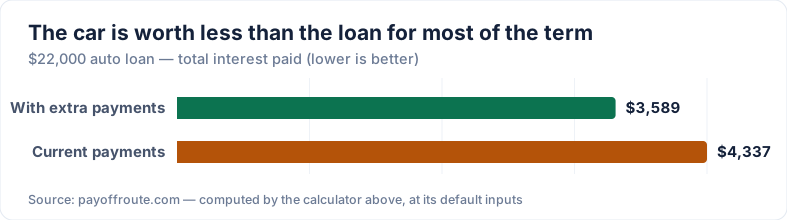
Because car loans are short, that leverage shows up fast. Here is what different extra payments do to the calculator’s default loan — $22,000 at 7.5% APR with a $450 monthly payment. These are the exact figures the tool above produces:
| Extra per month | Payoff time | Total interest | Interest saved |
|---|---|---|---|
| $0 (current payment) | 4 yr 11 mo | $4,337 | — |
| $50 | 4 yr 4 mo | $3,807 | $529 |
| $75 | 4 yr 1 mo | $3,589 | $747 |
| $150 | 3 yr 6 mo | $3,066 | $1,271 |
An extra $150 a month kills the loan 17 months early and saves $1,271 — and those 17 payment-free months are worth $450 each on their own. The reason the effect is so blunt on a car loan is the same reason the loan is dangerous in the first place: the term is short and the rate isn’t.
A generation ago the standard car loan ran 36 or 48 months. Today, 72-month terms are routine and 84-month (7-year) loans have become common, because stretching the term is how dealers keep monthly payments looking affordable as vehicle prices climb. The payment looks fine; the total cost doesn’t. A longer term means more months of interest on a balance that shrinks slowly, and used-car rates make it worse — while borrowers with excellent credit see single-digit APRs, average used-car rates typically run in the high single digits to low teens, and subprime rates can climb well beyond that.
The combination that really stings is long terms plus fast depreciation. A car loses value quickest in its first few years — exactly when a long loan’s payments are mostly servicing interest rather than reducing principal. The result is that many borrowers spend years owing more than the car is worth. Extra payments are the direct antidote: they attack the slow-shrinking balance on a fast-shrinking asset. Run your real numbers above and look at how much of the total interest an extra $50 or $75 a month quietly deletes.
Being upside-down, and how extra payments fix it
You’re upside-down (or “underwater,” or carrying “negative equity”) when you owe more on the loan than the car would sell for. It’s normal early in a long loan, especially if you made a small down payment or rolled a previous car’s balance into this one — but it’s a genuinely exposed position, not just an accounting curiosity:
- The totaled-car gap. If the car is wrecked or stolen, insurance pays what the car was worth, not what you owe. Upside-down by $4,000 means writing a $4,000 check for a car you no longer have — unless you carry GAP insurance to cover the difference.
- Trade-in freedom. With negative equity you can’t cleanly sell or trade the car; the shortfall either comes out of pocket or gets rolled into the next loan, digging the hole deeper. Right-side-up, the car becomes an asset you can exit whenever life changes.
Extra payments fix this faster than anything else, because every extra dollar goes 100% to principal — your regular payment already covered the month’s interest. The chart above makes it visible: the green “with extras” curve drops below the blue baseline immediately and the gap widens every month, which means your balance crosses below the car’s value — right-side-up — months or years sooner. If you’re paying for GAP insurance, crossing that line is also the point where the coverage stops protecting anything and can usually be dropped.
Check two things before your first extra payment
Two five-minute checks make sure your extra money actually does what this calculator assumes it does:
- Simple interest vs. precomputed interest. Most auto loans are simple-interest loans: interest accrues on the current balance, so prepayments cut future interest exactly as modeled here, and there’s typically no penalty. A minority — mostly in subprime financing — are precomputed (sometimes Rule-of-78s) loans, where the total finance charge is calculated up front and baked into the contract. Prepaying one of those saves little or nothing. Search your contract for “precomputed” or “Rule of 78”; if it’s there, your best move may be paying minimums or refinancing into a simple-interest loan rather than prepaying.
- Make sure the extra hits principal. Some lenders’ default is to treat extra money as an early next payment — which advances your due date but saves you almost nothing. When paying online, look for an “apply to principal” option; if you mail a check or use bill pay, write “apply to principal” on it, then verify on the next statement that the balance dropped by the full extra amount.
Paying it off early creates a refund. Almost nobody collects it.
If the finance office sold you GAP coverage, ending the loan early ends the coverage — GAP exists to bridge the difference between what you owe and what the car is worth, and once the loan is gone that difference is zero. The unused premium is yours, in cash. The same is true of an unused extended warranty.
Lenders are supposed to refund it automatically, and a great many do not. In November 2023 the CFPB ordered Toyota Motor Credit to pay $60 million, part of it for failing to refund prepaid GAP to customers who paid their loans off before the end of the term. So ask, in writing, and name the payoff date. Our extended warranty & GAP refund calculator works out what you are owed — and, if you are keeping the loan rather than closing it, how many months the refund cuts off this schedule.
Prepay the car or attack other debt first?
The car loan usually isn’t your highest-rate debt, and every spare dollar earns the most where the APR is highest. A credit card above 20% outranks a 7.5% car loan every single time — pay card minimums-plus-everything-extra first and let the car loan run on its regular payment until the cards are gone. Our credit card payoff calculator handles multiple cards and compares payoff orders directly.
Once high-rate debt is cleared, prepaying the car is a solid move: it’s a guaranteed, tax-free return equal to your APR, which at 7–10% beats anything a savings account pays and does it with zero risk. Just keep an emergency fund intact first — extra payments are a one-way door, and raiding them back means borrowing again.
There’s a third option worth checking: refinancing. Auto rates are heavily credit-driven, so if your score has improved since you bought the car — a year or two of on-time payments will often do it — you may qualify for a meaningfully lower APR on the same balance. Refinancing and prepaying aren’t either/or: the strongest play is often a lower rate and extra payments on top. Model the new rate with our generic loan payoff calculator, and if the car loan is one of several debts you’re juggling, the debt consolidation calculator shows whether rolling them into one lower-rate loan actually saves money after fees.
The payment-free months are the prize
The interest savings are nice, but the real payoff is the day the payment stops. Every month you shave off the loan is a month your $450 (or whatever your payment is) stays in your pocket — and what you do with it next determines whether you ever have a car payment again.
The classic move: keep making the payment, but to yourself. The money was already leaving your checking account every month; your budget won’t miss it. Redirect the old payment into a savings account the day the loan dies, and it becomes a next-car fund. A few years of a former $450 payment earning interest instead of paying it builds a serious down payment — or buys a decent used car outright. That’s how you break the perpetual-loan cycle: this loan is the last one that starts from zero, because the next car starts from a pile of your own money instead of a trade-in with negative equity. Run the calculator, find your payoff date, and put the automatic transfer on the calendar for the month after.
Frequently Asked Questions
Is there a penalty for paying off a car loan early?
Usually not. Most auto loans are simple-interest loans with no prepayment penalty, so you can pay extra or pay the whole thing off whenever you like. The exception is precomputed-interest loans (sometimes called Rule-of-78s loans), where the total finance charge is fixed up front and prepaying saves little — these still show up in some subprime financing. Check your contract for the words "precomputed" or "prepayment" before sending a large extra payment.
Does paying off an auto loan early hurt my credit score?
It can cause a small, temporary dip. Closing an installment account reduces your mix of open credit and ends that account’s stream of on-time payments. The effect is usually minor and fades within months, while the interest you stop paying is real and permanent. Keeping a car loan open just to feed a credit score is almost never worth it.
Should I pay extra on my car loan or refinance it instead?
They solve different problems. Extra payments shrink the balance; refinancing shrinks the rate. If your credit has improved meaningfully since you bought the car, refinancing to a lower APR can cut the cost of every remaining dollar — and you can still pay extra on the new loan. If your rate is already reasonable, skip the paperwork and just prepay. Run both scenarios through the calculator and compare.
What is GAP insurance, and when can I drop it?
GAP (guaranteed asset protection) coverage pays the difference between what you owe and what the car is worth if it’s totaled or stolen while you’re upside-down. It only has value while your balance exceeds the car’s value. Once extra payments push you right-side-up, GAP protects nothing — that’s usually the point where cancelling it (and often getting a partial refund if you prepaid it) makes sense.
How do I know if I’m upside-down on my car loan?
Compare your current loan balance (from your lender’s app or statement) to the car’s current market value from a pricing guide like KBB or Edmunds, using the private-party or trade-in figure. If the balance is higher than the value, you’re upside-down by the difference. Rechecking every few months as you pay extra shows you exactly when you cross back over.
Are biweekly car payments worth it?
They’re a mild but real accelerator. Paying half your payment every two weeks produces 26 half-payments a year — 13 full payments instead of 12 — and that extra payment goes straight to principal. You can get the same effect with no billing changes by entering one-twelfth of your payment in the extra-monthly field above. Never pay a fee for a biweekly "program"; you can do it yourself for free.
Does this calculator store my information?
No. All calculations run entirely in your browser. Nothing you type is saved, stored, or sent to any server.
Read more on this
0% Financing or the Cash Rebate? The Break-Even Map
Original data: the exact rate below which taking a car dealer’s cash rebate beats their 0% financing — mapped across every rebate size, term and price. Plus why the rule of thumb everyone repeats is calibrated to a car that barely exists any more.
Read →The Car Loan Deduction Dies at $111,000, Not $150,000 — and 0% Financing Kills It Outright
Original data: the 2025 car loan interest deduction phases out by a flat dollar amount, not a percentage. A typical car loan's deduction is worth nothing above a $111,000 MAGI. And 0% financing, having no interest, has nothing to deduct.
Read →The Refund That Never Reaches You: What Cancelling a Car Warranty Actually Does
Original data: cancelling a financed extended warranty or GAP policy sends the refund to your lender, not to you — and your payment does not drop. We computed what it does instead, and what one unread clause in the contract is worth.
Read →Related calculators
Personal Loan
Monthly payment and true total cost of a personal loan, including the origination fee most calculators ignore.
Open calculator →Loan Payoff
See how much sooner you’ll be debt-free and how much interest you save by adding extra monthly or one-time payments to any loan.
Open calculator →Student Loan Payoff
See when your student loans actually end — and how extra payments or one-time windfalls move the date and shrink the interest.
Open calculator →Disclaimer: This calculator is for educational purposes only and provides estimates based on the numbers you enter. It is not financial, legal, or tax advice. Actual loan terms, rates, and payments depend on your lender and personal circumstances. All calculations run in your browser — nothing you enter is stored or sent anywhere.