What debt consolidation really does
Debt consolidation means taking out one new loan and using it to pay off several existing debts — typically credit cards, medical bills, or smaller personal loans. Afterward you owe the same money to one lender instead of five, with one fixed payment and one due date. That’s the whole mechanism. It doesn’t forgive, settle, or reduce a single dollar of principal; every dollar you owed before, you still owe.
So where does the saving come from? Rate arbitrage. Credit cards routinely charge interest in the 20s; a borrower with decent credit can often qualify for a fixed-rate personal loan in the low-to-mid teens or better. If you move a balance from a high rate to a meaningfully lower one, less of each monthly payment is eaten by interest and more retires principal — so the same monthly budget clears the debt faster and cheaper. If the new rate isn’t meaningfully lower, or the fee eats the difference, consolidation is just reshuffling — sometimes an expensive reshuffle.
There’s also a genuine behavioral benefit that the math doesn’t capture: one payment is harder to miss than five, and a fixed installment loan has a built-in finish line that revolving credit cards never give you. Just remember that the finish line only holds if the paid-off cards stay paid off — the most common way consolidation fails is running the cards back up and ending with both the loan and fresh card debt.
Does debt consolidation actually save money?
Only when one number comes out positive. The whole verdict reduces to a single subtraction — what your current debts would cost you in interest, minus what the new loan costs in interest plus its origination fee:
Savings = current total interest − (new loan interest + origination fee)
Three conditions have to line up for that to land in the black. When all three hold, consolidation is one of the cleanest wins in personal finance; when any of them fails, the deal gets murky fast.
- The new APR is meaningfully below your weighted average APR. Not just below your worst card — below the average of everything you’re consolidating, weighted by balance. A couple of percentage points barely moves the needle after fees; look for a gap of five points or more.
- The term isn’t longer than your current payoff. If your debts would be gone in three years at your current payments, a five-year loan can cost more in total even at a lower rate, simply because interest accrues for two extra years.
- The fee is small relative to the rate savings. An origination fee is interest you pay up front. A 5% fee on a $10,000 loan is $500 gone before you save a cent.
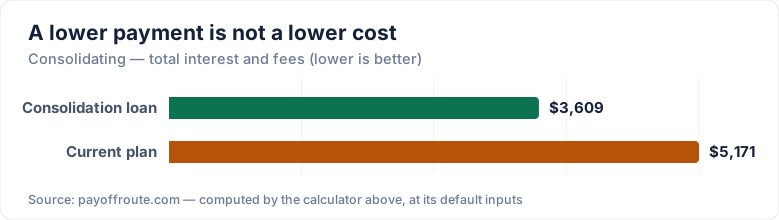
A worked example: suppose you owe $6,500 on a credit card at 24.99% (paying $200/month) and $4,000 on an older personal loan at 12.5% (paying $150/month) — the numbers seeded in the calculator above. Your weighted average APR is about 20.2%. Left alone, those payments clear everything in 4 yr 7 mo and cost $5,171 in interest. Now roll all $10,500 into one loan at 11% APR with a 3% origination fee financed in ($315, so the loan is written for $10,815) and watch what the term does to the answer:
| Plan | Monthly payment | Debt-free in | Total interest & fees | You save |
|---|---|---|---|---|
| Keep the current debts | $350/mo | 4 yr 7 mo | $5,171 | — |
| Consolidate — 3-year term | $354/mo | 3 yr | $2,246 | $2,925 |
| Consolidate — 5-year term | $235/mo | 5 yr | $3,609 | $1,563 |
| Consolidate — 7-year term | $185/mo | 7 yr | $5,055 | $116 |
Every row consolidates the same debt at the same rate with the same fee. The 3-year loan barely changes your monthly payment ($354 vs $350) yet saves $2,925. The 7-year loan nearly halves the payment to $185 — and saves almost nothing ($116), because the lower rate is handed straight back as three extra years of interest. That’s the pattern to look for: rate down a lot, term the same or shorter, fee modest. On the seeded defaults the calculator’s verdict line reads $1,563 saved. Run your own numbers above; it does the comparison honestly, fee included.
The trap: lower payment, higher cost
Here’s how a consolidation loan can look great and cost you money. Lenders know that most borrowers shop on monthly payment, so the easiest way to make an offer attractive is to stretch the term. Move $10,500 of debt that would have been gone in 4 yr 7 mo into a seven-year loan and the monthly payment drops beautifully — and you pay interest for nearly two and a half additional years. As the table above shows, that stretch turns a $2,925 saving into a $116 one; push the rate or fee a little further and the “cheaper” loan costs more in total than doing nothing at all, even at a lower APR.
That’s why this calculator always shows two numbers, never one. The monthly payment tells you whether the loan fits your budget this month. The total interest and fees tell you what the loan actually costs over its life. When the tool detects the trap — a lower payment but a higher lifetime cost — it flags it explicitly, because that combination is exactly how people end up paying for the same television for a decade. A lower payment is only a win if you need the breathing room; if you can afford your current payments, a shorter term at the same rate is almost always the better deal.
One practical middle path: take the longer term for safety, but pay the loan as if it had the shorter one. Most personal loans have no prepayment penalty (confirm before signing), so extra principal payments recreate the short-term savings while keeping the lower required payment as a cushion for bad months.
Ways to consolidate
“Consolidation” is a strategy, not a product — several very different loans can do the job, with very different risk profiles:
Want to work the arithmetic yourself before trusting any calculator? Our guide how to calculate savings from debt consolidation walks through the three numbers by hand.
| Option | Typical APR range | Secured? | Best for |
|---|---|---|---|
| Personal loan | ~7–36% depending on credit | No | Good-credit borrowers who want a fixed payment and a firm end date |
| 0% balance transfer card | 0% promo for 12–21 months, then a standard card APR; 3–5% transfer fee | No | Smaller balances you can clear before the promo period ends |
| Home equity loan / HELOC | Usually the lowest rates available | Yes — your house | Large balances, stable income, disciplined borrowers only |
| 401(k) loan ⚠️ | Low stated rate, but paid with lost market growth | Yes — your retirement savings | Rarely a good idea; leaving your job can make it due quickly, and defaults become taxable |
If your debt is mostly credit cards and you could clear it within a year or two, run the numbers on a balance transfer first — when it fits, 0% beats any loan rate. For large balances where you’re considering tapping your house, the home equity loan calculator will show the payment, but weigh the collateral risk honestly: missing payments on a credit card damages your credit; missing payments on a home equity loan can cost you your home. And don’t overlook the option that requires no new loan at all — an aggressive payoff plan using the credit card payoff calculator (snowball or avalanche) beats a mediocre consolidation offer more often than the marketing suggests, with zero fees and zero applications.
What lenders look at
The APR you’re quoted — which drives everything in this calculator — comes down to three things lenders verify before approving a consolidation loan:
- Credit score. This is the biggest driver of your rate. The strongest offers generally go to scores above roughly 720; below the mid-600s, quoted APRs climb toward card territory and the math stops working. If your score is borderline, even a few months of on-time payments and lower card utilization can change the offer materially.
- Debt-to-income ratio (DTI). Lenders compare your total monthly debt payments to your gross monthly income; most want the ratio comfortably under about 40–45%, and the best pricing goes lower. Check yours with the debt-to-income ratio calculator before applying — a high DTI is one of the most common reasons for a denial or a worse rate.
- Income proof. Expect to document income with pay stubs, W-2s, or tax returns (self-employed borrowers usually need more). Stable, verifiable income supports both approval and a better rate.
A useful habit: get pre-qualified quotes from two or three lenders — pre-qualification uses a soft credit pull that doesn’t affect your score — and plug each real offer into the calculator above. The best offer isn’t the one with the lowest payment or even the lowest APR; it’s the one with the lowest total cost on a term no longer than your current payoff.
Frequently Asked Questions
Does debt consolidation hurt my credit score?
Usually only briefly. Applying for the loan triggers a hard inquiry (a few points, temporary), and a new account lowers your average account age. But once the loan pays off your credit cards, your card utilization drops sharply — often the single biggest score factor — so many people see their score recover and then improve within a few months, as long as they make every payment on time and don’t run the cards back up.
Can I consolidate debt with bad credit?
It’s possible but often not worth it. Lenders price consolidation loans by credit risk, so with a score in the low 600s or below you may be quoted an APR as high as — or higher than — your credit cards, plus a large origination fee. In that case consolidation saves nothing. Alternatives include a credit union (they often work with lower scores), a co-signer, a secured loan, or simply attacking the debt directly with a payoff strategy while your score improves.
Is consolidation better than the snowball or avalanche method?
They solve different problems. Consolidation lowers your interest rate; snowball and avalanche organize how you attack the balances you have. The two combine well: consolidate to a lower rate if the math works, then pay more than the required payment to finish faster. If you can’t qualify for a meaningfully lower rate, a disciplined avalanche plan usually beats a bad consolidation loan.
What origination fee is reasonable on a consolidation loan?
Personal loan origination fees typically run from 0% to about 8% of the loan amount. The best-qualified borrowers often pay no fee at all. Anything at the high end of that range needs a large APR improvement to justify it — this calculator adds the fee into the total cost so you can see whether the rate savings actually outweigh it.
Should I use a secured loan (like home equity) to consolidate?
Secured loans — home equity loans, HELOCs, or loans backed by a car — usually carry lower rates because the lender can take the collateral if you default. That’s exactly the risk: you’d be converting unsecured credit card debt, where the worst case is collections and credit damage, into debt that can cost you your house. Only consider it if your budget is stable and you’re confident you won’t add new card debt.
Do I keep paying my old debts after consolidating?
Keep paying every debt on schedule until you have written confirmation that it’s paid off. Consolidation loan funds can take days to disburse, and a missed payment during the transition causes late fees and credit damage. Once each account shows a zero balance, consider keeping old credit cards open (with no balance) to preserve your credit history and utilization.
Is anything I enter here stored or sent anywhere?
No. This calculator runs entirely in your browser. The balances, rates, and payments you enter are never stored, transmitted, or shared.
Read more on this
Related calculators
Personal Loan
Monthly payment and true total cost of a personal loan, including the origination fee most calculators ignore.
Open calculator →Loan Payoff
See how much sooner you’ll be debt-free and how much interest you save by adding extra monthly or one-time payments to any loan.
Open calculator →Student Loan Payoff
See when your student loans actually end — and how extra payments or one-time windfalls move the date and shrink the interest.
Open calculator →Disclaimer: This calculator is for educational purposes only and provides estimates based on the numbers you enter. It is not financial, legal, or tax advice. Actual loan terms, rates, and payments depend on your lender and personal circumstances. All calculations run in your browser — nothing you enter is stored or sent anywhere.