How much can you borrow against your home?
Your home equity is simply your home’s market value minus everything you still owe on it. If your home is worth $400,000 and your mortgage balance is $250,000, you have $150,000 in equity. But lenders won’t let you borrow all of it — they cap total borrowing at a percentage of your home’s value called the combined loan-to-value ratio (CLTV), usually 80%, sometimes 85% or 90% for well-qualified borrowers.
The math the calculator runs for you:
Max home equity loan = (home value × lender CLTV cap) − mortgage balance
In the example above with an 80% cap: $400,000 × 0.80 = $320,000 total allowed debt, minus the $250,000 mortgage, leaves a maximum home equity loan of $70,000 — even though you have $150,000 of equity on paper. That buffer protects the lender if home prices fall. Raise the cap to 85% and the maximum becomes $90,000; at 90% it is $110,000 — but those caps are rarer and usually priced higher.
What is the monthly payment on a $70,000 home equity loan?
A home equity loan is a fixed-rate installment loan: you receive the full amount upfront and repay it in equal monthly payments over a set term, typically 5 to 30 years. Each payment covers that month’s interest first, and the remainder reduces your balance — so early payments are interest-heavy and later payments are mostly principal. In month one of the default loan, $495.83 of the $689.32 payment is interest and only $193.48 touches the balance. The amortization table above shows this shift year by year.
Here is the same $70,000 loan at 8.5% across every term the calculator offers. Only the term changes:
| Term | Monthly payment | Total interest | Total repaid |
|---|---|---|---|
| 5 years | $1,436.16 | $16,169 | $86,169 |
| 10 years | $867.90 | $34,148 | $104,148 |
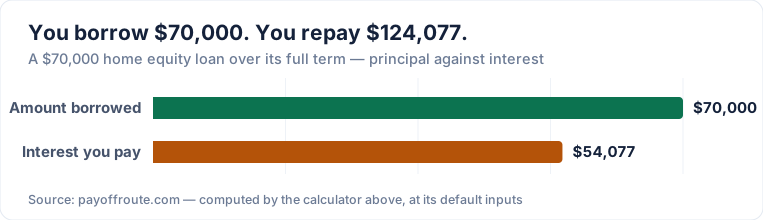
| 15 years | $689.32 | $54,077 | $124,077 |
| 20 years | $607.48 | $75,794 | $145,794 |
| 30 years | $538.24 | $123,766 | $193,766 |
Two levers matter most for the cost:
- Term length. A longer term lowers the monthly payment but raises total interest dramatically. Read the 15-year and 30-year rows together: stretching that $70,000 loan from 15 years to 30 years shaves only $151 off the monthly payment ($689.32 → $538.24) but more than doubles the interest, from $54,077 to $123,766. That is $69,689 of extra interest bought with about $150 a month of breathing room.
- Rate shopping. Because the loan sits in second position behind your mortgage, rates run higher than first-mortgage rates. Quotes routinely differ by 0.5–1% between lenders for the same borrower — on a long term that’s thousands of dollars, so get at least three quotes.
Home equity loan vs. HELOC vs. cash-out refinance
| Feature | Home equity loan | HELOC | Cash-out refi |
|---|---|---|---|
| Payout | Lump sum | Draw as needed | Lump sum |
| Rate | Fixed | Usually variable | Fixed or ARM |
| Payment | Equal every month | Varies with balance & rate | Equal every month |
| Keeps your current mortgage? | Yes | Yes | No — replaces it |
| Best for | One-time known cost | Ongoing/uncertain costs | Only if refi rate beats your current rate |
Since 2022, cash-out refinancing has lost its appeal for most homeowners: replacing a 3% mortgage with a 6–7% one just to extract cash is usually a bad trade. That’s exactly why home equity loans and HELOCs have surged — they let you tap equity without touching your existing low-rate mortgage. If you’re weighing the flexible option, try our HELOC payment calculator to compare payments side by side.
Smart uses — and real risks
Generally sensible: renovations that add value to the home, consolidating high-interest debt at a fraction of the rate (compare with our credit card payoff calculator first), or covering a major planned expense at a lower rate than unsecured borrowing.
The core risk: the loan is secured by your house. Miss payments and the lender can foreclose — even if your first mortgage is perfectly current. Rolling unsecured credit-card debt into a home equity loan lowers the rate, but converts debt that can’t take your home into debt that can — and stretched over fifteen or twenty years, the lower rate can still cost more in total interest than the cards would have. Our home equity vs credit card debt calculator puts both paths side by side, including the case where the honest answer is don’t. It only works if the spending habits that created the card balances change too. And avoid borrowing against your home for depreciating purchases or volatile investments.
What lenders look for
- Credit score: 620 is a common floor; 740+ gets the best rates.
- Combined LTV: usually capped at 80–85% (this calculator lets you test each cap).
- Debt-to-income ratio: most lenders want total monthly debt payments, including the new loan, under ~43% of gross income.
- Proof of income and an appraisal — expect closing costs of roughly 2–5% of the loan amount, sometimes waived in promotions.
Frequently Asked Questions
How much can I borrow with a home equity loan?
Most lenders let you borrow up to 80–85% of your home’s value minus what you still owe on your mortgage. For example, on a $400,000 home with a $250,000 mortgage balance, an 80% limit means you could borrow up to $70,000 ($400,000 × 0.80 − $250,000). Your credit score, income, and debt-to-income ratio also affect the amount a lender will approve.
Are home equity loan payments fixed?
Yes. A standard home equity loan has a fixed interest rate, a fixed term (commonly 5 to 30 years), and equal monthly payments. That predictability is the main difference from a HELOC, which usually has a variable rate and flexible draws.
What is a good home equity loan rate?
Home equity loan rates typically run 1–3 percentage points above 30-year mortgage rates because the lender is in second position behind your primary mortgage. The best rates go to borrowers with credit scores above 740 and combined loan-to-value below 80%. Always compare at least three lenders — rate differences of half a percent are common and add up over a long term.
Is home equity loan interest tax deductible?
In the U.S., interest is generally deductible only if the loan proceeds are used to buy, build, or substantially improve the home securing the loan, and only if you itemize deductions. Interest on funds used for other purposes (debt consolidation, tuition, vacations) is typically not deductible. Confirm with a tax professional.
What happens if I can’t make the payments?
A home equity loan is secured by your house. If you default, the lender can foreclose — even if your first mortgage is current. This is why using home equity to pay off unsecured debt like credit cards should be done carefully: you convert debt that can’t take your home into debt that can.
Home equity loan or HELOC — which is better?
A home equity loan fits a one-time, known expense (a renovation with a fixed quote, debt consolidation) because you get a lump sum at a fixed rate. A HELOC fits ongoing or uncertain expenses because you draw only what you need, when you need it, though usually at a variable rate. Many borrowers compare both offers from the same lender.
Does this calculator store my information?
No. All calculations run entirely in your browser. Nothing you type is saved, stored, or sent to any server.
Read more on this
HELOC vs Home Equity Loan: How to Decide in 5 Questions
Five questions that decide between a HELOC and a home equity loan — spending pattern, rate risk, payoff speed, discipline, and the fine print.
Read →The Solar Loan Trap: A Fee You Were Not Allowed To Be Told, and a Payment That Jumps 47%
Original data: the 2.99% solar loan is bought with a dealer fee of 15–30% hidden in your price, and its payment assumes a tax credit you may not be able to use — or, after 2025, one that no longer exists.
Read →Related calculators
HELOC Payment
Estimate your HELOC payments during the interest-only draw period and the repayment period that follows.
Open calculator →HELOC vs HEL
Same equity, two very different loans. Compare payments and lifetime cost side by side — including what happens to the HELOC if rates rise.
Open calculator →Cash-Out Refi vs HEL
Need cash from your home? Compare replacing your whole mortgage against adding a home equity loan — total interest for each path.
Open calculator →Disclaimer: This calculator is for educational purposes only and provides estimates based on the numbers you enter. It is not financial, legal, or tax advice. Actual loan terms, rates, and payments depend on your lender and personal circumstances. All calculations run in your browser — nothing you enter is stored or sent anywhere.