Same goal, opposite personalities
A personal loan and a balance transfer solve the same problem — a credit card charging 20–30% APR — with opposite temperaments. The personal loan is forced discipline. You get a fixed rate, a fixed payment, and a fixed end date written into a contract. The card gets paid to zero on day one, the loan payment arrives like a utility bill, and as long as you make it, the debt dies on schedule. You can’t “pay a little less this month” without defaulting, which sounds harsh but is exactly why it works for people who know their own weaknesses.
The balance transfer is the cheapest possible rate — rented, not owned. A genuine 0% for 12 to 21 months beats any loan rate on the market, but nothing about the product forces you to use the window well. The minimum payment is tiny and feels safe, the promo deadline is far away and easy to ignore, and the new card works perfectly well for new purchases — which typically accrue interest at the full rate from day one. The transfer hands you the best math available and then quietly tests whether you’ll execute it. Same destination, two different drivers: one is an autopilot, the other a manual transmission that stalls if you don’t shift on time.
Personal loan or balance transfer — which is cheaper?
Both products charge admission. The loan takes an origination fee, commonly 1–8%, usually deducted from or financed into the loan — so borrowing enough to clear an $8,000 card at a 4% fee means a loan of $8,320. The transfer takes a transfer fee of 3–5% added to the new card’s balance: $8,000 moved at 3% starts the promo at $8,240. After that, the products diverge: the loan charges its APR from month one, while the transfer charges nothing until the promo ends and then charges a lot.
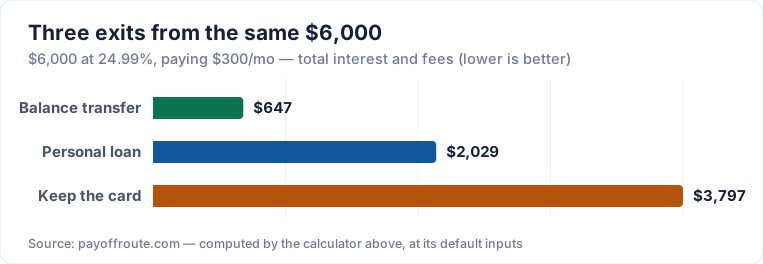
Run the calculator’s defaults and you can watch it play out. Keeping the card — $8,000 at 24.99% with $300 a month — takes 3 yr 4 mo and $3,797 in interest. The personal loan at 13.5% for 3 years with a 4% fee requires $282.34 a month; paying your full $300 budget clears it in 2 yr 10 mo at a total cost of $2,029 including the $320 fee. The transfer at 0% for 18 months with a 3% fee finishes in 2 yr 5 mo at a total cost of $647 — the $240 fee plus $407 of post-promo interest on the $2,840 that survives the window. The transfer wins by $1,382 even though the balance doesn’t clear inside the promo, because eighteen interest-free months retire so much principal that the leftover is small.
The rule of thumb that decides it is one division — the payment that would finish the transferred balance before the promo dies:
Payment that beats the promo = (balance × (1 + transfer fee %)) ÷ intro months
Here that’s $8,240 ÷ 18 ≈ $458 a month. If your budget reaches it, the transfer is essentially unbeatable. The further you fall below it, the more balance survives the cliff at 27.99% — a worse rate than the card you escaped — and the better the fixed loan looks. Watch the crossover happen as the balance grows, with everything else held at the defaults ($300/month, 13.5% loan for 3 years with a 4% fee, 0% transfer for 18 months with a 3% fee):
| Card balance | Keep the card | Personal loan (all-in) | Balance transfer (all-in) | Cheaper |
|---|---|---|---|---|
| $5,000 | $1,206 · 1 yr 9 mo | $817 · 1 yr 8 mo | $150 · 1 yr 6 mo | Transfer |
| $8,000 (default) | $3,797 · 3 yr 4 mo | $2,029 · 2 yr 10 mo | $647 · 2 yr 5 mo | Transfer |
| $12,000 | $14,051 · 7 yr 3 mo | $3,246 · 3 yr | $3,536 · 4 yr 4 mo | Loan |
| $16,000 | Never pays off | $4,329 · 3 yr | $15,119 · 8 yr 8 mo | Loan |
Two honest footnotes on that table. In the bottom two rows the loan’s required payment ($423.51 at $12,000 and $564.68 at $16,000) is above the $300 budget — the contract demands it, so the simulation pays it, which is part of why the loan wins there. And at $16,000 the $300 budget doesn’t even cover the card’s monthly interest, so keeping it never pays off at all. That’s the crossover in one picture: a 3% fee plus 0% for 18 months crushes a 13.5% loan when the window is long enough for your budget, and loses badly when it isn’t — at $16,000 the transfer strands $11,080 on the cliff and ends up costing more than three times the loan.
The failure modes
The spreadsheet comparison above assumes you execute the plan. Honest accounting requires the other column: how each product fails, because both fail constantly in the real world.
The transfer fails at the cliff. The minimum payment on a 0% balance can be 1% of the balance — about $82 on the default transfer — and paying it feels responsible because no interest is accruing. Do that for 18 months and you arrive at the deadline still owing more than $6,700, now at 27.99%. The second trap is the old card: it’s sitting at a zero balance with an open limit, and a meaningful share of people fill it back up. Issuers price 0% offers profitably for a reason — enough customers hit the cliff or reload the old card to pay for everyone who doesn’t.
The loan fails after the consolidation. The loan itself almost never fails — the payment is fixed and the end date is contractual. What fails is the cardholder: the cards are suddenly at zero, the monthly pain is gone, and within a year or two the balances creep back. Now you have the loan payment and new card debt, which is the one outcome worse than doing nothing. Behavioral relapse — running the cards back up after consolidating — is widely cited as the number one reason debt consolidation doesn’t work, and no interest rate can fix it. If you suspect the spending problem is still live, the safer first move is attacking the debt where it sits with a fixed payment and no new credit at all — our credit card payoff calculator shows what your budget achieves without borrowing another dollar.
Qualifying realities
The comparison also assumes you can get both offers, which is not a given. The long 0% transfer cards want good-to-excellent credit — typically a score around 670 or better, with the 18–21 month windows mostly going to the 700+ crowd. And approval isn’t the whole story: your transfer limit is often below your credit limit, and you won’t know the number until after approval. Getting approved to move $5,000 of an $8,000 balance changes the math materially — the stranded $3,000 keeps compounding at the old rate.
Personal loans reach further down the credit spectrum — lenders write them for fair and even poor credit — but the price climbs fast. The 13.5% in the default box is a good-credit rate; fair-credit borrowers commonly see high teens to twenties, and at some point the loan APR gets close enough to your card’s rate that consolidation buys you structure but little savings. Always compare quoted offers, not advertised ones. To pressure-test a single product on its own terms, use the personal loan calculator or the balance transfer calculator; if you’re juggling several debts rather than one card, the debt consolidation calculator compares a consolidation loan against your whole current lineup.
A hybrid worth knowing
The two products aren’t mutually exclusive, and for balances too big for one promo window the strongest play is often a split: transfer the slice you can realistically pay off inside the intro period — your monthly budget times the intro months, minus a margin for the fee — and consolidate the rest into the fixed-rate loan. The transferred portion rides at 0% and dies at the deadline; the loan portion amortizes on schedule with no cliff. You pay both fees, but every dollar sits at the cheapest rate available to it.
The riskier variant is transfer now, refinance the remainder later: put everything on the 0% card, pay hard, and take a personal loan (or a second transfer) for whatever remains just before the promo expires. When it works, it captures the maximum interest-free time. But it only works with good credit at the future date, and there is no guarantee — offers change, limits come in low, and a denied application in month 17 leaves the whole remainder at the penalty-priced post-promo rate. Treat the refinance as a bonus if it materializes, not a plan you depend on. Whichever route you pick, the calculator above tells you the honest baseline: what each path costs with the budget you actually have.
Frequently Asked Questions
Which hurts my credit score more, a personal loan or a balance transfer?
Both cause the same short-term dings: a hard inquiry (a few points, fades within a year) and a new account that lowers your average account age. Both also tend to help afterward — the loan converts revolving debt to installment debt and the transfer card adds available credit, so your utilization ratio usually improves either way. Neither is a lasting reason to avoid the other; pick based on cost and behavior, not the temporary score dip.
Can I transfer a personal loan balance to a 0% card?
Usually not directly. Standard balance transfers move card-to-card debt; most issuers do not accept a personal loan as a transfer source. Some cards offer convenience checks or "transfer from a bank account" features that can effectively pay off a loan, but fees and terms differ from the advertised transfer offer. If you already have the loan, the simpler move is usually just to prepay it — most US personal loans have no prepayment penalty.
What happens if I miss a payment on each?
On the balance transfer card, a missed payment can be catastrophic: many agreements let the issuer cancel the 0% promo immediately and reprice your whole balance to the standard or penalty APR. On a personal loan, you owe a late fee and the missed payment is reported to the bureaus after 30 days, but your rate does not change — it is fixed by contract. That asymmetry is one of the loan’s quiet advantages. Either way, set up autopay on day one.
Can I pay a balance transfer off early?
Yes, and you should if you can. There is no prepayment penalty on credit card balances — every extra dollar simply reduces principal sooner. Finishing before the promo deadline is the whole game with a transfer, so paying early is not just allowed, it is the strategy.
Do balance transfer fees ever get waived?
Occasionally. A handful of cards — most often from credit unions — offer no-fee transfers, and some banks run limited-time fee waivers. These offers usually pair with shorter intro windows or membership requirements, so run the numbers rather than assuming no fee automatically wins. A 0% fee with a 12-month window can still lose to a 3% fee with 21 months if your balance needs the time.
Why does this tool use the same monthly budget for all three paths?
Because that is the only fair comparison. If you give one option a bigger payment, it wins for reasons that have nothing to do with the product. Holding your budget constant isolates what the loan or the transfer actually changes: the rate, the fees, and the schedule. The one exception is when the loan’s required payment exceeds your budget — the loan legally demands it, so the simulation uses the required amount and tells you so.
Is my information stored?
No. All calculations happen in your browser. Nothing you enter is saved or transmitted anywhere.
Read more on this
Related calculators
Credit Card Payoff
Compare the snowball and avalanche strategies across all your cards and see how much interest each plan saves.
Open calculator →Balance Transfer
Is a 0% balance transfer worth the fee? Compare keeping your card vs transferring, month by month.
Open calculator →Transfer Fee
What the 3–5% transfer fee costs in dollars, how many days of interest it buys back, and the exact balance where it stops being worth paying.
Open calculator →Disclaimer: This calculator is for educational purposes only and provides estimates based on the numbers you enter. It is not financial, legal, or tax advice. Actual loan terms, rates, and payments depend on your lender and personal circumstances. All calculations run in your browser — nothing you enter is stored or sent anywhere.