How much is a balance transfer fee?
A balance transfer fee is a one-time toll. You pay it once, at the start, and it never comes back. The arithmetic is as simple as it looks:
Transfer fee = balance × fee %, or the flat minimum — whichever is greater
So 3% of a $6,000 transfer is $180.00, added straight to your new balance so you owe it from day one and start the promo at $6,180. Your old card’s interest is the opposite kind of cost: a meter that runs every single day. At 24.99% APR, that $6,000 accrues $4.11 a day — about $125 a month — whether or not you ever open the statement.
Putting the two costs side by side is the entire point of this page. The fee is worth paying when the meter you switch off would have cost you more than the toll you pay to switch it off. The cleanest way to see that is the break-even figure at the top of the calculator: divide the fee by the old card’s daily interest and you get the number of days the old card would need to run to rack up the same dollar amount as the fee. On the defaults, $180.00 ÷ $4.11 works out to 44 days — a month and a half. Since a real payoff almost always takes many months, the interest you escape dwarfs the fee many times over. It’s only when the balance would be gone in a month or two that the math gets tight.
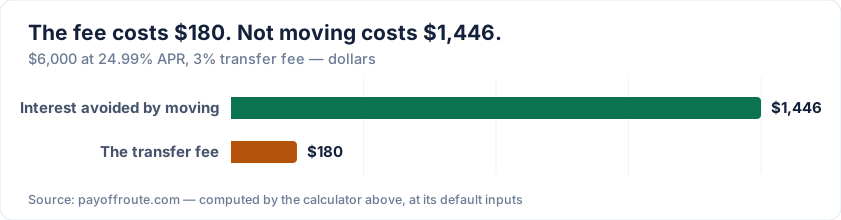
Here is the whole picture for the default transfer — $6,000 leaving a 24.99% card, an 18-month 0% window, paying $350 a month — with only the fee percentage changing. These are the figures the calculator above produces:
| Transfer fee | Fee in dollars | Fee pays for itself in | Interest avoided | Net saving |
|---|---|---|---|---|
| 0% (no-fee offer) | $5.00 | 1 day | $1,446 | $1,441 |
| 3% (default) | $180.00 | 44 days | $1,446 | $1,266 |
| 4% | $240.00 | 58 days | $1,446 | $1,206 |
| 5% | $300.00 | 2.4 months | $1,446 | $1,146 |
Two things jump out. First, even the 5% fee earns itself back in under two and a half months of the interest it switches off — and then keeps saving for the other fifteen. Second, the “no-fee” row still costs $5.00, because the card’s $5 minimum fee is what binds when the percentage is zero. The gap between the best and worst row here is $295: real money, but far smaller than the $1,446 of interest all four rows avoid. Which is the whole lesson — the fee percentage is rarely the thing worth optimizing.
This is deliberately a narrower question than “should I transfer at all.” The tool here doesn’t model your whole payoff; it isolates the fee and asks whether it earns itself back. For the complete month-by-month plan — including what happens to any balance that outlives the promo — use the full balance transfer calculator. On this page we stay at the toll booth.
The 3% vs 5% question
Not every offer charges the same fee, and the headline percentage isn’t the number to optimize — the length of the 0% window usually matters more. Start from the defaults: $6,000, a 3% fee ($180), 24.99% on the card you’re leaving. Now compare two shapes of offer you’ll actually see in the wild.
Card A charges 3% for a 12-month 0% window — a $180 fee. Card B charges 5% ($300) for a 21-month window. The fee gap is $120, and the cheaper card looks like the obvious pick. But at $350 a month, Card A leaves roughly $2,000 still sitting on the card when its shorter promo expires, and that remainder immediately starts accruing at the new card’s regular APR. Card B’s longer runway lets the same $350 payment clear far more of the balance before the 0% ends — often the whole thing. The extra $120 of fee bought nine more months of frozen interest, and on a balance this size those months are worth a great deal more than $120.
So the rule of thumb runs backwards from intuition: a higher fee with a longer window beats a lower fee with a short one whenever your payment won’t clear the balance inside the short window. Flip it around, though, and the cheaper fee wins — if your payment is large enough to wipe the balance out inside the short window anyway, you never needed the extra months, and paying 5% for runway you won’t use is just a bigger toll. Enter each offer one at a time and read the “Net saving” line; the larger number is your answer, fee and window included.
When the fee is a mistake
The fee is dead weight in a handful of specific situations, and they’re worth naming because the offer’s marketing never will.
- Small balances you’ll clear in a few months. Owe $800 and paying $400 a month? The card is gone in two or three months. The interest you’d avoid is maybe $30–40, and you’ve opened a new account and paid a fee to save it. Pay it off where it sits.
- The fee minimum on tiny transfers. Almost every card charges “3% or $5, whichever is greater.” On a $120 transfer, 3% is only $3.60, so you pay the $5 minimum — an effective rate above 4% on a balance so small the 0% barely helps. The calculator calls this out when the minimum is what’s binding.
- Balances you were about to knock out anyway. If a bonus or a tax refund is about to clear the card, paying a 3% fee to borrow your own runway is a lateral move that just costs you 3%.
- Cards that also carry an annual fee. A transfer card with a $95 annual fee stacks that on top of the transfer fee. If you’ll only hold the card through one 0% window, count the annual fee as part of the cost of transferring — on a small balance it can quietly double the toll.
Fee waivers and caps exist
The 3–5% range is the default, not a law. A few structures can shrink or erase the fee, and they’re worth ten minutes of searching before you apply.
- Introductory waivers. Some issuers waive the transfer fee entirely if you complete the transfer within a window of opening the account — often 60 days. These offers come and go and the 0% period is sometimes shorter, but a genuine no-fee transfer changes the math completely: with no toll, almost any interest you avoid is pure savings.
- Credit unions. Member-owned credit unions frequently charge lower transfer fees — 2%, a flat few dollars, or nothing — though their 0% periods tend to be shorter than the big banks’ 18–21 month promotions. If you already belong to one, check its card before a national issuer’s.
- Fee caps. A handful of offers cap the fee in dollars — “3%, up to $150,” for example. On a large transfer that cap matters: 3% of $10,000 is $300, but a $150 cap halves it. Always read the fine print for a cap. The calculator assumes an uncapped percentage, so a real cap only makes your deal better than what it shows.
After the fee: don’t waste the window
Deciding the fee is worth paying is only step one. The fee pays off only if you actually use the 0% window it buys — a transfer you don’t pay down aggressively just moves the debt sideways and adds a toll on top. Three tools pick up exactly where this one stops:
- The full balance transfer calculator models both paths month by month, including the balance that survives the promo and what it costs once the regular APR kicks in — the complete plan, not just the fee.
- Not sure a new card is the right move at all? The credit card payoff calculator shows what a focused payment does to your current cards with no new account, no fee, and no hard inquiry.
- Want to watch the meter you’re trying to switch off? The credit card interest calculator breaks your old card’s cost down to the day — the very number the break-even figure above is built on.
The through-line is simple: a transfer fee is only ever worth it as the price of admission to a window you’re going to use. Pay the toll, then finish the job before the clock runs out.
Frequently Asked Questions
Is the balance transfer fee charged upfront or added to the balance?
It is added to your new balance, and you owe it immediately. Transfer $6,000 at a 3% fee and you start the promo owing $6,180 — the $180 is not billed separately, it simply becomes part of the debt sitting on the card. Because it is added on day one, it also uses up part of your credit line, so make sure the fee plus the transfer stays under the limit you are approved for.
Does the transfer fee sit at the 0% intro rate too?
Usually, yes. On a standard bank balance-transfer card the fee is treated as part of the transferred balance, so it rides at 0% for the length of the intro window right alongside the rest of the debt. That means the fee itself does not accrue interest during the promo — but it still has to be paid off before the window closes, or whatever is left (fee included) gets repriced to the regular APR. Always confirm in the offer terms, since a few cards handle fees differently.
Can I negotiate a lower balance transfer fee?
Rarely on a published offer — the 3% to 5% fee is baked into the promotion and front-line agents cannot waive it. What you can do is shop for a better offer: no-fee promotions, introductory fee waivers for transfers made within 60 days of opening, and lower-fee credit-union cards all exist. The negotiating lever is choosing the right card before you apply, not haggling after.
Do all balance transfers have a fee?
No, but no-fee offers are the exception. Most national issuers charge 3% to 5%. A handful of cards — more often from credit unions — run genuine no-fee transfers, sometimes as a limited-time promotion. The trade-off is usually a shorter 0% window, so weigh the saved fee against the shorter runway using the calculator above.
Does the transfer fee affect my credit utilization?
Yes. The fee is added to your balance, so it raises the amount you owe on the new card and nudges your utilization ratio up by that much. On a large transfer the effect is tiny relative to the balance itself, and opening a new card also adds available credit, which generally lowers your overall utilization. But the fee does count as debt from the moment it posts.
What if I transfer less than the minimum fee amount?
You pay the minimum, not the percentage. Most cards charge "3% or $5, whichever is greater," so a $120 transfer is charged the $5 minimum — an effective rate above 4% rather than 3%. On very small balances the minimum makes the fee disproportionately expensive relative to the interest you would avoid, which is exactly the case the calculator flags as not worth it.
Is any of this stored?
No. Every calculation runs in your browser. Nothing you enter is saved, stored, or sent to any server.
Read more on this
What Is a Balance Transfer Fee — and How Do You Calculate It?
What a balance transfer fee is, how to work out the exact dollar cost, the typical 3–5% range, when no-fee offers make sense, and the one number that tells you if it is worth paying.
Read →Balance Transfer Break-Even: When the Fee Pays for Itself — The Full Tables
Original data: exactly how many days of interest a 3% or 5% transfer fee buys back, the payment needed to clear the balance before 0% ends, and why a no-fee card can be the most expensive offer on the board.
Read →Related calculators
Credit Card Payoff
Compare the snowball and avalanche strategies across all your cards and see how much interest each plan saves.
Open calculator →Balance Transfer
Is a 0% balance transfer worth the fee? Compare keeping your card vs transferring, month by month.
Open calculator →Loan vs Transfer
The two main escapes from card debt, compared honestly: fixed-rate loan vs 0% intro offer, fees included, same monthly budget.
Open calculator →Disclaimer: This calculator is for educational purposes only and provides estimates based on the numbers you enter. It is not financial, legal, or tax advice. Actual loan terms, rates, and payments depend on your lender and personal circumstances. All calculations run in your browser — nothing you enter is stored or sent anywhere.