How much interest does a credit card charge?
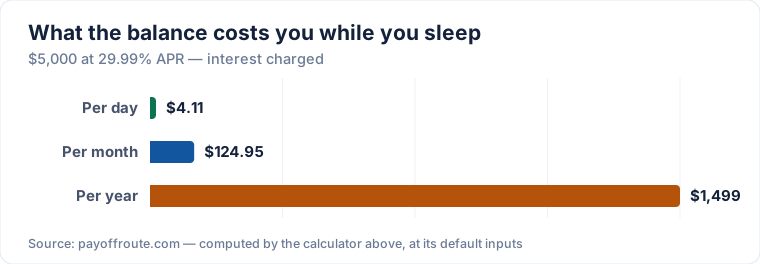
Credit card interest doesn’t arrive once a month — it drips in every single day. Your issuer takes your APR and divides it by 365 to get a daily periodic rate. At 24.99% APR, that’s about 0.0685% per day. Each day, the issuer multiplies that rate by your balance and adds the result to a running interest tally. On a $6,000 balance, that’s roughly $4.11 every day — before breakfast, whether you use the card or not.
Two lines of arithmetic produce every number on this page:
Interest per day = balance × APR ÷ 365
Interest per month = balance × APR ÷ 12
Run those two lines at 24.99% APR and the cost of carrying a balance stops being abstract. These are the exact figures the calculator above prints:
| Balance at 24.99% APR | Interest per day | Per month | Per year |
|---|---|---|---|
| $1,000 | $0.68 | $20.83 | $250 |
| $3,000 | $2.05 | $62.48 | $750 |
| $6,000 | $4.11 | $124.95 | $1,499 |
| $10,000 | $6.85 | $208.25 | $2,499 |
The monthly column doubles as the tread-water payment — one month’s interest, the payment at which the balance never moves. Every $1,000 you carry at 24.99% costs $20.83 a month, so the numbers scale in a straight line: the “per year” column is simply the balance times the APR.
Two details make the real charge slightly worse than the simple math. First, most issuers use the average daily balance method: they track your balance on every day of the billing cycle (new purchases raise it, payments lower it), average those daily figures, and charge interest on the average. Second, interest usually compounds daily — each day’s interest is added to the balance, so tomorrow’s interest is charged on today’s interest. That’s why the interest line on your statement rarely matches balance × APR ÷ 12 exactly — and the billing cycle’s length moves it as much as the compounding does, because APR ÷ 12 quietly assumes a 30.4-day month. On $6,000 at 24.99%, a 31-day cycle accrues about $128.66 while a 30-day cycle accrues about $124.47, against the calculator’s flat $124.95. Expect your statement to land within a few dollars either side of the figure above. Across a full year, though, daily compounding is unambiguously the more expensive method: 24.99% compounded daily is an effective 28.38%.
The grace period: the only free lunch
There is exactly one way to use a credit card for free, and it’s binary: pay the full statement balance by the due date, every cycle. Do that and the grace period — the window between the statement closing date and the due date — means your purchases never accrue a cent of interest. The 24.99% APR is irrelevant to you; you are borrowing the bank’s money for three to seven weeks at 0%.
Carry anything past the due date, though, and the deal changes completely. On most cards, carrying even $50 of a $2,000 statement doesn’t mean you pay interest on $50 — it means you lose the grace period entirely. Interest is charged on the average daily balance for the whole cycle, and new purchases start accruing interest from the day you make them, with no grace at all. That state persists until you’ve paid in full for one or two consecutive cycles (issuers vary). This is the single most misunderstood rule in consumer credit: the line between “free” and “expensive” isn’t how much you carry — it’s whether you carry anything at all.
Trailing interest, the goodbye surprise
Here’s the scenario that generates a million confused phone calls: you’ve been carrying a balance, you finally pay the entire statement balance, you exhale — and next month a statement arrives with $9 of interest on it. That’s trailing interest (issuers call it residual interest). Because interest accrues daily, the days between your statement’s closing date and the day your payment actually posted each added a little interest — and the statement you paid was printed before those days happened. You paid yesterday’s number; the meter kept running.
The fix is simple once you know it exists. When you’re ready to kill a carried balance for good, don’t pay the statement balance — call the issuer (or check the app) for a payoff amount good through a specific date, and pay that. If you’ve already been surprised by a trailing charge, pay it promptly so it doesn’t accrue its own interest, and consider asking for a goodwill waiver — issuers often grant one to customers who just brought a balance to zero.
Reading your APRs
A single card usually carries several APRs at once, and they behave differently:
- Purchase APR — the headline rate, applied to ordinary spending when you carry a balance. This is the number to enter in the calculator above.
- Cash-advance APR — almost always higher (often 5+ points above the purchase rate), plus an upfront fee of 3–5%. Crucially, cash advances have no grace period: interest starts the moment the ATM dispenses the money, even if you pay your statements in full. An ATM withdrawal on a credit card is one of the most expensive legal ways to borrow.
- Penalty APR — some issuers reserve the right to raise your rate to 29–30% after a payment 60+ days late. Federal rules require them to review and restore your original rate after six months of on-time payments, but six months at a penalty rate on a large balance is genuinely painful.
- Promotional APR — the 0% intro rate on purchases or balance transfers. Read the end date, and know whether unpaid promotional balances accrue deferred interest retroactively (common on store cards).
One reassurance: for purchases, APR and “interest rate” are the same thing on a credit card. There are no closing costs to bundle in, so unlike a mortgage APR, the card’s purchase APR is just the annual rate, applied daily at APR ÷ 365.
From bleeding to healing
Every credit card balance has a pivot point, and the calculator above prints it: the tread-water payment, equal to one month’s interest. Pay less than that and your balance grows even though you’re paying every month — you are bleeding. Pay exactly that and you’ll owe the same amount forever — the world’s worst subscription. Every dollar above it is the only part of your payment that actually touches the debt. On $6,000 at 24.99%, the tread-water payment is about $125: a $150 payment isn’t “$150 of progress,” it’s $25 of progress and $125 of rent paid to the bank.
Seeing that number clearly is the start; getting out is a plan. Once you know your tread-water figure, our credit card payoff calculator turns a payment amount into a full payoff date and total-interest picture. Juggling several cards? The debt avalanche calculator orders them so every extra dollar hits the highest APR first — the mathematically fastest exit. And if your credit is decent, a 0% intro offer can freeze the meter entirely while you pay down principal: the balance transfer calculator weighs the transfer fee against the interest you’d escape. Whatever the route, the goal is the same — get your payment decisively above the tread-water line, then keep it there.
Frequently Asked Questions
Why did I get charged interest after paying my balance in full?
Almost certainly trailing (residual) interest. If you carried a balance last month, interest kept accruing daily between the day your statement printed and the day your payment arrived — and that interest shows up on the next statement. Paying the statement balance does not stop it, because the statement number was already stale when you paid. To close a carried balance cleanly, call the issuer for a payoff amount good through a specific date, or expect one small final charge.
What is the difference between daily and monthly compounding?
With daily compounding, each day’s interest is added to the balance, so the next day’s interest is calculated on a slightly larger number. Month to month, the bigger factor is actually the length of your billing cycle, because APR ÷ 12 quietly assumes a 30.4-day month. At 24.99% APR on $6,000, simple monthly interest is $124.95, while daily compounding produces about $128.66 over a 31-day cycle and about $124.47 over a 30-day one — a few dollars either way. Over a full year, though, daily compounding is unambiguously the costlier method: 24.99% compounded daily works out to an effective 28.38% a year.
Do all credit cards accrue interest daily?
Most do. The dominant method in card agreements is the average daily balance method with daily compounding: the issuer applies your daily periodic rate (APR ÷ 365) to each day’s balance. A few issuers use APR ÷ 360 or compound monthly, so the exact formula lives in your cardholder agreement under “how we calculate interest.” The differences are pennies; the daily mechanics are near-universal.
How is APR different from the interest rate on a credit card?
For credit card purchases they are the same thing. Unlike a mortgage, where APR bundles the rate plus closing costs and fees, a card’s purchase APR is simply the annual interest rate — there are no origination costs to fold in. Where cards get complicated is having several APRs at once: purchases, balance transfers, cash advances, and a penalty rate can each carry a different number.
Can interest charges be refunded if I call and ask?
Sometimes, yes. Issuers can and do reverse interest or fees as a one-time goodwill gesture, especially for customers with a long on-time history who are surprised by trailing interest or a first slip-up. It is never guaranteed and it will not work repeatedly, but a polite phone call costs you nothing. Ask specifically for a “goodwill adjustment.”
Is the minimum payment the same as the tread-water payment?
No, and the difference matters. The tread-water payment is exactly one month’s interest — pay that and the balance never moves. The minimum payment is set by the issuer’s formula, typically 1% of the balance plus that month’s interest and fees, so it usually sits slightly above the tread-water number. That is why minimum payments technically shrink a balance, but so slowly that payoff can take decades.
Is anything I enter here stored?
No. Every calculation runs in your browser. Nothing you type is saved, stored, or sent to any server.
Read more on this
How Much Interest Does a Credit Card Charge Per Day?
The daily interest math behind your credit card: what the daily periodic rate (DPR) is, worked examples at 24.99% APR, and how to get the daily charge to zero.
Read →Payday Rollover Math: The Day the Fees Become Bigger Than the Loan
Original data: on a typical $15-per-$100 payday loan, cumulative rollover fees exceed the entire amount borrowed after seven 14-day terms — while every dollar of principal is still due.
Read →Related calculators
Credit Card Payoff
Compare the snowball and avalanche strategies across all your cards and see how much interest each plan saves.
Open calculator →Balance Transfer
Is a 0% balance transfer worth the fee? Compare keeping your card vs transferring, month by month.
Open calculator →Loan vs Transfer
The two main escapes from card debt, compared honestly: fixed-rate loan vs 0% intro offer, fees included, same monthly budget.
Open calculator →Disclaimer: This calculator is for educational purposes only and provides estimates based on the numbers you enter. It is not financial, legal, or tax advice. Actual loan terms, rates, and payments depend on your lender and personal circumstances. All calculations run in your browser — nothing you enter is stored or sent anywhere.