How the avalanche works
The debt avalanche has three rules. First, list every debt from highest APR to lowest — the balances don’t set the order, the rates do. Second, pay the minimum on every debt so nothing goes delinquent. Third, send every extra dollar you have to the highest-rate debt until it’s dead. Then re-aim at the new highest rate and repeat.
Each payoff is a rate kill, and each kill compounds the next. When the 30% card dies, two things happen at once: its minimum payment rolls forward into the attack budget instead of back into your spending, and the most expensive interest charge on your books stops accruing forever. The next target absorbs the extra plus the freed minimum, so the attack budget grows at every elimination while the average rate on your remaining debt falls. By the last debt — your cheapest — your entire former payment budget is landing on the balance that costs the least to carry. That’s the shape of the method: pain first, speed last.
This calculator simulates the plan month by month with your real numbers: interest accrues monthly at each debt’s APR, minimums go out first, and the extra plus every freed minimum hits the highest-rate open balance (ties broken by smaller balance first). If the target dies mid-month, the remainder rolls to the next rate immediately — no dollar waits.
Does the debt avalanche really save more than the snowball?
Yes — always, by construction — but the size of the win is the part worth checking. Run the three seeded debts above through both orders at $150 extra a month and the avalanche pays $4,220 in interest while the snowball pays $4,450. The avalanche saves $230, and both plans finish in 2 yr 9 mo — the speed is identical here, only the cost differs. That is a typical result for a stack whose rates span roughly 11% to 30%. Whether $230 is worth giving up the snowball’s early wins is a question about you, not about arithmetic.
The proof fits in a sentence. Every dollar of debt you carry for a month costs you its APR divided by twelve; a dollar of principal paid at 30% APR cancels 2.5 cents of next month’s interest, while the same dollar at 10% cancels only 0.83 cents. So whenever you hold a dollar of extra payment, sending it to the highest rate always cancels the most future interest — and since that’s true for every dollar in every month, no other ordering can pay less in total. Any plan that pays a cheaper debt while a more expensive one still has a balance is, dollar for dollar, leaving interest on the table.
How much is on the table depends on your rate spread. On a stack where every APR sits within a few points of the others, the avalanche’s edge over any other order is small — often tens of dollars. On a mixed stack — say a 30% store card, a 23% credit card, and an 11% personal loan — the gap versus smallest-first ordering routinely reaches hundreds of dollars, and on large balances with wide spreads it can run into the thousands. The “Total interest” figure this calculator shows is the floor: given your balances, rates, and monthly budget, no rearrangement of targets can beat it. The only ways to pay less are to pay more per month or to lower a rate.
The bleed number
Most payoff calculators lead with a date. This one leads with your interest bleed: the dollars per month your debt is costing you right now, computed as each balance times its monthly rate, summed.
Interest bleed = Σ (balance × APR ÷ 12)
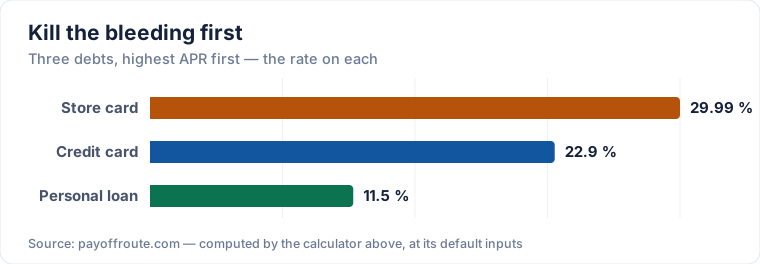
The $3,200 store card at 29.99% bleeds $79.97 a month before you’ve bought a single thing. Add the $5,800 credit card at 22.9% ($110.68) and the $6,000 personal loan at 11.5% ($57.50), and the stack seeded in the calculator above bleeds $248/mo. That number gets uncomfortably real, and the discomfort is the point. Here is exactly how the avalanche kills it, at the default $150 extra a month:
| Order | Debt (highest APR first) | Balance | APR | Its bleed | Killed in | Bleed after |
|---|---|---|---|---|---|---|
| 1 | Store card | $3,200 | 29.99% | $79.97/mo | Month 16 (1 yr 4 mo) | $129/mo |
| 2 | Credit card | $5,800 | 22.9% | $110.68/mo | Month 30 (2 yr 6 mo) | $13/mo |
| 3 | Personal loan | $6,000 | 11.5% | $57.50/mo | Month 33 (2 yr 9 mo) | $0 — debt-free 🎉 |
Read the “bleed after” column top to bottom: $248 → $129 → $13 → $0. By the time the first kill lands in month 16, your monthly interest charge has roughly halved — partly because the store card is gone, partly because sixteen months of minimums have chipped away at the other two. That is the avalanche’s progress meter, and it moves from the very first payment. Total interest across the whole plan: $4,220, debt-free in 2 yr 9 mo.
The bleed is the avalanche’s native progress meter. The snowball gives its followers closed accounts as visible wins; the avalanche’s wins are quieter, because its first target is chosen by rate, not by size, and can take a while to fall. But if you’re wired for the math, the bleed makes progress visible from the very first payment: every dollar of principal you clear shrinks next month’s interest charge, and every rate kill makes it drop in a satisfying step. The timeline above prints that step after each elimination — watch the bleed fall from its starting number toward zero, fastest at the start, because you’re killing the most expensive dollars first. It also turns “found money” decisions into arithmetic: if your bleed is $220 a month, a $500 windfall sent to the target debt pays a visible dividend every month afterward.
Avalanche’s weakness is human
The avalanche’s one weakness has nothing to do with math. When your highest-APR debt is also a large one, the first account closure can be a year or more away — and a long, winless opening stretch is where payoff plans die. Studies of real repayment behavior keep finding the same thing: people who see early, concrete wins are more likely to finish. The avalanche asks you to run on faith and a spreadsheet for months, and not everyone’s motivation survives that.
There’s an honest hybrid fix. If your list contains one small debt — a few hundred dollars, whatever its rate — kill it first for the quick win and the freed minimum, then run a strict avalanche on everything else. You give up a sliver of interest savings and buy a working plan. If you know you need visible milestones to keep going, the debt snowball calculator builds the motivation-first version of this plan; if you want both strategies run side by side on the same numbers with the exact dollar gap between them, use the credit card payoff calculator. Whichever order you pick, the plan you finish beats the plan you abandon.
Feeding the avalanche
The extra payment is the input you control most directly, and every dollar of it goes where it cancels the most interest — that’s the method doing the optimizing for you. Raise it however you can: trim recurring spending, pick up extra hours, re-shop insurance. Then add snowflakes — one-off amounts like a tax refund, a rebate, or a $40 marketplace sale — thrown at the current target whenever they appear. Snowflakes hit hardest early, when the target is your most expensive debt: a $300 snowflake against a 30% balance saves more interest than the same $300 will ever save later in the plan.
The avalanche also has a lever no payment schedule offers: the rates themselves. A negotiated APR cut is a free avalanche boost — call the card issuer, cite your payment history and competing offers, and ask; a few points off a 27% rate shrinks your bleed instantly without costing a dollar. A 0% balance-transfer or a lower-rate consolidation loan can do the same, provided the fees don’t eat the savings and you don’t treat the emptied card as new spending room. After any rate change, re-sort the list — the avalanche’s order is always the current rates, not the ones you started with. And the rule that must never break: when a debt dies, its minimum rolls forward to the next target. That money is already spoken for. If your real-world attack budget isn’t growing the way the timeline above says it should, the chain is leaking somewhere.
Frequently Asked Questions
How much does the avalanche actually save versus the snowball?
It depends entirely on how spread out your rates are. If everything sits between 20% and 25%, the two orders finish within weeks of each other and the savings are pocket change. If a 30% card shares the list with a 7% loan, the avalanche can save hundreds or thousands of dollars, because every month the snowball spends on the cheap debt, the expensive one keeps compounding. The wider the APR gap and the bigger the balances, the bigger the avalanche’s edge.
Two debts have the same APR — which goes first?
Attack the smaller balance first. At equal rates, the interest math is indifferent to the order, so you take the free psychological win: the small debt dies sooner, its minimum rolls into the attack budget earlier, and your list gets shorter. This calculator applies that tiebreak automatically.
Should 0% promotional debts go last?
Yes — while the promo holds, a 0% balance bleeds nothing, so every avalanche dollar belongs on debts that actually charge interest. The catch is the expiration date. A promo balance jumps to its regular APR (often 25%+) the day the window closes, and some deferred-interest offers charge back-interest on the whole original amount. When the promo end is a few months out, reprioritize: either clear the balance before the cliff or accept its post-promo rate as its true APR and re-sort your list around it.
Should my mortgage go in the avalanche list?
Usually no. A mortgage is almost always your lowest-rate debt, so a strict avalanche would put it last anyway — but including it also drags a huge minimum payment and a decades-long tail into a plan meant for consumer debt. Run the avalanche on cards and loans, get to consumer-debt-free, and then decide separately whether prepaying a low-rate mortgage beats investing the difference.
What about debts where I can only afford the minimum?
They still count — list them. The avalanche never asks you to pay extra on more than one debt at a time; every non-target debt gets exactly its minimum. Listing a minimum-only debt does two things: its interest is counted in your bleed number and your payoff date, and the moment it becomes the highest-APR survivor, the full attack budget swings onto it automatically.
Can I switch methods midway through?
Yes, at any time and at no penalty. Both methods pay minimums on everything and aim the extra at one target; the only difference is which target. Your balances simply carry over — re-sort the surviving debts by the new rule and keep paying. A common switch is snowball-to-avalanche: use small early wins to build the habit, then flip to rate order once the plan feels solid.
Is my data stored anywhere?
No. The calculator runs entirely in your browser. Debt names, balances, and rates you type are never saved or transmitted anywhere.
Related calculators
Credit Card Payoff
Compare the snowball and avalanche strategies across all your cards and see how much interest each plan saves.
Open calculator →Balance Transfer
Is a 0% balance transfer worth the fee? Compare keeping your card vs transferring, month by month.
Open calculator →Loan vs Transfer
The two main escapes from card debt, compared honestly: fixed-rate loan vs 0% intro offer, fees included, same monthly budget.
Open calculator →Disclaimer: This calculator is for educational purposes only and provides estimates based on the numbers you enter. It is not financial, legal, or tax advice. Actual loan terms, rates, and payments depend on your lender and personal circumstances. All calculations run in your browser — nothing you enter is stored or sent anywhere.