How the snowball works
The debt snowball has exactly three rules. First, list every debt from smallest balance to largest — ignore the interest rates entirely. Second, pay the minimum on every debt so nothing goes delinquent. Third, take every extra dollar you can find each month and aim all of it at the smallest balance until that debt is gone. Then repeat with the new smallest.
The magic is in what happens at each payoff. When a debt dies, its minimum payment doesn’t go back into your lifestyle — it rolls forward into the attack budget. Say you start with $150 extra and a $50 minimum on your smallest bill: your first target absorbs $200 a month. When it’s gone, that $50 joins the extra, and the next debt takes $200 plus its own minimum. Every elimination makes the next one faster, which is why the method is named after a snowball rolling downhill: the mass you’ve already gathered does more and more of the work. By the final debt, your entire former minimum-payment budget plus the extra is hitting one balance at once — often three or four times your starting attack power.
This calculator simulates that plan month by month with your real numbers: interest accrues monthly at each debt’s APR, minimums go out first, and the extra plus every freed minimum lands on the current smallest balance. The result isn’t just a payoff length — it’s a dated milestone for every single debt on your list. The one number driving the whole thing has a name — attack power — and a one-line definition:
Attack power = extra payment + every freed-up minimum
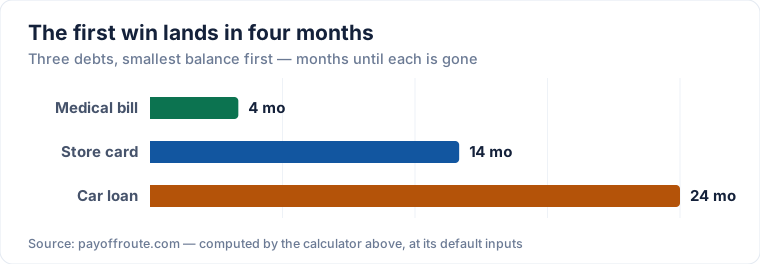
Watch it work on the three debts seeded in the calculator above. With $150 extra a month, your snowball starts at $200/mo of attack power ($150 plus the medical bill’s $50 minimum) and finishes at $595/mo — the $150 plus all three minimums, every one of them recycled rather than reabsorbed by your budget. Here is the exact milestone schedule the calculator prints:
| # | Debt (smallest first) | Balance | APR | Minimum | Paid off | Frees up |
|---|---|---|---|---|---|---|
| 1 | Medical bill | $800 | 0% | $50 | Month 4 | $50/mo |
| 2 | Store card | $2,400 | 28.99% | $75 | Month 14 (1 yr 2 mo) | $75/mo |
| 3 | Car loan | $9,500 | 7.5% | $320 | Month 24 (2 yr) | Debt-free 🎉 |
Total: debt-free in 2 yr for $1,407 of interest. The first win lands in month 4 — four months in, one bill is gone forever. That is the snowball’s entire pitch, delivered on schedule. Drop the extra payment to $0 and the same three debts take 2 yr 11 mo and cost $2,502; so that $150 a month buys you eleven months and $1,095.
Is the debt snowball worth the extra interest?
On paper, smallest-first is rarely the cheapest order. If your APRs vary — a 29% store card sitting next to a 6% car loan — attacking the highest rate first (the avalanche) always costs less in total interest. Put a number on it with the three debts above: the avalanche order (store card first, at 28.99%) pays $1,268 of interest versus the snowball’s $1,407, and both finish in 2 yr. The snowball’s quick win in month 4 costs you $139 and not a single extra month. That is a price most people will happily pay — but on a stack with wider rates and bigger balances, the same gap can run into the thousands, so check it rather than assume it. If you want the comparison side by side with your own numbers, our credit card payoff calculator runs both strategies and shows the exact dollar gap.
So why does anyone choose the snowball? Because payoff plans don’t fail on arithmetic — they fail on abandonment. Researchers studying real repayment behavior have repeatedly observed that people who concentrate their payments and close entire accounts early are more likely to keep going and finish, compared with people who spread payments thin and see every balance shrink slowly at once. Closing an account is a discrete, unmistakable event: one less bill in the mailbox, one less login, one line crossed off the list. That feeling is fuel.
The first win is the engine of the whole method. If your smallest debt is a $400 medical bill, the snowball can hand you a victory in month one or two — long before an avalanche grinding away at a $9,000 high-APR balance would show anything visible. Look at the “First win” date the calculator gives you: if it’s close, the snowball is playing to its strength. And be honest about the trade: when your rates are wildly uneven, the avalanche’s savings can run into the thousands, and it deserves a serious look. When the rates are similar, the gap is often small enough that the method you’ll actually stick with wins by default.
Build your list right
The snowball only works if the list is complete. Put everything on it: credit cards, store cards, personal loans, the car loan, money owed to family, old utility balances, and — yes — medical bills. Medical debt is the classic forgotten entry, and it’s often the perfect snowball starter: small balance, frequently 0% interest, quick to kill. The one common exclusion is the mortgage. It’s usually your largest and cheapest debt, and dropping a six-figure balance into a smallest-first plan would park your snowball on one line for a decade. Most people finish the consumer-debt snowball first, then point the freed-up cash at the house — our mortgage payoff calculator covers that stage.
Don’t skip 0% debts because “they aren’t costing anything.” In an avalanche they’d go last; in a snowball, a small interest-free balance is a gift — a fast, cheap win that frees its minimum payment for the rest of the plan. A $300 interest-free bill with a $50 minimum is one of the best first dominoes you can have.
Do leave off debts in active dispute — a bill you’re contesting with a provider, an account you’ve challenged with the credit bureaus, an amount an insurer should have covered. Paying on a disputed debt can be read as acknowledging it, and the balance isn’t real until the dispute resolves. Once it’s settled, add the final number to the list wherever its size puts it.
Feeding the snowball
The extra payment is the input you control most directly, and it doesn’t have to be dramatic. Most people find it in three places: trimming recurring spending (subscriptions, food delivery, an insurance re-shop), earning a little more (overtime, a few hours of side work), and redirecting money that used to service a now-dead debt. Even $50 a month changes the timeline visibly — try editing the field above and watch the milestone dates move.
Then there are snowflakes: one-off amounts you throw at the current target whenever they appear. A tax refund, a birthday check, a $40 marketplace sale, a rebate — individually trivial, collectively powerful, because every snowflake lands entirely on principal. Snowflakes early in the plan matter most; they drag the first milestone closer, and everything downstream inherits the head start.
The one rule that must never break: when a debt dies, its minimum rolls forward. That money is already spoken for — it belongs to the next debt on the list, not to your spending. This is where plans quietly fail: each payoff “frees up” cash, lifestyle absorbs it, and the snowball stops growing. The milestone timeline above shows your attack power climbing at every elimination precisely so you can see what that discipline buys. If the number isn’t growing in real life the way it grows in the timeline, the chain is leaking.
Snowball pitfalls
Recharging cleared cards. A paid-off card with a fresh $0 balance is a trap if your spending habits haven’t changed. You don’t have to close every account (that can ding your credit utilization), but move day-to-day spending to debit or to one card you pay in full monthly. A snowball can’t outrun a shovel adding new debt behind it.
Skipping the emergency buffer. Throwing literally every dollar at debt feels heroic until the water heater fails and the only option is the card you just cleared. Set aside a starter emergency fund — $1,000 is the common benchmark — before the aggressive payoff begins. It exists so that a surprise expense becomes a paused month, not a broken plan.
Ignoring a toxic-APR outlier. The snowball’s indifference to interest rates is a feature, not a bug — until one debt is compounding at 30%+ while you cheerfully clear small balances. If one account’s interest charge dwarfs everything else’s combined, consider a hybrid: kill that one monster first, then run a strict smallest-first snowball on the rest. You keep most of the psychological structure and stop the worst bleeding. This is the only reordering worth making; beyond it, trust the list.
Frequently Asked Questions
What is the difference between the debt snowball and the debt avalanche?
Both pay the minimum on every debt and send all extra money to a single target. The snowball targets the smallest balance first, so accounts close quickly and you feel progress early. The avalanche targets the highest interest rate first, which minimizes total interest paid. Snowball optimizes for motivation; avalanche optimizes for math.
Should my mortgage go in the snowball list?
Usually no. A mortgage is typically your largest and lowest-rate debt, and folding it in would freeze your snowball on one line for years — the opposite of what the method is designed to do. Most people run the snowball on consumer debts only, then turn to the house afterward. Our mortgage payoff calculator handles that stage separately, with its own extra-payment math.
What about debts in collections?
Include a collection account if you have acknowledged the debt and intend to pay it — treat the negotiated amount as the balance and any agreed installment as the minimum. Leave out debts you are actively disputing: the balance is not settled, and paying on a disputed account can complicate the dispute. Get any settlement agreement in writing before you send money.
Should I stop investing while I snowball?
Keep contributing enough to capture a full employer 401(k) match — that is an immediate 50–100% return no debt payoff can beat. Beyond the match, it is reasonable to pause extra investing while you clear high-interest debt, since a guaranteed 25% APR saved beats an uncertain market return. Low-interest debt is more of a judgment call.
What if two debts have the same balance?
Break the tie with the interest rate: attack the higher-APR debt first. You get the same quick win either way, so you might as well pocket the interest savings. Note that this calculator follows the strict snowball rule and always targets the smallest current balance — and once a month of interest is added, the higher-APR debt is the slightly larger one, so the tool will aim at the cheaper debt first. If you want the interest-saving tiebreak, put an extra few dollars against the higher-APR debt so it becomes the smaller balance, or run the avalanche instead.
Can I reorder the list manually?
The method says no — smallest balance first, every time, no exceptions. The whole point is a simple rule you never have to renegotiate with yourself, because renegotiation is where payoff plans die. The one defensible exception is a single toxic-APR debt growing faster than everything else; kill it first, then return to strict smallest-first order.
Is my data stored anywhere?
No. The calculator runs entirely in your browser. Debt names, balances, and rates you type are never saved or transmitted anywhere.
Read more on this
Related calculators
Credit Card Payoff
Compare the snowball and avalanche strategies across all your cards and see how much interest each plan saves.
Open calculator →Balance Transfer
Is a 0% balance transfer worth the fee? Compare keeping your card vs transferring, month by month.
Open calculator →Loan vs Transfer
The two main escapes from card debt, compared honestly: fixed-rate loan vs 0% intro offer, fees included, same monthly budget.
Open calculator →Disclaimer: This calculator is for educational purposes only and provides estimates based on the numbers you enter. It is not financial, legal, or tax advice. Actual loan terms, rates, and payments depend on your lender and personal circumstances. All calculations run in your browser — nothing you enter is stored or sent anywhere.