How much do extra payments save on a mortgage?
More than most people expect — because of where the money lands. Every month, your payment covers interest on the outstanding balance first, and only the remainder chips away at principal:
Monthly interest = balance × (annual rate ÷ 12)
On the calculator’s defaults, month one is $320,000 × (6.5% ÷ 12) = $1,733.33 of interest. The required payment is $2,160.66, so only $427.33 touches the balance. That is the whole story of mortgage interest being front-loaded — and it is why an extra $200 is so much more powerful than it looks. It doesn’t just add 9% to your payment; it adds nearly 50% to the amount of principal retired that month, and every dollar of principal you eliminate stops accruing interest for the entire remaining term.
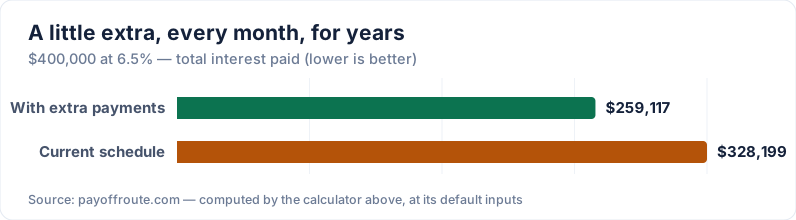
Here is what different extras do to that same $320,000 loan at 6.5% with 25 years remaining. Nothing changes but the extra:
| Extra per month | You actually pay | Payoff time | Total interest | Interest saved |
|---|---|---|---|---|
| $0 | $2,160.66 | 25 yr | $328,199 | — |
| $100 | $2,260.66 | 22 yr 6 mo | $289,139 | $39,059 |
| $200 | $2,360.66 | 20 yr 6 mo | $259,117 | $69,082 |
| $400 | $2,560.66 | 17 yr 6 mo | $215,554 | $112,645 |
Look at the leverage. Doubling the extra from $100 to $200 doesn’t double the saving — it raises it from $39,059 to $69,082, because those dollars land on a balance that is shrinking faster. At $400 a month extra, you retire the mortgage 7 yr 6 mo early and keep $112,645 that would otherwise have gone to the bank.
Timing matters as much as size. A dollar of principal knocked out in year one saves you several dollars of interest by the time the loan would have ended, while the same dollar in year 22 saves only pennies. If you’re going to accelerate, the best month to start is this one.
Extra monthly, annual lump, or biweekly?
All three work; they differ in timing and convenience, not in kind.
- Extra monthly payments save the most interest per dollar, because each dollar hits the balance at the earliest possible moment. They’re also the easiest to automate — set your autopay above the required amount and forget it.
- An annual lump sum — a tax refund, a bonus — moves the same dollars but applies them later in the year, so it saves slightly less interest than the equivalent amount spread monthly. The difference is small; the habit matters more than the timing. If a once-a-year windfall is what you realistically have, use it. This calculator applies the lump every 12th month so you can model exactly that.
- Biweekly payments mean paying half your monthly payment every two weeks. Because there are 26 two-week periods in a year, you make the equivalent of 13 monthly payments instead of 12 — a built-in extra month annually. On the default loan that extra ~$2,161 a year performs almost identically to adding $180 a month. One honest warning: banks and third parties sell biweekly “programs” with enrollment fees of $300–400 plus per-payment charges. You are paying them for arithmetic. Do it yourself for free by adding one-twelfth of your payment to each month’s check — same result, no fees, and you can pause whenever money gets tight.
The same acceleration logic applies to car loans, student loans, and personal loans — our loan payoff calculator handles those.
Should you pay off your mortgage early?
Honest answer: it depends, and the math doesn’t always say yes. Extra principal payments earn a guaranteed, risk-free return equal to your interest rate. At 6.5%, that’s a return few safe investments can match, which makes acceleration genuinely attractive for anyone holding a recent, higher-rate mortgage. But if you locked in a sub-4% rate before 2022, the calculus flips: broadly diversified investments have historically returned more than that over long periods, and lately even high-yield savings accounts and Treasury bills have paid more than a 3% mortgage costs. Rushing to retire cheap debt while passing up higher-yielding alternatives is, mathematically, a losing trade.
There’s also a liquidity catch the payoff spreadsheets skip: money paid into your house is hard to get back. If you lose your job two years into an aggressive payoff plan, the bank doesn’t care that you’re ahead of schedule — the payment is still due, and your only ways to reach that trapped equity are selling or borrowing it back through something like a home equity loan — paying interest, with an approval process, to access your own prepayments. So sequence matters. Before sending extras to the mortgage: build a 3–6 month emergency fund, capture any employer retirement match, and kill high-APR debt first — a credit card at 22% costs more than triple what a 6.5% mortgage does (see our credit card payoff calculator).
And one factor the spreadsheets can’t price: peace of mind is a legitimate return. Owning your home outright — no payment, no lender, housing costs reduced to taxes and insurance — changes how people sleep, work, and retire. If a paid-off house is worth more to you than a marginally larger brokerage account, that’s not irrational. It’s a preference the math should serve, not overrule.
Make sure extras hit principal
This is where good intentions leak. Send your servicer an unlabeled extra $200 and, depending on their defaults, it may be applied as an early payment of next month’s bill (saving you nothing) or parked in a suspense account until it accumulates to a full payment. To get the benefit this calculator shows, the money must reduce principal now:
- In your servicer’s online portal, look for a “principal only” or “apply to principal” option when making the payment.
- For mailed checks, write “apply to principal” in the memo line and, ideally, send extras separately from the regular payment.
- Spot-check your next statement: the principal balance should drop by the extra amount, and the next payment due date should not jump forward a month.
While you’re at it, confirm there’s no prepayment penalty. These are rare on US first mortgages — the 2014 Qualified Mortgage rules effectively banned them for most new loans — but older loans and some non-QM products still carry them, so verify with your note or servicer. Finally, know the alternative: recasting. Pay a qualifying lump sum (often $5,000–10,000 minimum) and, for a fee of roughly $150–500, the lender re-amortizes your loan over the remaining term — your required payment drops, but the term stays the same. Recasting suits people who want breathing room in the monthly budget; straight extra payments suit people who want out of debt years sooner. They save interest differently, so decide which problem you’re solving.
The escrow illusion
The number you send your servicer each month is usually not your mortgage payment. For most US borrowers it bundles principal and interest (P&I) with an escrow portion for property taxes and homeowners insurance — often $500–900 a month that merely passes through the servicer to your county and insurer. Extra payments do nothing to that portion, because it isn’t debt. Only the P&I slice amortizes, so enter only your P&I amount’s inputs here — the balance, rate, and term of the loan itself. Your monthly statement or online account shows the exact split. Two practical consequences: your total housing bill won’t fall by the full “payment” when the loan is gone (taxes and insurance continue forever), and once you do pay off the mortgage, the servicer refunds your escrow balance and those bills start arriving directly to you — budget for them so freedom from the bank doesn’t turn into a surprise tax bill.
Frequently Asked Questions
Is there a penalty for paying off my mortgage early?
Almost certainly not. Since the 2014 Qualified Mortgage rules, prepayment penalties have been effectively banned on most US first mortgages, and even where allowed they phase out after three years. Loans older than that, or certain non-QM loans, can still carry one — check your promissory note or ask your servicer to confirm in writing before making large extra payments.
Are paid biweekly payment programs worth it?
No. Biweekly services charge setup fees of $300–400 plus per-payment fees to do something you can do yourself for free: add one-twelfth of your monthly payment as an extra principal payment each month. The math result is identical — 13 payments per year instead of 12 — and you keep the flexibility to stop any month you need the cash.
What is recasting, and how is it different from extra payments?
A recast is when you pay a lump sum toward principal (often $5,000–10,000 minimum) and the lender re-amortizes the loan over the remaining term, lowering your required monthly payment for a small fee, usually $150–500. Extra payments keep your payment the same and shorten the term, which saves more interest. Recasting fits people who want lower required payments; extra payments fit people who want out of debt sooner.
Does paying off my mortgage early hurt my credit score?
Closing your mortgage can trim a few points temporarily because your credit mix loses an installment account and your average account age may shift. The effect is trivial and short-lived, and it is never a good reason to keep paying interest. Your payment history, which drives most of your score, stays on your report for years.
What happens to my escrow account when the mortgage is paid off?
Your servicer must refund any remaining escrow balance, typically within 20–30 days of payoff. From then on, property taxes and homeowners insurance become your responsibility to pay directly — set aside roughly one-twelfth of the annual total each month so the big bills don’t catch you off guard.
Why should I enter only principal and interest, not my full payment?
Because extra payments only accelerate the loan itself. The taxes and insurance portion of your bill is passed through to your county and insurer and continues regardless of your loan balance. Including escrow would make the calculator overstate your payment and understate your payoff time. Your statement or online account shows the P&I split.
Does this calculator store my information?
No. All calculations run entirely in your browser. Nothing you type is saved, stored, or sent to any server.
Read more on this
What an Extra $100 a Month Does to Your Debt: The Full Tables
Original data: how much time and interest an extra $100/month cuts from a mortgage, student loans, an auto loan, a personal loan, and a credit card — including the debts it outright rescues.
Read →Recast, Extra Payments, or Refinance? Where a Lump Sum Does the Most
A lump sum can lower your payment, shorten your loan, or fix your rate — three different moves. Here is how to pick the right one for your goal.
Read →Pay Off Debt or Invest? A Decision Order That Actually Ends the Debate
The debt-vs-invest debate ends with an order, not a winner: employer match, emergency fund, high-APR debt, then a genuine choice. Here is the math.
Read →Related calculators
Home Equity Loan
See how much you can borrow against your home and what the monthly payment would be, with a full amortization schedule.
Open calculator →HELOC Payment
Estimate your HELOC payments during the interest-only draw period and the repayment period that follows.
Open calculator →HELOC vs HEL
Same equity, two very different loans. Compare payments and lifetime cost side by side — including what happens to the HELOC if rates rise.
Open calculator →Disclaimer: This calculator is for educational purposes only and provides estimates based on the numbers you enter. It is not financial, legal, or tax advice. Actual loan terms, rates, and payments depend on your lender and personal circumstances. All calculations run in your browser — nothing you enter is stored or sent anywhere.