Back-end DTI = total monthly debt payments ÷ gross monthly income × 100
What counts as debt — and what doesn’t
This is the single biggest source of confusion with DTI, and getting it wrong can swing your ratio by ten points or more. Lenders do not count everything you spend money on. They count recurring debt obligations — payments that show up on your credit report or are court-ordered — and ignore ordinary living expenses entirely.
Counts toward DTI:
- Housing — rent, or your full mortgage payment including property taxes, homeowners insurance, and HOA dues
- Loan payments — auto loans, student loans, personal loans, and any other installment debt
- Credit card minimum payments — the minimum on your statement, not the balance and not what you actually pay each month
- Support obligations — court-ordered alimony and child support
Does NOT count toward DTI:
- Utilities — electricity, gas, water, trash, internet
- Groceries, gas, and everyday spending
- Insurance premiums — car, health, life (homeowners insurance is the exception, because it’s bundled into the mortgage payment)
- Phone bills and streaming subscriptions
- Income taxes and payroll deductions
Two concrete examples of where people go wrong. First, credit cards: if you carry a $6,000 balance and pay $500 a month toward it, but the statement minimum is $150, the lender counts $150 — not $500 and not the balance. Second, cars: your $450 auto loan payment counts, but the $160 you pay for auto insurance does not, even though both are non-negotiable in real life. DTI measures contractual debt, not your actual cost of living.
Front-end vs back-end
Lenders — especially mortgage lenders — actually look at two versions of the ratio:
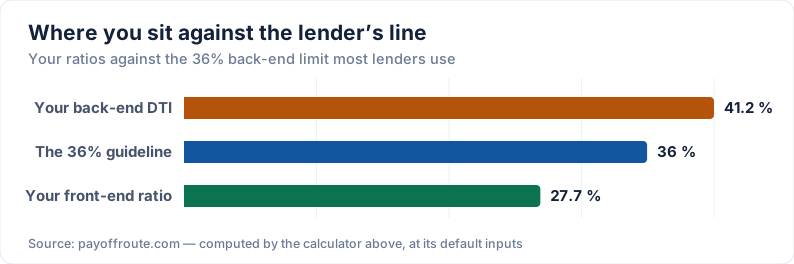
- Front-end ratio (housing ratio): your housing payment alone divided by gross monthly income. A $1,800 payment on $6,500 income is a 27.7% front-end ratio.
- Back-end ratio (total DTI): all monthly debt payments — housing plus every loan, card minimum, and support obligation — divided by gross income. This is the headline number, and when someone says “DTI” without qualification, this is the one they mean.
The classic guideline is the 28/36 rule: spend no more than 28% of gross income on housing and no more than 36% on total debt. It dates back decades and remains a genuinely useful budgeting benchmark. In modern underwriting, though, the back-end number does most of the work — many lenders no longer enforce a hard front-end cap at all if the total DTI, credit score, and reserves look good. Treat 28% as advice for your budget and 36% as the number that actually moves approvals.
What is a good debt-to-income ratio?
A back-end DTI at or below 36% is the widely accepted answer — it is the “36” in the classic 28/36 rule, and it is where lenders approve without hesitation. Above that, approval is still very possible: these are the bands lenders actually work with.
| Back-end DTI | What it typically means |
|---|---|
| ≤ 36% | Conventional comfort zone — most lenders approve without hesitation, and you’ll qualify for the widest range of loans and best pricing |
| ≤ 43% | Typical qualified-mortgage ceiling — many mortgage lenders cap standard approvals around here |
| ~45–50% | FHA & VA territory — possible with compensating factors such as a strong credit score, large down payment, or substantial cash reserves |
| Up to 40–45% | Where many personal-loan lenders draw the line for unsecured credit |
Treat these as typical guidelines, not guarantees. Every lender sets its own overlays, and the same 44% DTI that gets declined at one bank can be approved at another — particularly on FHA or VA loans where automated underwriting weighs your whole file. What’s consistent everywhere: the lower your DTI, the easier the approval and the better the rate offers tend to be. Crossing under 36% is the single most valuable threshold to clear.
How to lower your DTI
The ratio has exactly two inputs, so there are exactly two levers: shrink the debt number or grow the income number. Most people can move the debt side faster.
To flip this calculation around — starting from the lender’s ceiling and working back to the largest loan your income supports — use our personal loan affordability calculator.
Lever 1: shrink your monthly debt. The key insight is that DTI counts payments, not balances — so the fastest win is to eliminate an entire payment. Paying a $4,000 car loan down to $1,500 does nothing for your DTI, because the $450 payment is unchanged. Paying it off completely removes $450 from the calculation overnight. If you’re preparing for a mortgage application, target the smallest loan you can kill entirely rather than spreading extra money across everything. Our credit card payoff calculator and loan payoff calculator will show you how quickly you can retire a specific balance. Consolidation is the other route: rolling several payments into one loan with a longer term or lower rate can cut your total monthly obligation — and therefore your DTI — even though the balances haven’t changed. Run the numbers with our debt consolidation calculator, but go in with eyes open: stretching the term often means paying more in total interest over the life of the debt, even as the monthly picture improves.
Lever 2: grow your documented income. The operative word is documented. A raise at your W-2 job counts immediately. Side income — freelancing, rideshare driving, a rental unit — usually needs a track record, often two years of tax returns, before a mortgage underwriter will count it. Cash income that never hits a tax return doesn’t exist as far as your DTI is concerned. If a home purchase is a year or two away and you have real side income, start reporting it cleanly now so it counts when you apply. Adding a co-borrower with income (and hopefully little debt) is a variation on the same lever.
The “what it takes” table in the calculator above turns this into a concrete target: if your DTI is over 36% or 43%, it shows the exact dollar amount of monthly payments to eliminate — or the exact raise in gross monthly income — that would bring you under each threshold.
DTI vs credit score
These two numbers answer completely different questions. Your credit score measures your history — have you paid what you owed, on time, in the past? Your DTI measures your capacity — does your current income leave room for another payment? A lender needs both answers to be yes, which is why they check both.
The two can diverge dramatically. A high earner who pays every bill on time but carries a big mortgage, two car loans, and student debt can have an 800 credit score and a 52% DTI — flawless history, no capacity. A recent graduate with a thin credit file and one late payment from college might have a 640 score and a 15% DTI — shaky history, plenty of capacity. The first borrower gets declined despite the great score; the second might be approved at a higher rate. Notably, your DTI is not part of your credit score at all — credit bureaus don’t know your income. That’s exactly why lenders ask for pay stubs: the score tells them how you’ve behaved, and the DTI tells them whether the next payment fits. If you’re getting ready to borrow, work on both — but know that DTI is often the faster one to fix, because paying off a single loan changes it immediately, while credit scores move on a lag.
Frequently Asked Questions
Is my rent included in DTI when I apply for a mortgage?
No. When you apply for a mortgage, the lender drops your current rent from the calculation and uses the proposed payment on the new mortgage instead — principal, interest, property taxes, homeowners insurance, and any HOA dues. Your rent only matters while you are renting; the new housing payment replaces it the moment you buy.
Do lenders use gross or net income for DTI?
Gross income — your pay before taxes, health insurance, retirement contributions, and other deductions come out. That surprises many people because gross income makes the ratio look better than your take-home budget feels. A 36% DTI on gross income can easily consume 45–50% of your actual paycheck.
Do utilities, groceries, or car insurance count in DTI?
No. Utilities, groceries, gas, phone bills, streaming subscriptions, car insurance, health insurance, and everyday living expenses are not part of DTI. Lenders only count recurring debt obligations that appear on your credit report or are court-ordered — loan payments, credit card minimums, housing, alimony, and child support.
What DTI do I need to get approved for a mortgage?
Most conventional lenders are comfortable at or below 36%, and 43% is the typical ceiling for a qualified mortgage. FHA and VA loans sometimes allow up to roughly 50% when you have strong compensating factors like a high credit score, large down payment, or significant cash reserves. These are typical guidelines, not guarantees — every lender sets its own limits.
Does my spouse’s debt count in my DTI?
It depends on how you apply. On a joint application, the lender combines both incomes and both sets of debts into one DTI. If you apply alone, only your income and the debts in your name count — though in community property states, FHA and VA loans may still count a non-borrowing spouse’s debts. Sometimes applying solo produces a better ratio; sometimes the second income more than offsets the added debt.
Why is my front-end ratio higher than the 28% guideline but I still got approved?
The back-end ratio carries far more weight in modern underwriting. Many lenders no longer enforce a strict front-end limit at all, especially if your total DTI, credit score, and reserves are strong. The 28% front-end figure is a budgeting guideline more than a hard approval rule.
Does this calculator store my information?
No. All calculations run entirely in your browser. Nothing you type is saved, stored, or sent to any server.
Read more on this
Related calculators
Personal Loan
Monthly payment and true total cost of a personal loan, including the origination fee most calculators ignore.
Open calculator →Loan Payoff
See how much sooner you’ll be debt-free and how much interest you save by adding extra monthly or one-time payments to any loan.
Open calculator →Student Loan Payoff
See when your student loans actually end — and how extra payments or one-time windfalls move the date and shrink the interest.
Open calculator →Disclaimer: This calculator is for educational purposes only and provides estimates based on the numbers you enter. It is not financial, legal, or tax advice. Actual loan terms, rates, and payments depend on your lender and personal circumstances. All calculations run in your browser — nothing you enter is stored or sent anywhere.