How much is the monthly payment on a $50,000 HELOC?
A home equity line of credit (HELOC) works like a credit card secured by your house: you get a credit limit, borrow what you need when you need it, and pay interest only on what you’ve drawn. Its lifetime splits into two phases that feel like two different loans — which is why there is no single answer to “what is the payment?”
- Draw period (usually 10 years). You can borrow, repay, and re-borrow freely. Required payments are typically interest-only — affordable, but your balance never shrinks on its own.
- Repayment period (usually 10–20 years). The line closes to new borrowing and whatever you owe converts to a fully amortizing loan: every payment now includes principal, so payments jump substantially.
The draw-period payment is the simplest number in home lending — no amortization, just one month’s interest on what you owe:
Draw-period payment = balance × (annual rate ÷ 12)
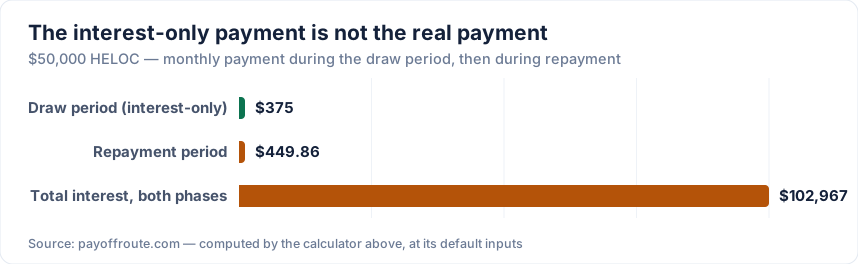
So $50,000 × (9% ÷ 12) = $375.00 a month, every month, for ten years — and at the end of those ten years you still owe the whole $50,000, having paid $45,000 in interest for the privilege.
Then the second phase starts, and the payment jumps. That jump is called payment shock, and it’s the single most important thing to understand before signing. Here is what the repayment period does to the same $50,000 at 9%, after a 10-year draw:
| Repayment period | Draw payment (interest-only) | Repayment payment | Payment shock | Total interest, both phases |
|---|---|---|---|---|
| 10 years | $375.00 | $633.38 | +69% | $71,005 |
| 15 years | $375.00 | $507.13 | +35% | $86,284 |
| 20 years | $375.00 | $449.86 | +20% | $102,967 |
Read that table in both directions. A shorter repayment period means a brutal payment jump (+69% on a 10-year repayment) but far less total interest — $71,005 instead of $102,967. A longer one softens the shock to a manageable +20% and costs you an extra $31,962 in interest. The calculator above shows your exact before-and-after numbers so you can budget for the second phase from day one.
The variable-rate factor
Most HELOCs float with the prime rate: when the Federal Reserve moves, your rate — and next month’s payment — moves too. A practical stress test: rerun the calculator with your rate 2 percentage points higher. If that payment would strain your budget, consider borrowing less, or ask your lender about a fixed-rate lock option, which many HELOCs now offer on part or all of the balance. If you want full rate certainty from the start, compare with our home equity loan calculator — same collateral, fixed rate, fixed payment.
Why HELOCs boomed when mortgage rates rose
Millions of homeowners locked in mortgages near 3% in 2020–2021. For them, a cash-out refinance at today’s 6–7% would reprice their entire mortgage just to extract some cash — a terrible trade. A HELOC (or home equity loan) taps equity while leaving the cheap first mortgage untouched, which is why home-equity borrowing has surged since 2022. The HELOC’s draw-as-you-need design also means a renovation that runs in stages doesn’t rack up interest on money sitting idle.
Smart HELOC habits
- Pay principal during the draw period, even though you don’t have to. Every dollar of principal you retire early shrinks both your interest cost and the payment jump later.
- Don’t treat the line as an emergency fund substitute. Lenders can freeze or reduce HELOCs when home values drop — exactly when you might need the money.
- Watch the fees: annual fees ($50–$100), early-closure fees, and appraisal costs vary widely between lenders and are often negotiable.
- Borrow for things that outlast the debt. A roof, not a vacation. The house is the collateral either way.
Frequently Asked Questions
How are HELOC payments calculated during the draw period?
During the draw period (typically 10 years) most HELOCs require interest-only payments: your monthly payment is simply your outstanding balance × (annual rate ÷ 12). On a $50,000 balance at 9%, that is $375 per month. The balance itself does not shrink unless you voluntarily pay principal.
What happens when the draw period ends?
The line closes to new borrowing and the loan converts to full principal-and-interest amortization over the repayment period (typically 10–20 years). Payments jump, and the size of the jump depends mostly on the length of the repayment period: on a $50,000 balance at 9%, the required payment rises about 20% with a 20-year repayment period, about 35% with a 15-year one, and nearly 70% with a 10-year one. This “payment shock” surprises many borrowers, and it is exactly what this calculator shows you in advance.
Are HELOC rates fixed or variable?
Most HELOCs have variable rates tied to the prime rate, so your payment can rise or fall over time. Many lenders offer a fixed-rate conversion option that locks a portion of your balance at a fixed rate. This calculator assumes a constant rate — run it again with a higher rate to stress-test your budget.
HELOC vs home equity loan — which is cheaper?
Neither is universally cheaper. A HELOC lets you borrow only what you need, when you need it, so you pay interest on less. A home equity loan gives you rate certainty. If rates rise, the fixed loan wins; if they fall or you borrow gradually, the HELOC often wins.
Can I pay off a HELOC early?
Yes — most HELOCs have no prepayment penalty, though some charge an early-closure fee if you close the line within the first few years. Paying principal during the draw period reduces both your interest cost and the size of the payment jump later.
Is my information stored?
No. All calculations happen in your browser. Nothing is saved or transmitted.
Read more on this
HELOC vs Home Equity Loan: How to Decide in 5 Questions
Five questions that decide between a HELOC and a home equity loan — spending pattern, rate risk, payoff speed, discipline, and the fine print.
Read →Does Velocity Banking Work? We Modelled It Generously. It Is Worth $13 a Month.
Original data: velocity banking is not a scam — it beats plain extra payments by $1,835 over twelve years. But paying $25/month more beats it outright, every dollar of the benefit is the float, and below $102/month of surplus it turns on you.
Read →Related calculators
Home Equity Loan
See how much you can borrow against your home and what the monthly payment would be, with a full amortization schedule.
Open calculator →HELOC vs HEL
Same equity, two very different loans. Compare payments and lifetime cost side by side — including what happens to the HELOC if rates rise.
Open calculator →Cash-Out Refi vs HEL
Need cash from your home? Compare replacing your whole mortgage against adding a home equity loan — total interest for each path.
Open calculator →Disclaimer: This calculator is for educational purposes only and provides estimates based on the numbers you enter. It is not financial, legal, or tax advice. Actual loan terms, rates, and payments depend on your lender and personal circumstances. All calculations run in your browser — nothing you enter is stored or sent anywhere.