Does Velocity Banking Work? We Modelled It Generously. It Is Worth $13 a Month.
Search “does velocity banking work” and the results have a strange shape. There is no Bankrate. No NerdWallet. No Experian, no Chase, no Rocket Mortgage. We checked each one directly; none of them has written about it. What fills page one instead is a wall of sites selling the strategy — courses, coaching, whole-life insurance funnels, HELOC brokers — a couple of YouTube videos, and a Quora thread.
So the question “is this true?” is currently being answered, almost exclusively, by people who get paid if you believe it is. We have nothing to sell you, so we ran the arithmetic. Every figure below comes from the same engine that powers our calculators; the methodology is public, and you can reproduce any row in the velocity banking calculator.
And we did not rig it. A debunk that cheats proves nothing, so we modelled velocity banking generously — every assumption bent in its favour. It still comes out as a $13-a-month trick.
Key findings
- It works — barely. On a $300,000 mortgage at 6.5% with a $1,104/month surplus and a 9% HELOC, velocity banking saves $1,835 over twelve years. That is $13 a month.
- Paying $25 a month more beats the entire strategy. No HELOC. No lien. No closing costs. No rate risk. No course.
- Every dollar of the benefit is the float. Remove the paycheck-parking and the same plan stops saving $1,835 and starts costing $2,761. There is no “velocity of money” — there is a cash-parking trick.
- The advice to “take a big chunk” is backwards. A $5,000 chunk saves $2,896; a $25,000 chunk loses $308. The strategy is at its best when you barely use it.
- There is a cliff, and it is where the buyers are. Below about $102/month of genuine surplus it loses money. With no surplus it costs $73,792 and leaves you in debt three years and three months longer than doing nothing.
- The break-even HELOC rate is 11.20% — and HELOCs are variable. A two-point rise does not dent the plan; it deletes it.
How we modelled it — in its own favour
Velocity banking: you open a HELOC, draw a lump (a chunk), throw it at your mortgage principal, then run your whole financial life through the line — paycheck in, bills out. Because a HELOC charges interest on the average daily balance, your income parks against the balance for part of each month and shaves the interest. When the line is clear, take another chunk. Repeat.
We gave it every break the arithmetic allows:
- The chunk is only re-drawn once the line is fully clear — its cheapest possible rhythm, and the one its own advocates describe.
- The paycheck parks in the HELOC exactly as advertised, so interest accrues on the average daily balance, not the closing balance.
- No dollar idles: any surplus the line does not need goes straight onto the mortgage.
- The comparison plan is the boring one: take the same surplus and pay it onto the mortgage.
Both plans run on exactly the same surplus — take-home pay, minus living expenses, minus the mortgage payment. That surplus is the only thing that kills debt in either plan. A HELOC does not create money.
The result
| Just pay the surplus | Velocity banking | |
|---|---|---|
| Monthly surplus | $1,103.80 | $1,103.80 |
| Debt-free in | 12 yr 1 mo | 12 yr |
| Mortgage interest | $133,259 | $126,585 |
| HELOC interest | $0 | $4,839 |
| Total interest | $133,259 | $131,424 |
Velocity banking wins — by $1,835, over twelve years. That is $13 a month, in exchange for a lien on your house, a variable-rate line of credit, and routing every dollar you earn through a loan account.
Here is the sentence the courses do not contain:
Paying $25 a month more onto your mortgage beats the entire strategy.
The column you are never shown
Look again at the table. Velocity banking really does cut mortgage interest — by $6,674. That is the slide you see in the video: the amortization schedule collapsing, the payoff date leaping forward, the triumphant arrow. It is real, and it is not the point.
The line underneath is $4,839 of HELOC interest, charged to you for the privilege. Subtract one from the other and the famous strategy is worth $1,835.
The trick is not that the numbers are fake. The trick is that you are shown one of the two columns.
The float is the whole strategy
So where does the remaining $1,835 come from? Not from velocity. From the float — the two or three weeks each month when your paycheck sits against the line before your bills pull it back out, quietly lowering the average daily balance the interest is charged on.
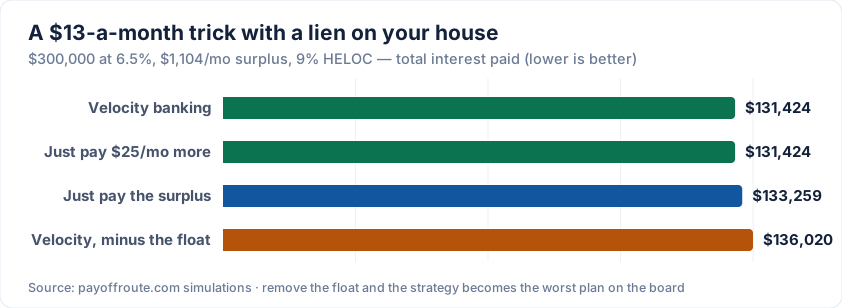
That mechanism is completely genuine. It avoids $3,225 of HELOC interest here. It is also the only thing holding the strategy above water. We turned it off — same chunk, same rates, same surplus, but the surplus is paid to the line at month end instead of the paycheck being parked in it:
| Plan | Total interest |
|---|---|
| Velocity banking | $131,424 |
| Just pay $25/month more | $131,424 |
| Just pay the surplus | $133,259 |
| Velocity banking, minus the float | $136,020 |
Read the bottom row. Without the float, velocity banking is the worst plan on the board — it loses $2,761 to simply paying your mortgage.
The float is not a feature of velocity banking. It is velocity banking. Everything else — the chunking, the “velocity of money”, the whiteboards — is packaging around a cash-parking trick worth thirteen dollars a month.
The advice that makes it worse
Every video tells you to take a big chunk. The arithmetic says the opposite, and this is the clearest evidence the advice is not coming from a spreadsheet. A bigger chunk means a bigger HELOC balance, outstanding for longer, at a rate higher than your mortgage’s.
| Chunk size | Velocity banking |
|---|---|
| $5,000 | saves $2,896 |
| $10,000 | saves $2,646 |
| $15,000 | saves $1,835 |
| $20,000 | saves $885 |
| $25,000 | costs $308 |
The strategy is at its best when you barely use it. Follow the advice you paid for, and you walk it off the edge.
The cliff — and who is standing on it
This is the finding that made us build the calculator rather than write an opinion.
A $15,000 chunk at 9% charges $112.50 a month in interest — and it charges that before a single dollar of your surplus touches the principal. The line eats first.
So if your genuine surplus is smaller than that bite, the balance never comes down. You have not accelerated anything. You have permanently moved 6.5% mortgage debt onto a 9% line, and secured it against the same house.
| Your monthly surplus | Velocity banking | Debt-free in |
|---|---|---|
| $1,104 | saves $1,835 | 12 yr |
| $300 | saves $2,952 | 20 yr 8 mo |
| $100 | costs $413 | 26 yr |
| $0 | costs $73,792 | 33 yr 3 mo (vs 30 yr) |
Below roughly $102 a month of real surplus, velocity banking loses money outright.
Now ask who buys a mortgage-acceleration course.
It is not the household with a comfortable thousand dollars spare each month — that household does not need a trick, and $13 a month would not tempt it. It is the household that feels stuck. The one with almost nothing left at the end of the month, being told that this works because of how money moves rather than how much of it you have.
The people the strategy is sold to are the people it damages. That is not an accident of the marketing. It is the marketing.
The risk that is never priced
The break-even HELOC rate on these numbers is 11.20%, against a 6.5% mortgage. Below it the plan works; above it, it does not.
But a HELOC is variable — typically pinned to prime — and you are proposing to hold one for a decade. A two-point rise does not dent this strategy; it deletes it, and leaves you holding a lien on your home in exchange for nothing. The pitch treats today’s HELOC rate as a fact. It is a forecast.
What is actually true about it
We will not pretend the arithmetic is the whole story, because one advantage here is real and it is not financial: a HELOC is more flexible than a prepaid mortgage. Money shovelled into your mortgage principal is gone until you sell or refinance. Money repaid on a HELOC can be drawn back if you lose your job. That is a genuine benefit, and it is the strongest honest argument for keeping a line of credit open.
It is not an argument for chunking. You can hold a HELOC as an emergency backstop and never once use it to buy yourself $13 a month.
If you want your mortgage gone sooner, the boring version is not just simpler — on these numbers it is better. Our mortgage payoff calculator shows what any extra payment does to your payoff date, and our $100 a month study shows what the unglamorous version is actually worth.
Methodology: standard monthly amortization for the mortgage; the HELOC accrues interest on the average daily balance, with the paycheck deposited at the start of the month and expenses drawn evenly across it. The chunk is re-drawn only when the line is clear, and surplus the line does not need is applied to mortgage principal — both choices favour velocity banking. Rates are held constant, which also favours it, since a variable HELOC can only realistically move against you from a 9% starting point. HELOC closing costs and annual fees are not modelled, which favours it again. Taxes are not modelled. Reproduce any figure in the velocity banking calculator.
Run your own numbers
HELOC Payment Calculator
Estimate your HELOC payments during the interest-only draw period and the repayment period that follows.
Open calculator →Mortgage Payoff Calculator
See how extra monthly or annual payments shorten your mortgage and how many thousands in interest they save.
Open calculator →Velocity Banking Calculator
Does chunking a HELOC into your mortgage actually beat just paying extra? Both plans, the same surplus, side by side — plus the break-even HELOC rate.
Open calculator →Disclaimer: This article is for educational purposes only and is not financial advice. Figures are computed with the models described on our methodology page; actual loan terms depend on your lender and circumstances.