What an Extra $100 a Month Does to Your Debt: The Full Tables
“Just pay a little extra” is the most common piece of debt advice on the internet — and the least quantified. So we quantified it: the same $100/month, applied to five typical American debts and across every common interest rate, simulated month by month with the same engines that power our calculators. Full methodology on the methodology page; reproduce any row with the loan payoff calculator.
Key findings
- On a $320,000 mortgage at 6.5%, an extra $100/month erases 3 years 10 months of payments and $61,698 in interest.
- On a $5,000 credit card at 24.99%, the same $100 cuts the payoff from 4.6 years to 2.2 years and saves $1,918 — more than a third of the debt itself.
- Rate is the multiplier: the identical $100 saves $569 on a 6% loan but $6,962 on the same loan at 20%.
- The headline: on a $10,000 balance at 25% APR or higher, a $200/month payment never pays off the debt at all — the balance outruns it. Adding $100 doesn’t accelerate that loan; it rescues it.
(Cite these figures freely with a link to this page.)
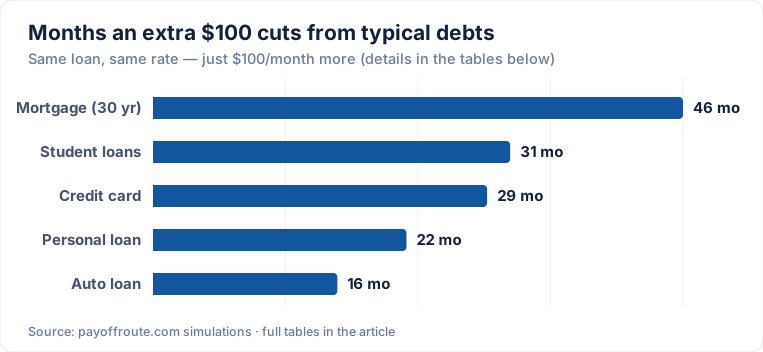
Five typical debts, one extra $100
Each row keeps the loan’s normal payment and adds exactly $100/month, starting today.
| Debt | Base payment | Payoff time | Interest paid | With +$100 | Time cut | Interest saved |
|---|---|---|---|---|---|---|
| Mortgage $320,000 @ 6.5% (30 yr) | $2,023 | 30 yr | $408,142 | 26 yr 2 mo · $346,444 | 3 yr 10 mo | $61,698 |
| Student loans $35,000 @ 6.8% (10 yr) | $403 | 10 yr | $13,334 | 7 yr 5 mo · $9,636 | 2 yr 7 mo | $3,698 |
| Auto loan $25,000 @ 7.5% (72 mo) | $432 | 6 yr | $6,122 | 4 yr 8 mo · $4,688 | 1 yr 4 mo | $1,434 |
| Personal loan $10,000 @ 13.5% (5 yr) | $230 | 5 yr | $3,806 | 3 yr 2 mo · $2,297 | 1 yr 10 mo | $1,509 |
| Credit card $5,000 @ 24.99% (min frozen at $154) | $154 | 4 yr 7 mo | $3,418 | 2 yr 2 mo · $1,501 | 2 yr 5 mo | $1,918 |
Two things stand out. In absolute dollars, the mortgage wins by a mile — $100 against a six-figure, multi-decade loan compounds into a five-figure saving. But in proportional damage, the credit card is the standout: the extra $100 wipes out 56% of the interest bill on a debt 64 times smaller than the mortgage.
The same $10,000 at every rate
To isolate what the interest rate does, here is one $10,000 debt with a $200/month payment, and what one extra $100 changes at each APR:
| APR | On $200/month | With $300/month | Interest saved | Time cut |
|---|---|---|---|---|
| 6% | 4 yr 10 mo · $1,536 | 3 yr 1 mo · $967 | $569 | 1 yr 9 mo |
| 10% | 5 yr 5 mo · $2,990 | 3 yr 4 mo · $1,764 | $1,226 | 2 yr 1 mo |
| 15% | 6 yr 7 mo · $5,791 | 3 yr 8 mo · $3,017 | $2,774 | 2 yr 11 mo |
| 20% | 9 yr 1 mo · $11,680 | 4 yr 2 mo · $4,718 | $6,962 | 4 yr 11 mo |
| 25% | never pays off | 4 yr 10 mo · $7,251 | — | rescued |
| 29.99% | never pays off | 6 yr 1 mo · $11,757 | — | rescued |
The pattern is not linear — it’s exponential in disguise. From 6% to 20%, the same $100 becomes twelve times more valuable. And past roughly 24% (where $10,000 generates $200/month in interest), the base payment merely treads water forever; the extra $100 is the difference between a six-year plan and an infinite one.
Why $100 punches so far above its weight
Your regular payment is mostly spoken for: it must cover the month’s interest before a cent touches the balance. The extra $100 skips that line entirely — 100% of it retires principal. And every dollar of principal it removes stops generating interest for the loan’s whole remaining life, which frees more of every future payment for principal, which compounds again. Prepayment is compound interest working for you, and the earlier it starts, the longer it compounds: the identical $100 is worth more in month 1 than in month 100.
That’s also why the savings figures above can’t be reproduced with simple percentage math — they come from month-by-month simulation, and you can watch the balance curves diverge in real time in the mortgage payoff calculator or, for multiple cards at once, the credit card payoff calculator.
How to actually find the $100
The mechanics only matter if the $100 exists. The reliable sources, in rough order of painlessness: round your payment up to a clean number and automate it; commit half of any raise, refund, or bonus in advance; redirect a payment that just ended (a paid-off subscription, a finished loan); and if you’re paid biweekly, the “13th payment trick” adds a full extra payment per year with no monthly budget change at all.
Methodology
Month-by-month simulation: interest accrues at APR ÷ 12 on the current balance, then the payment applies; payments never exceed the remaining balance; simulations cap at 100 years (“never pays off”). Base payments are the standard amortizing payment for each loan (the credit card row freezes the first minimum — interest + 1% of balance, $25 floor — as a fixed payment, the honest way to model a card being paid down without new charges). No fees, rate changes, or new borrowing are modeled. Details on the methodology page.
Run your own numbers
Mortgage Payoff Calculator
See how extra monthly or annual payments shorten your mortgage and how many thousands in interest they save.
Open calculator →Credit Card Payoff Calculator
Compare the snowball and avalanche strategies across all your cards and see how much interest each plan saves.
Open calculator →Loan Payoff Calculator
See how much sooner you’ll be debt-free and how much interest you save by adding extra monthly or one-time payments to any loan.
Open calculator →Disclaimer: This article is for educational purposes only and is not financial advice. Figures are computed with the models described on our methodology page; actual loan terms depend on your lender and circumstances.