Where the extra payment hides
The biweekly trick works because of a mismatch between how loans are billed and how time actually passes. A year has 52 weeks, which is 26 two-week periods — but only 12 months. Pay half your monthly payment every two weeks and you make 26 half-payments a year: 13 full payments instead of 12. The 13th payment is pure extra principal, and because it repeats every single year of the loan, it compounds into years of saved payments.
What makes the strategy psychologically effective is that it doesn’t feel like paying more. You never write a bigger check — you just write a normal-sized half-check on a different rhythm. The extra payment hides in the calendar: two months a year contain three paydays instead of two, and the biweekly schedule quietly harvests them. If you’re paid every two weeks — as most US workers are — the alignment is even cleaner, because a half-payment can come out of every single paycheck. You feel a rhythm change, not a budget cut. The same dollars would sting if a bill demanded them as a lump sum in December; spread invisibly across 26 paychecks, most households never notice they left.
The trick applies to any fixed-payment amortizing loan: mortgages are where the dollar savings are largest, but car loans, personal loans, and private student loans respond the same way, in proportion to their size and rate.
How much does a biweekly payment plan actually save?
The whole strategy reduces to a single line of arithmetic. Twenty-six half-payments a year equal thirteen monthly payments, so the accelerated schedule is just your normal payment scaled up by one twelfth:
Accelerated monthly equivalent = monthly payment × 13 ÷ 12
On a $2,025.62 payment that is $2,194.42 a month — about $169 of pure extra principal. Here is what that does across common loans, all computed by the engine above. Mortgage rows are a $300,000 balance at 6.5%; the last row is a car loan:
| Loan | Monthly payment | Biweekly payoff | Time saved | Interest saved |
|---|---|---|---|---|
| $300,000 · 6.5% · 30 yr | $1,896.20 | 24 yr 2 mo | 5 yr 10 mo | $87,256 |
| $300,000 · 6.5% · 25 yr | $2,025.62 | 20 yr 10 mo | 4 yr 2 mo | $59,673 |
| $300,000 · 6.5% · 15 yr | $2,613.32 | 13 yr 2 mo | 1 yr 10 mo | $23,215 |
| $30,000 · 7% · 5 yr (car) | $594.04 | 4 yr 7 mo | 5 mo | $528 |
Read the first three rows together and the pattern is unmistakable: the longer the term, the more the 13th payment is worth, because it has more years of interest left to kill. The 30-year row saves nearly four times what the 15-year row does on the same balance and rate.
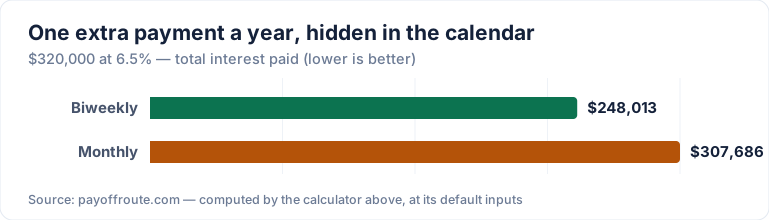
Take the calculator’s defaults: a $300,000 balance at 6.5% with 25 years remaining. The required monthly payment is about $2,025.62, so the biweekly version is $1,012.81 every two weeks. Ride out the monthly schedule and you’ll pay roughly $307,700 in interest — more than the original balance. Switch to the biweekly rhythm and the loan is gone in about 20 years 10 months instead of 25 years. That’s 4 years 2 months of payments erased and about $59,700 in interest saved — from a schedule change that never once asked you to find extra room in the monthly budget.
Why does one extra payment a year buy so much? Because amortizing interest is front-loaded. In the first month of that default mortgage, $1,625 of the $2,026 payment is interest; only about $400 actually reduces the balance. The extra one-twelfth the biweekly rhythm delivers — about $169 a month — goes entirely to principal, so it increases the amount of debt retired each month by roughly 40% even though it raises your annual outlay by barely 8%. And every dollar of principal removed early stops accruing interest for the whole remaining term, which is how a modest schedule change snowballs into a five-figure saving. The corollary: the earlier in the loan you start, the more the 13th payment is worth, so the best year to begin is this one.
The savings scale with the size and length of the debt, so set expectations accordingly on smaller loans. On a $30,000 car loan at 7% over five years ($594 a month), the same trick saves only about $500 in interest — real money, but not life-changing. What it does do is end the loan roughly five months early, which means five fewer months of a payment obligation hanging over your budget and five months’ head start on saving for the next car in cash. On short, small loans the biweekly trick is less about the interest and more about getting your cash flow back sooner.
Never pay for a biweekly program
Here is the industry’s open secret: third-party “biweekly payment programs” charge enrollment fees of $200–400, plus per-draft processing charges, to perform the arithmetic on this page. Many don’t even send your money in biweekly — they hold your half-payments and forward a normal monthly payment plus one extra payment a year, pocketing the float and the fees. You are paying hundreds of dollars for a division problem. There are two free ways to get the identical result:
- True biweekly drafts — but only if your servicer confirms, in writing or in the portal, that it accepts partial payments and applies them when received. Many don’t.
- The monthly-extra equivalent — keep paying monthly and add one-twelfth of your payment as extra principal each month. Thirteen payments’ worth of money moves every year either way. Our mortgage payoff calculator and loan payoff calculator model exactly this, and let you test any other extra amount too.
The second route has a hidden advantage beyond simplicity. Some servicers, on receiving half a payment, don’t credit it at all — they park it in a suspense account until the other half arrives, then apply both as one ordinary monthly payment. Interest accrues on your full balance the whole time, and the biweekly “benefit” evaporates. The monthly-extra route avoids this failure mode entirely: a full payment plus a clearly marked extra-principal amount is something every servicer on earth processes correctly. Just verify on your next statement that the extra reduced the principal balance rather than being treated as an early payment of next month’s bill.
True biweekly vs the model here
An honesty note about the math. This calculator models the accelerated-biweekly schedule the standard way: as your regular monthly payment plus one-twelfth extra every month — the same total dollars as 26 half-payments a year, applied monthly. A literal biweekly loan, where the lender computes interest every 14 days and credits each half-payment the moment it arrives, would come out very slightly better, because some of your money reaches the balance up to two weeks earlier each cycle.
How much better? On typical loans, trivially. The early-crediting effect amounts to moving roughly half a payment two weeks earlier on average — worth a few dollars a year on a mid-size mortgage, a rounding error over the life of the loan. The savings you see above come almost entirely from the 13th payment, not from the crediting cadence. That’s worth internalizing, because it frees you from caring whether your servicer supports “real” biweekly processing at all. The money is what matters; the calendar is just the delivery mechanism. If anyone — a servicer, a third-party program, a well-meaning forum post — implies the two-week cadence itself holds some special mathematical power, they are selling the wrapper, not the gift.
One more modeling detail for the careful reader: this page computes your required payment from the balance, rate, and term you enter, then simulates both plans month-by-month rather than plugging numbers into a closed-form shortcut. That means the final payment is a true partial payment, the interest totals reflect an actual amortization run, and the two lines on the chart are the real trajectories of the two plans — you can watch the gap between them widen year by year as the extra principal compounds.
Who should NOT bother
Accelerating a loan earns a guaranteed return equal to its interest rate — which also tells you exactly when it’s the wrong move.
- Anyone carrying higher-APR debt. Prepaying a 6.5% mortgage while a credit card charges 22% is choosing a 6.5% return over a guaranteed 22% one. Kill the cards first — our credit card payoff calculator will show you why that debt deserves every spare dollar.
- Anyone without an emergency fund. Extra principal is trapped equity: if you lose your job, the lender still wants the full payment on schedule and won’t hand your prepayments back. Three to six months of expenses in savings comes before acceleration.
- Anyone near payoff already. Interest savings come from cutting time off the schedule, and in the final few years most of each payment is already principal. With two or three years left, the biweekly trick saves little — the loan simply doesn’t have enough interest left in it to rescue.
If none of those describe you, the biweekly rhythm — or its monthly-extra twin — is one of the rare personal-finance moves that costs nothing, risks nothing, and pays a guaranteed return. Run your own numbers above and see what the 13th payment is worth on your loan.
Frequently Asked Questions
Does my lender have to accept biweekly payments?
No. Some servicers accept half-payments every two weeks and apply them properly; others refuse partial payments or hold them in a suspense account until a full payment accumulates, which erases the benefit. Call and ask exactly how half-payments are applied before setting one up. If the answer is vague, skip biweekly drafts entirely and add one-twelfth of your payment as an extra monthly principal payment instead — the math result is virtually identical and every servicer can handle it.
Is biweekly the same as paying extra monthly?
Almost exactly. Twenty-six half-payments per year equal thirteen full payments, which is the same total money as twelve payments plus one-twelfth extra each month. True biweekly crediting applies some money slightly earlier in each month, which saves a trivially small additional amount of interest on typical loans. The 13th payment does essentially all the work, so choose whichever version your servicer handles cleanly.
How much does a biweekly schedule save on a car loan?
Less in dollars than on a mortgage, because the balance is smaller and the term shorter, but the loan still ends meaningfully sooner. On a $30,000 loan at 7% over five years, the biweekly rhythm saves roughly $500 in interest and retires the loan about five months early. The percentage effect is similar to a mortgage; the absolute savings scale with the size of the debt.
Do paid biweekly programs ever make sense?
Rarely. The only defensible case is someone who truly cannot automate the extra payment themselves and would otherwise never make it — and even then, most servicers offer free autopay with an extra-principal field that does the same job. Paying $200–400 in enrollment fees plus per-draft charges for arithmetic you can do for free is a bad trade in almost every situation.
What if my servicer holds partial payments in suspense?
Then a true biweekly schedule saves you nothing: the first half-payment sits in a holding account earning no credit until the second half arrives, so interest accrues exactly as if you had paid monthly. The fix is simple — keep paying monthly and add one-twelfth of your payment as an extra amount marked "apply to principal." You get the same 13-payments-a-year effect with no suspense-account risk.
Does biweekly help on a 0% loan?
There is no interest to save, so the dollar benefit is zero — but the loan still ends about one-thirteenth sooner because you are simply paying more per year. Whether that matters is up to you; mathematically, prepaying 0% debt is the lowest-value use of extra cash, since the same dollars could earn interest in savings or retire debt that actually costs something.
Does this calculator store my information?
No. All calculations run entirely in your browser. Nothing you type is saved, stored, or sent to any server.
Read more on this
Related calculators
Home Equity Loan
See how much you can borrow against your home and what the monthly payment would be, with a full amortization schedule.
Open calculator →HELOC Payment
Estimate your HELOC payments during the interest-only draw period and the repayment period that follows.
Open calculator →HELOC vs HEL
Same equity, two very different loans. Compare payments and lifetime cost side by side — including what happens to the HELOC if rates rise.
Open calculator →Disclaimer: This calculator is for educational purposes only and provides estimates based on the numbers you enter. It is not financial, legal, or tax advice. Actual loan terms, rates, and payments depend on your lender and personal circumstances. All calculations run in your browser — nothing you enter is stored or sent anywhere.