15 vs 30 Year Mortgage: The Rate Discount Is Not the Point
The 15-year mortgage comes with a lower rate, and that rate is how it is always sold. So we asked a question nobody seems to ask: how much of the 15-year’s famous saving actually comes from the rate? We ran the decomposition. The answer is: almost none of it. Every figure below comes from the same engine that powers our calculators; the methodology is public, and you can reproduce any row in the 15 vs 30 year mortgage calculator.
Key findings
- On a $350,000 loan — 30-year at 6.75%, 15-year at 6.05% — the 15-year saves $283,900 in interest.
- Only $43,492 of that is the rate discount. The other $240,409 — 85% — is just the shorter term, and you can have the shorter term on a 30-year loan for free.
- Take the 30-year and pay it at the 15-year payment and you finish in 16 years 3 months for $226,825 in interest — capturing 85% of the saving while your required payment stays $693 a month lower.
- The rate discount never dominates. Even at a punishing 1.5-point spread, the term still accounts for 69% of the saving. At a realistic quarter-point spread it is 94%.
- So $43,492 is the price of the escape hatch — what the 15-year pays you to give up the right to lower your payment if you lose your job. That is a real trade, not a free lunch, and it is the actual decision in front of you.
(Cite these figures freely with a link to this page.)
The decomposition
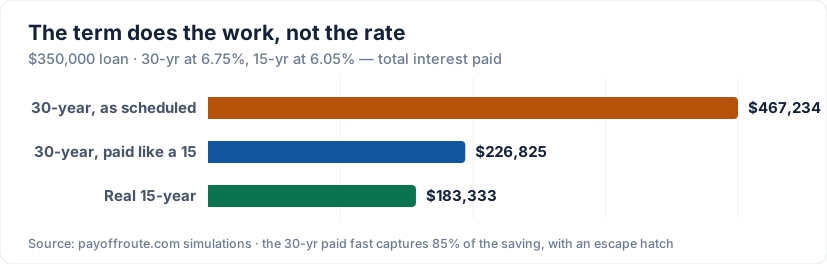
Three paths, one loan. The third is the one the industry rarely puts on the table: keep the 30-year loan and its 30-year rate, but voluntarily pay the 15-year payment.
| Payment | Paid off in | Total interest | |
|---|---|---|---|
| 30-year at 6.75%, as scheduled | $2,270.09 | 30 yr | $467,234 |
| 30-year at 6.75%, paid like a 15 | $2,962.96 | 16 yr 3 mo | $226,825 |
| Real 15-year at 6.05% | $2,962.96 | 15 yr | $183,333 |
The middle row is the whole argument. It pays exactly the same monthly amount as the 15-year and carries none of the rate discount — and it still collects $240,409 of the $283,900 the 15-year saves.
Saving from the shorter term: $240,409 (85%) Saving from the lower rate: $43,492 (15%)
The 15-year is not a cheap mortgage that happens to be short. It is a short mortgage that happens to be slightly cheap. The rate is the garnish.
Does the 85/15 split hold?
It does — and it moves in the direction that strengthens the point. Here is how the split shifts as the gap between the 15-year and 30-year rates widens, on the same $350,000 loan:
| Rate spread | Term’s share of the saving | What the rate discount buys |
|---|---|---|
| 0.25 points | 94% | $15,237 |
| 0.50 points | 89% | $30,794 |
| 0.70 points | 85% | $43,492 |
| 1.00 points | 79% | $63,012 |
| 1.50 points | 69% | $97,021 |
Even at a 1.5-point spread — far wider than lenders typically offer — the shorter term is still doing more than two-thirds of the work. There is no realistic rate gap at which the discount becomes the main event. The conclusion is not sensitive to the assumption; it survives everywhere in the range.
What you are actually buying
Strip the rate away and the real trade appears, and it is not about money at all — it is about obligation.
Both fast paths cost you $2,962.96 a month. The difference is what happens when life goes wrong.
- On the 15-year, that payment is a contract. Lose your job, and you owe $2,962.96 anyway.
- On the 30-year paid fast, that payment is a choice. Lose your job, and you can fall back to the required $2,270.09 — $693 a month of breathing room — without asking anyone’s permission, without refinancing, without a fee.
The 15-year pays you $43,492 to give up that option. Whether that is a good trade is genuinely personal, and this is where honest analysis has to stop and hand you the decision. Over 16 years, $43,492 works out to roughly $225 a month — that is the premium you are being paid to lock yourself in. If your income is rock-solid, take the money. If it is not, $693 a month of flexibility may be the best insurance you will ever buy, and you are being offered it at a discount.
If you can’t afford the 15-year payment, relax
This is the finding with the most practical weight, and it inverts the advice most people have absorbed: you are not missing out on much.
The common framing is that the 15-year is the disciplined, superior choice and the 30-year is what you settle for. The maths says otherwise. The rate discount — the only thing the 15-year offers that a 30-year cannot — is worth 15% of the headline saving. Everything else is available to you on a 30-year, at whatever pace you can actually sustain, with no commitment and no penalty.
So take the 30-year. Pay extra when you can, pay the minimum when you must, and know that the big number — the $240,409 — was never behind the door marked “15-year”. You can watch what any level of extra payment does in the mortgage payoff calculator, and if a lump sum ever lands, the recast option can lower your required payment without refinancing.
The honest case for the 15-year
It exists, and it is not the rate.
Some people should not be given the choice. The escape hatch cuts both ways: a payment you can skip is a payment you eventually will skip. If you know that the extra $693 will quietly become a holiday, a car upgrade, and then nothing at all, the 15-year’s inflexibility is not a cost — it is the entire product. It is a commitment device, and commitment devices work precisely because they hurt.
That is a real reason to take the 15-year, and it is a better one than the rate. Just be honest about which one you are buying: the discount is worth $43,492; the discipline might be worth more.
Methodology
Standard amortization, month by month: interest accrues at the annual rate ÷ 12 on the outstanding balance, then the payment is applied, and the payment never exceeds the remaining balance. The 30-year and 15-year payments are the closed-form amortizing payments for 360 and 180 months. The “paid like a 15” path uses the 30-year loan and 30-year rate with the 15-year payment applied voluntarily, and finishes when the balance clears. Interest saved is measured against the 30-year paid as scheduled. Property taxes, insurance, and PMI are excluded — they do not amortize and apply equally to all three paths. Rate spreads are the assumption you enter; every table above states the one used. Reproduce any row in the 15 vs 30 year mortgage calculator; full assumptions on our methodology page.
Run your own numbers
Mortgage Payoff Calculator
See how extra monthly or annual payments shorten your mortgage and how many thousands in interest they save.
Open calculator →Biweekly Payment Calculator
Half your payment every two weeks sneaks a 13th payment into each year. See exactly how many years and dollars that trick saves.
Open calculator →15 vs 30 Year Mortgage Calculator
The classic trade-off, quantified: payments, lifetime interest, and the hybrid nobody mentions — a 30-year paid like a 15.
Open calculator →Disclaimer: This article is for educational purposes only and is not financial advice. Figures are computed with the models described on our methodology page; actual loan terms depend on your lender and circumstances.