How much interest does a 15-year mortgage save vs a 30-year?
The 15-year mortgage doesn't beat the 30-year by one mechanism — it beats it by two, and they stack.
Effect one: half the time. Interest is rent on borrowed money, charged monthly on whatever you still owe. A 30-year loan keeps a large balance outstanding for decades — after ten years of payments on this calculator's default $350,000 loan at 6.75%, you'd still owe roughly $299,000. Cut the term to 15 years and every dollar of principal leaves the balance sooner, so there's simply less debt sitting around accruing interest. On the defaults, a 30-year loan at 6.75% costs about $467,000 in lifetime interest; the same loan amortized over 15 years at that same rate would cost about $207,000. Term alone saves roughly $260,000.
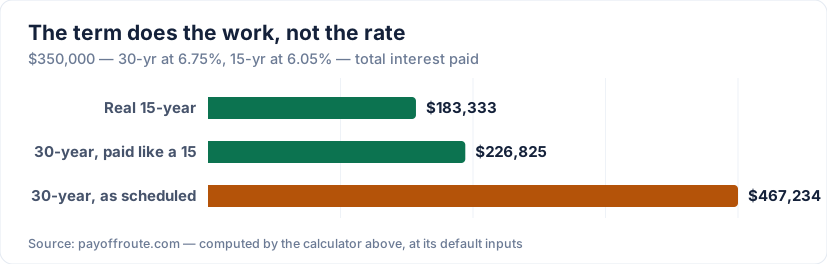
Effect two: a lower rate. Lenders price 15-year loans about 0.5–0.75 percentage points below 30-year loans, because they get their money back faster and carry less risk over the loan's life. Dropping the default from 6.75% to 6.05% takes that $207,000 down to about $183,000 — another $24,000 or so. Stack both effects and the true 15 saves roughly $284,000 against the 30-year minimum on these numbers. Six figures is not an exaggeration; on a typical American mortgage it's the normal result.
The cost of all that saving shows up in one place: the monthly payment. On the defaults, the 15-year requires about $2,963 a month versus $2,270 for the 30 — a gap of roughly $693, every month, for fifteen years, with no legal way to pay less.
Both payments come from the same standard amortization formula — principal P, monthly rate r (annual rate ÷ 12), and n months (180 or 360):
Monthly payment = P × r ÷ (1 − (1 + r)−n)
Run it on all three paths for the default $350,000 loan — 30-year quoted at 6.75%, 15-year quoted at 6.05% — and the whole decision fits in one table:
| Path | Monthly payment | Payoff time | Total interest | Saved vs the 30-year minimum |
|---|---|---|---|---|
| True 15-year at 6.05% | $2,962.96 — required | 15 yr | $183,333 | $283,900 |
| 30-year at 6.75%, paid like a 15 | $2,270.09 required — you pay $2,962.96 | 16 yr 3 mo | $226,825 | $240,409 |
| 30-year minimum at 6.75% | $2,270.09 — required | 30 yr | $467,234 | — |
The middle row is the one most comparisons omit. It captures $240,409 of the $283,900 the true 15 saves — about 85% of the benefit — while leaving your required payment at $2,270.09. The $43,492 gap between rows one and two is the flexibility premium, and the rest of this page is about whether it is worth paying.
Why the 30-year still wins for most buyers
If the 15-year is so much cheaper, why do the overwhelming majority of American buyers take the 30? Because the comparison above prices only interest — not risk, and not opportunity.
Qualification. Lenders approve you based on your debt-to-income ratio, and DTI counts the required payment — the 15-year's full $2,963, not what you could theoretically afford in a good month. The same income that comfortably qualifies for this house on a 30-year loan may not qualify at all on a 15. Run your own numbers through our debt-to-income ratio calculator to see how much of your budget each payment consumes.
Payment shock risk. A mortgage payment is not a goal; it's a legal obligation that survives job losses, medical bills, new babies, and recessions. The 15-year's higher payment is owed in your worst month exactly as it is in your best one. Miss it and you're in default territory — late fees, credit damage, and eventually foreclosure risk — regardless of fifteen years of perfect history.
Opportunity cost. The roughly $693 monthly gap isn't destroyed if you take the 30 — it's freed. It can max out a 401(k) match, fill a Roth IRA, or build the down payment on a rental. Whether prepaying a mortgage at 6.75% beats investing is a genuine debate that depends on returns, taxes, and your risk tolerance; what's not debatable is that the 15-year removes the choice entirely.
Emergency resilience. A smaller required payment means a smaller emergency fund covers more months of obligations. In a genuine crisis, the 30-year borrower can shrink their housing outflow by $693 a month instantly and unilaterally. The 15-year borrower cannot.
The hybrid: a 30 paid like a 15
Here is the option most 15-vs-30 articles skip: take the 30-year loan, then voluntarily pay the 15-year payment every month. Nearly all US mortgages allow unlimited penalty-free prepayment, and every extra dollar goes straight to principal.
The hybrid does not match the true 15, and this calculator refuses to pretend otherwise. Your extra payments amortize at the 30-year rate, which is higher — so the payoff runs a bit past 15 years and the interest runs higher. On the defaults, paying the 15's $2,963 on a 30-year loan at 6.75% pays it off in about 16 years 3 months with roughly $227,000 of interest — about $43,500 more than the true 15. That gap is the flexibility premium: the price of being allowed to drop back to $2,270 in any month you need to, without asking anyone. Compare it against the roughly $240,000 the hybrid still saves versus the 30-year minimum, and for many households it reads less like a cost and more like cheap insurance on their own budget.
The honest caveat: the hybrid only works if you actually pay it. The true 15 has a contract enforcing the higher payment; the hybrid has only your follow- through, and "just this month" has quietly turned thousands of would-be 15-year payoffs back into 30-year loans. The fix is automation — set the recurring payment to the 15-year amount with the extra flagged as principal-only, so skipping requires a deliberate act rather than a lapse. Then treat drop-backs as what they are: an emergency valve, not a spending raise. To model a custom extra amount instead of the full 15-year payment, use our mortgage payoff calculator; if you'd rather sync extra principal to your paychecks, the biweekly payment calculator runs the half-payment-every-two-weeks version of the same idea.
When the true 15 is right
The flexibility premium buys real protection, but not everyone needs it — and some people are better off without the option it preserves.
- High, stable income with a funded safety net. If the 15-year payment fits under roughly a quarter of your take-home pay and you hold six months of expenses in reserve, the flexibility you'd be paying $43,500 to keep is protection you already have in cash. Take the lower rate; it's the cheaper form of the same security.
- Refinancers already deep into a 30. If you're ten years into a 30-year loan, refinancing into a new 30 restarts the amortization clock and stretches your debt to 40 years of total payments. Refinancing into a 15 keeps you near your original payoff date, captures the rate discount, and often costs little more per month than you're paying now, since the balance has shrunk.
- People who know they won't keep the discipline. Self-knowledge is a financial asset. If a decade of good intentions says the "extra" payment will erode into vacations and car upgrades, the 15-year's contract is the feature, not the bug — you're paying the higher required payment precisely so that future-you can't negotiate with it.
Beyond the payment
A few second-order effects don't show up in the interest math but belong in the decision.
PMI ends sooner. If you put down less than 20%, you're paying private mortgage insurance until your equity reaches the cancellation thresholds. A 15-year loan (or a 30 paid like one) crosses 20% and then 22% equity years earlier through amortization alone, killing a cost that can run $100–300 a month on top of everything this calculator shows.
Equity builds faster. Five years in, the 15-year borrower on our defaults has paid their balance down to roughly $266,000, while the 30-year minimum borrower still owes about $329,000 — over $62,000 more equity from schedule alone, before any appreciation. That equity is borrowing power if you ever need it: lenders cap home equity loans and HELOCs by your combined loan-to-value, so a faster-amortizing first mortgage directly raises what you could access later. Our home equity loan calculator shows how that math works.
Retirement-date alignment. Perhaps the most underrated variable: when does the loan end relative to when your paycheck does? A 30-year mortgage signed at 45 runs to 75; carrying a $2,270 payment on retirement income is a very different life than owning the house outright at 60. For mid-career buyers, the 15 — or the hybrid, which lands close behind it — is often less about interest saved and more about retiring without a housing payment at all. Work backward from your target retirement date and let that, not just the monthly gap, pick your path.
Frequently Asked Questions
Can I refinance a 30-year mortgage into a 15-year later?
Yes, and many homeowners do exactly that once their income grows into the higher payment. But a refinance is not free — closing costs typically run 2–5% of the loan balance, you have to qualify all over again at whatever rates prevail at the time, and there is no guarantee those rates will be attractive. The hybrid approach in this calculator gets you most of the way to a 15-year payoff without any of those costs or conditions: you simply start paying more this month.
Is a 20-year mortgage a good compromise?
Often, yes. A 20-year term usually prices between the 15 and the 30, and its payment lands roughly halfway between the 30-year payment and the 15-year payment. It suits buyers who want a contractual payoff date meaningfully sooner than 30 years but find the 15-year payment too tight. The same logic in this calculator applies: compare the required payment against a 30-year loan you prepay to the same schedule, and decide whether the rate discount is worth locking in the higher obligation.
Do lenders actually offer lower rates for shorter terms?
Yes — that rate gap is real and it is a core part of this comparison. A 15-year loan returns the lender’s money faster and carries less interest-rate and default risk over its life, so 15-year fixed rates typically run about 0.5 to 0.75 percentage points below 30-year rates. That discount is the one advantage of the true 15 that no prepayment strategy on a 30-year loan can replicate.
Does choosing a 15-year loan reduce how much house I can qualify for?
Yes. Lenders qualify you on your debt-to-income ratio using the required monthly payment, and the 15-year requirement is much larger for the same loan amount. On this calculator’s defaults, the roughly $690 monthly gap could translate into meaningfully less approved loan amount at the same income. This is one of the main practical reasons buyers take the 30 and prepay: the smaller required payment qualifies them for the house, and the extra principal is voluntary.
What about an adjustable-rate mortgage (ARM) instead?
An ARM offers a lower initial rate for a fixed period (often 5, 7, or 10 years), after which the rate floats with the market. It can beat both fixed options if you are confident you will sell or refinance before the adjustment — but if you keep the loan, you inherit rate risk that neither the 15 nor the 30 has. This calculator compares fixed-rate loans only; an ARM is a different bet about the future, not a different term on the same bet.
If I take the hybrid approach, can I switch back to the minimum payment anytime?
Yes — that is the entire point. With a 30-year loan, the only payment you are contractually obligated to make is the 30-year minimum. Any extra principal you send is voluntary, month by month, and you can stop or restart without penalty, paperwork, or your lender’s permission (nearly all US mortgages have no prepayment penalty; confirm yours). The flexibility premium this tool computes is what that permission costs in interest.
Does this calculator store my information?
No. All calculations run entirely in your browser. Nothing you type is saved, stored, or sent to any server.
Read more on this
15 vs 30 Year Mortgage: The Rate Discount Is Not the Point
Original data: only 15% of what a 15-year mortgage saves you comes from its lower rate. The other 85% comes from the shorter term — which a 30-year gives you for free, and lets you undo.
Read →Mortgage Points vs a Bigger Down Payment: The 4-Point Ceiling Nobody Mentions
Original data: the advice to "put it toward the down payment and kill PMI" describes a choice most buyers do not have. Absorbing that cash in points would take 11.1 points — and lenders sell four.
Read →Related calculators
Home Equity Loan
See how much you can borrow against your home and what the monthly payment would be, with a full amortization schedule.
Open calculator →HELOC Payment
Estimate your HELOC payments during the interest-only draw period and the repayment period that follows.
Open calculator →HELOC vs HEL
Same equity, two very different loans. Compare payments and lifetime cost side by side — including what happens to the HELOC if rates rise.
Open calculator →Disclaimer: This calculator is for educational purposes only and provides estimates based on the numbers you enter. It is not financial, legal, or tax advice. Actual loan terms, rates, and payments depend on your lender and personal circumstances. All calculations run in your browser — nothing you enter is stored or sent anywhere.