Is a cash-out refinance or a home equity loan cheaper?
It depends almost entirely on one number: your current mortgage rate. The refinance doesn’t just price the cash you want — it reprices everything you already owe, because the new loan swallows the old balance whole:
New refinance loan = mortgage balance + cash + closing costs
On the calculator’s defaults that is $280,000 + $60,000 + $10,200 = $350,200, all of it now charged at 6.75% for 30 fresh years. The home equity loan borrows $60,000 + $1,200 in costs = $61,200 at 8.5%, and leaves the $280,000 sitting quietly at 3.25%. A higher rate on $61,200 beats a moderate rate on $350,200 — every time:
| Path A: Cash-out refi | Path B: Mortgage + home equity loan | |
|---|---|---|
| Monthly payment | $2,271.39 for 30 yrs | $1,967.15, then $1,364.49 once the HEL ends after 15 yrs |
| Closing costs financed | $10,200 (3% of the new loan) | $1,200 (2% of the HEL) |
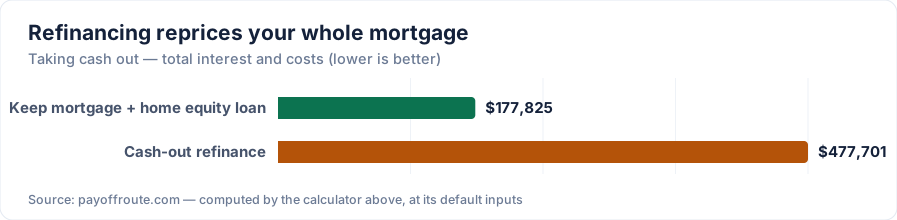
| Total interest & costs | $477,701 | $177,825 |
| Your current mortgage rate | Lost — whole balance repriced to 6.75% | Kept at 3.25% |
The cheaper path on these numbers is the Home equity loan, and the gap is not close: $299,876. The refinance loses on the monthly payment too, because a 3.25% mortgage costs only $1,364.49 a month to carry. The answer narrows as your current rate climbs — at 6.75%, identical to the refi rate, the equity loan still wins, but by $128,856 instead of $299,876. Enter your real rate above; that single input decides most of this comparison.
Both options hand you a lump sum secured by your house, but the mechanics could hardly be more different. A cash-out refinance pays off your existing mortgage completely and replaces it with a single new, larger loan. You walk away with one payment, one rate — today’s rate — and a clock that restarts, usually at 30 years. The cash you take is simply the difference between the new loan and what your old mortgage owed, minus closing costs.
A home equity loan takes the opposite approach: your current mortgage stays exactly as it is — same rate, same payment, same payoff date — and the lender adds a second, smaller loan behind it. You make two payments each month, and only the new cash carries the new (typically higher) rate. Our home equity loan calculator breaks down that second loan in detail, including how much lenders will let you borrow.
There is also a flexible third option worth knowing about: a HELOC, a revolving credit line against your equity that lets you draw funds as needed instead of taking one lump sum. Our HELOC payment calculator covers that path. But for a one-time, known cash need, the head-to-head comparison above is the decision most homeowners actually face.
The rate-lock effect: why this decision flipped after 2022
For most of the 2010s, cash-out refinancing was the default answer, because rates kept falling: you could pull cash out and lower your rate in the same transaction. That logic inverted when rates climbed sharply in 2022. Millions of homeowners locked in mortgages below 4% — and a cash-out refinance forces you to give that rate up on your entire balance, not just the new cash.
Run the arithmetic on the calculator’s default numbers and the size of that penalty becomes obvious. Say you owe $280,000 at 3.25% and want $60,000 in cash. The refinance doesn’t just charge the new rate on the $60,000 — it reprices the whole $280,000 you already borrowed. If the refi rate is 3.5 percentage points above your current rate, that repricing alone costs roughly $9,800 in extra interest per year at the start ($280,000 × 3.5%), before you count a single dollar of the cash you actually wanted.
The home equity loan sidesteps that entirely. Yes, its rate is usually 1–3 points higher than refi rates, because the lender sits in second position behind your mortgage. But that higher rate applies only to the $60,000 of new money. Paying a premium rate on $60,000 is almost always cheaper than paying a moderate rate increase on $340,000. That is the rate-lock effect in one sentence, and it’s why the calculator asks for your current rate first — it is the single most important number on the page.
When cash-out refi still wins
None of this means the refinance is always the loser. It wins in specific, recognizable situations:
- Your current rate is high. If you bought or refinanced near a rate peak and today’s refi rate is at or below what you’re paying now, the cash-out refi does double duty: it delivers the cash and lowers the rate on your entire balance. In that scenario there’s often no contest — the refi wins on both monthly payment and lifetime cost. Enter your actual numbers above and the tool will show it.
- You want one payment, not two. Some borrowers simply prefer a single loan with a single due date. That’s a legitimate preference — just check what the calculator says the convenience costs in dollars before paying for it.
- You need the lowest possible monthly outlay. A new 30-year term spreads the combined debt over the longest runway available, which usually produces the smallest monthly payment of any option — at the price of more total interest. If monthly cash flow is the binding constraint, the refi’s long term may matter more to you than lifetime cost.
Costs beyond the rate
The rate comparison gets the headlines, but three quieter cost differences can move the answer:
Closing costs scale with the loan they attach to. Cash-out refinance closing costs — typically 2–5% — apply to the entire new loan. On a $340,000 refinance, 3% is about $10,200, and most borrowers roll it into the loan, which means you pay interest on your own closing costs for decades. A home equity loan’s closing costs apply only to the second loan itself and are often lower in percentage terms too; some lenders reduce or waive them in promotions. This calculator finances each path’s closing costs into its loan balance, exactly as most borrowers experience it.
Escrow and paperwork reset with a refinance. A refi is a full mortgage origination: new appraisal, new underwriting, new escrow account for taxes and insurance (your old escrow balance is refunded a few weeks after closing, but you fund the new one upfront). A home equity loan is usually a lighter process with faster closing.
The term reset is a real cost, even though no line item shows it. If you have 25 years left and refinance into a new 30-year loan, you’ve signed up for five extra years of payments. The monthly number may look pleasantly low, but you’re renting the money for longer — and the lifetime interest totals in this calculator capture exactly that, which is why a refi can show a lower payment and a higher total cost at the same time. If both paths look expensive, it may be worth asking whether a smaller cash amount changes the picture.
Questions to ask a lender
- “What does the no-closing-cost option really cost?” Many lenders offer to waive closing costs in exchange for a higher rate. That markup applies for the life of the loan, so it usually only makes sense if you expect to sell or refinance again within a few years. Ask for both quotes and compare total cost, not just the cash due at closing.
- “How long is the rate lock, and what does an extension cost?” Refinance closings can slip past 30–45 days; if your lock expires first, you may pay an extension fee or lose the quoted rate entirely.
- “Can you bundle a home equity loan or HELOC with my existing relationship?” Banks sometimes discount second-lien rates for customers who hold their first mortgage or checking accounts there. It costs nothing to ask, and a quarter-point discount on a 15-year loan is real money.
- “What is the total of payments over the full term?” This number appears on your loan estimate and cuts through rate-versus-fee confusion — it is the same total-cost lens this calculator uses.
Get quotes for both products, ideally from at least three lenders, before deciding. The spread between lenders on the same product is often bigger than people expect, and it compounds over 15 or 30 years.
Frequently Asked Questions
Which hurts my credit more — a cash-out refinance or a home equity loan?
Both trigger a hard inquiry and add a new account, so the short-term effect is similar and usually modest. A cash-out refinance closes your existing mortgage and replaces it, which resets the age of that account; a home equity loan leaves your old mortgage intact and adds a second account. In both cases, on-time payments matter far more over time than the inquiry itself.
Can I do a cash-out refinance and keep my current mortgage rate?
No. A cash-out refinance pays off your existing mortgage entirely and replaces it with a new loan at today’s rates — that is exactly the trade this calculator measures. If keeping your current rate is the priority, a home equity loan or HELOC adds borrowing on top without touching the first mortgage.
Is the interest tax deductible?
For both options, mortgage interest is generally deductible only if the borrowed funds are used to buy, build, or substantially improve the home securing the loan — and only if you itemize deductions rather than taking the standard deduction. Cash used for debt consolidation, tuition, or other purposes typically does not qualify. Consult a tax professional about your situation.
How much cash can I take out of my home?
Most lenders cap total borrowing at around 80% of your home’s appraised value across all loans combined (combined loan-to-value, or CLTV). On a $500,000 home with a $280,000 balance, an 80% cap allows up to $120,000 in new borrowing. Some lenders allow 85% or occasionally 90% for well-qualified borrowers, usually at higher rates.
Is a HELOC better than both of these options?
Sometimes. A HELOC lets you draw only what you need, when you need it, and pay interest only on what you have drawn — ideal for staged projects or uncertain costs. The trade-off is a variable rate that can rise, so your payment is less predictable than either fixed-rate option compared here.
Do closing costs really matter that much in the comparison?
Yes, especially for the refinance. Cash-out refi closing costs run roughly 2–5% of the entire new loan — on a $340,000 loan that can be $7,000–$17,000 — because they apply to the whole balance, not just the cash you take. Home equity loan closing costs apply only to the smaller second loan and are often lower or partially waived.
Does this calculator store my information?
No. All calculations run entirely in your browser. Nothing you type is saved, stored, or sent to any server.
Related calculators
Home Equity Loan
See how much you can borrow against your home and what the monthly payment would be, with a full amortization schedule.
Open calculator →HELOC Payment
Estimate your HELOC payments during the interest-only draw period and the repayment period that follows.
Open calculator →HELOC vs HEL
Same equity, two very different loans. Compare payments and lifetime cost side by side — including what happens to the HELOC if rates rise.
Open calculator →Disclaimer: This calculator is for educational purposes only and provides estimates based on the numbers you enter. It is not financial, legal, or tax advice. Actual loan terms, rates, and payments depend on your lender and personal circumstances. All calculations run in your browser — nothing you enter is stored or sent anywhere.