Payday Rollover Math: The Day the Fees Become Bigger Than the Loan
A payday-loan fee is usually sold as a small number: $15 for every $100 borrowed. The number the fee hides is not just its APR. It is the calendar date on which the fees become larger than the money you borrowed — even though the whole original balance is still due.
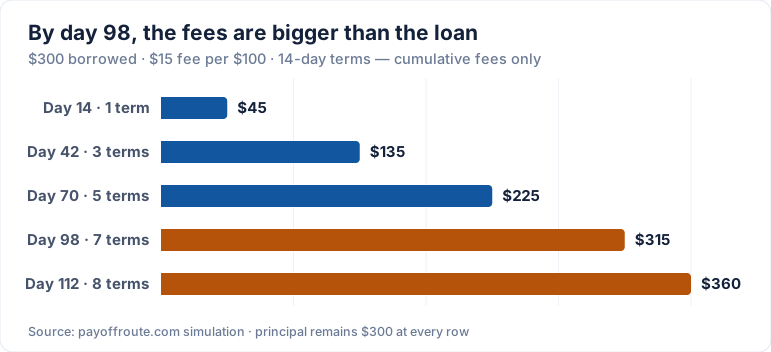
We mapped that date using the same arithmetic as our payday loan calculator. It does not depend on whether the loan was $100 or $1,000. At a $15-per-$100 fee, it is always the same: day 98, after seven 14-day terms.
Key findings
- The fee overtakes the loan on day 98. A $15-per-$100 fee is 15% each term. Seven terms cost 105% of the original principal: $315 in fees on a $300 loan, while the $300 balance has not moved by one cent.
- The threshold does not depend on loan size. The fee and the principal both scale with the amount borrowed, so the amount cancels. The same seven-term threshold applies to $100, $300, $500, or $1,000.
- Four months is enough to pay more in fees than you borrowed. At eight 14-day terms, the CFPB’s $300 / $15-per-$100 example produces $360 in fees and still leaves the original $300 due.
- A rollover is not a payment plan. In states where a no-cost extended payment plan is available, CFPB illustrates that the same $300 loan can be repaid for $345 total — the principal plus the first $45 fee — instead of continuing to add $45 every two weeks.
(Cite these figures freely with a link to this page.)
The formula: a fee clock, not a repayment schedule
The calculation is unusually simple because a rollover does not reduce principal. Let the fee be f percent of the original loan each term, and let n be the number of terms paid. Then:
Cumulative fees = original loan × fee % × terms
The fees become larger than the loan when that total is more than the original loan. Divide both sides by the original loan and the dollar amount disappears:
Terms until fees exceed principal = first whole term above 1 ÷ fee %
At 15%, 1 ÷ 0.15 is 6.67. You cannot pay two-thirds of a rollover fee, so the first whole term past the line is term seven. With a 14-day loan, that is 98 days.
This is the feature a total-cost display can make easy to miss. A $45 charge seems smaller on a $300 loan than a $75 charge on a $500 loan. But both are the same 15% rent on the same untouched principal. Both cross the line on the same date.
| 14-day terms paid | Days in debt | Fees on $300 | Principal still due | Fees as % of loan |
|---|---|---|---|---|
| 1 | 14 | $45 | $300 | 15% |
| 3 | 42 | $135 | $300 | 45% |
| 5 | 70 | $225 | $300 | 75% |
| 7 | 98 | $315 | $300 | 105% |
| 8 | 112 | $360 | $300 | 120% |
The fourth column is the whole story. It is unchanged in every row. Fees buy more time; they do not buy down the debt.
Why the CFPB’s four-month example matters
The Consumer Financial Protection Bureau describes a common $300 loan carrying a $15-per-$100 fee. The first two weeks cost $45. If the borrower cannot repay in full and the law permits a rollover, the lender can extend the due date for another fee. The CFPB’s example reaches $360 in fees after four months, with the original $300 still outstanding.
That is not a strange edge case produced by an APR formula. It is just eight repetitions of the same $45 charge:
| What happens over eight 14-day terms | Amount |
|---|---|
| Original money received | $300 |
| Fees paid to keep extending the due date | $360 |
| Principal still required to close the loan | $300 |
| Total cash required if you settle then | $660 |
The borrower has paid more than the amount borrowed in fees alone, then still needs the amount borrowed to end the sequence. Calling this a repayment plan reverses what the cash flow does. It is a renewal plan.
The CFPB reports that, in its study of state extended-payment-plan programs, rollover and default rates consistently exceeded use of those plans. That matters because these plans are structured around a different transaction: repay principal and the fee already incurred in installments, without a new rollover fee. Availability and eligibility vary by state, so ask the lender and your state regulator what applies before agreeing to any extension.
The alternative the fee schedule hides
In its example, CFPB says a borrower who chooses a no-cost extended payment plan at the first rollover would repay $345 over time: the $300 principal plus the original $45 fee. That is not free money, and it is not available everywhere. But it exposes the price of the rollover choice clearly.
| $300 loan at $15 per $100 | Amount paid | Balance after the arrangement |
|---|---|---|
| Repay on the first due date | $345 | $0 |
| No-cost extended payment plan (where offered) | $345 | $0 |
| Eight 14-day terms, then settle | $660 | $0 |
The gap is $315. That is exactly the seven extra $45 fees paid after the first term. It is not interest compounding or a late-payment penalty. It is the price of repeatedly buying the same two weeks.
A credit card is not cheap; it is still a different universe
It is tempting to dismiss APR because no one borrows a payday loan for a whole year. The relevant comparison is the same number of days. On the $300 example, eight 14-day terms is 112 days. At a 24.99% card APR, simple daily interest for that same window is about $23.00. The payday fees are $360 — about 16 times as much.
That comparison deliberately gives the card no credit for any payment made along the way. It is not an argument to carry card debt casually; 24.99% is expensive. It is a scale check: a $15-per-$100 fee is 15% for fourteen days, or about 391% when annualized. The fee’s small-looking dollar presentation is doing most of the marketing work.
If you already have a payday loan and cannot pay it in full, a better next question than “can I roll it over?” is “does my state require an extended payment plan, and do I qualify?” You can also ask the biller you were trying to pay for a payment arrangement, contact a credit union, or call 211 for local emergency assistance. Those paths are not guaranteed; they are simply worth checking before paying another full fee for an unchanged balance.
What this study does and does not claim
Classic payday lending is regulated state by state. Some states prohibit it, cap its cost, limit rollovers, or require extended payment plans; some do not. This study does not say that every lender can legally offer every rollover, nor does it model late fees, returned-payment fees, or default. It models the mechanics CFPB describes: a borrower pays the standard fee and receives another standard term with the same principal still due.
It also does not assume that a borrower had a painless alternative available. Emergencies are real, and people often use high-cost credit precisely because lower-cost credit was unavailable. The narrow claim is arithmetic: if the principal does not fall, every rollover is another full fee on the original loan. The day the cumulative fees exceed that loan is a useful warning light, not a judgment about why someone needed the money.
Methodology and sources
All tables use a $300 principal, a $15 fee per $100 borrowed, and consecutive 14-day terms. The fee per term is $300 × 15% = $45. Cumulative fees are $45 × number of terms; the model holds principal at $300 after every term because a rollover pays only the fee. The card comparison is $300 × 24.99% × 112 ÷ 365 = $23.00 and is illustrative, not a card payoff schedule.
The typical fee and rollover mechanics are from CFPB’s payday-loan cost explainer. The $300, four-month, $360-fee and $345 extended-payment-plan example is from CFPB’s 2022 report on state payday-loan extended payment plans. The model is arithmetic, not legal or financial advice; verify rules and options in your state.
Run your own numbers
Credit Card Interest Calculator
What your balance really costs: interest per day, per month, and per year — and the payment that finally beats it.
Open calculator →Loan Payoff Calculator
See how much sooner you’ll be debt-free and how much interest you save by adding extra monthly or one-time payments to any loan.
Open calculator →Payday Loan APR & True-Cost Calculator
Turn a “$15 per $100” payday fee into the real APR — often around 400% — and watch how rolling the loan over stacks fees while the balance never moves. See the cheaper alternatives, side by side.
Open calculator →Disclaimer: This article is for educational purposes only and is not financial advice. Figures are computed with the models described on our methodology page; actual loan terms depend on your lender and circumstances.