What is the real APR on a payday loan?
A payday lender rarely quotes an interest rate. It quotes a flat fee — commonly $15 to $30 for every $100 you borrow — which sounds modest next to a credit card. The catch is the calendar. That fee buys you the money for only about two weeks, so to compare it fairly to any other loan you have to annualize it. The formula is short:
APR = fee ÷ amount × (365 ÷ days) × 100
Run the typical numbers — a $500 loan, a $15-per-$100 fee ($75), due in 14 days — and you get $75 ÷ $500 × (365 ÷ 14) × 100 ≈ 391% APR. That is not a typo, and it is not an outlier: the Consumer Financial Protection Bureau puts the typical payday APR near 400%. A few worked examples, all on a 14-day term:
- $15 per $100: a 15% two-week charge → about 391% APR.
- $20 per $100: a 20% two-week charge → about 521% APR.
- $30 per $100: a 30% two-week charge → about 782% APR.
The short term is the whole story: the same dollar fee spread over a full year would be a reasonable rate, but squeezed into two weeks it annualizes into the triple digits. That is why the APR box — the one number that lets you compare any loan to any other — is the honest way to read a payday offer.
The rollover trap: fees that never touch the balance
A single payday loan repaid on time is expensive but survivable. The damage comes from the rollover (some states call it a renewal). Because the entire balance plus fee is due in one lump sum on your next payday, many borrowers cannot cover it and their whole paycheck — so the lender offers to extend the loan for another term if you just pay the fee again. You get breathing room, but you have paid down nothing: the principal is untouched, and a new fee is now ticking.
This is where a $75 fee becomes a $375 one. The arithmetic is brutally simple, because the principal never moves:
Total fees = fee per term × (rollovers + 1)
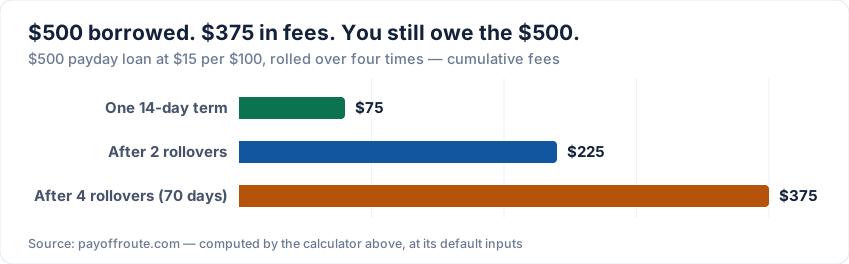
Roll a $500 loan over four times and you have paid the $75 fee five times — while still owing the original $500. Cycle by cycle, on the calculator’s defaults:
| Term | Days in debt | Fee that term | Cumulative fees | Still owe |
|---|---|---|---|---|
| Initial loan | 14 days | $75.00 | $75.00 | $500 |
| Rollover 1 | 28 days | $75.00 | $150.00 | $500 |
| Rollover 2 | 42 days | $75.00 | $225.00 | $500 |
| Rollover 3 | 56 days | $75.00 | $300.00 | $500 |
| Rollover 4 | 70 days | $75.00 | $375.00 | $500 |
Read the last two columns together: the cumulative fees climb every fortnight and the balance never moves. After 70 days you have paid $375.00 and you still owe the whole $500. The CFPB found this is the norm, not the exception: the typical payday borrower takes out 10 loans a year and spends about 200 days in debt. The calculator above lets you set the number of rollovers and shows the fees stacking up cycle by cycle, with the balance frozen in place the whole time.
What it costs versus the alternatives
The fairest way to judge a payday loan is to price the same borrowing on the tools you might use instead, over the same number of days. Borrowing $500 for 70 days costs roughly:
- Payday loan (rolled over 4×): about $375 in fees.
- Credit card at 24.99% APR: about $24 in interest.
- Personal loan at 12% APR: about $12 in interest.
Even a card's daily interest — which feels punishing at 25% — is roughly a sixteenth of what the payday loan charges for the same money over the same time. A personal loan is cheaper still. That gap is the entire case against payday borrowing: it is not that the alternatives are free, it is that they are dramatically less expensive.
Cheaper ways to cover an emergency
If you are staring down a shortfall, a payday loan is almost never your only option — it is just the most heavily advertised one. Worth checking first:
- A Payday Alternative Loan (PAL) from a federal credit union: the APR is capped at 28% and the application fee at $20 — a fraction of a payday loan's cost.
- A payment plan with the biller you are trying to pay. Utilities, medical offices, and landlords often arrange them, and they usually cost nothing.
- A paycheck advance from your employer or an earned-wage-access app, which typically costs far less than a payday fee.
- An existing credit card — even a cash advance, expensive as it is, is far below 400% APR.
- Local assistance — dialing 211 or visiting 211.org connects you to emergency help with rent, utilities, and food in your area.
None of these are as instant as a storefront payday loan, but the calculator above shows what that convenience really costs. When the alternative is a 400% APR and a real chance of the rollover cycle, an afternoon of phone calls is usually the better trade.
Frequently Asked Questions
Why is a payday loan APR so high when the fee seems small?
Because APR annualizes a fee charged over a very short term. A $15 fee on $100 is a 15% charge — but you pay it for only about two weeks, not a year. Stretch that same 15% across the 26 two-week periods in a year and it becomes roughly 391% APR. The formula is fee ÷ amount × (365 ÷ days) × 100. The short term is exactly what makes the annual rate explode, and it is why a $15-per-$100 payday loan is far more expensive than almost any credit card.
What is a payday loan rollover and why is it dangerous?
A rollover (or renewal) is when you cannot repay on your due date, so you pay just the fee to extend the loan another term. The trap is that the fee buys you time but pays down none of the principal — you still owe the full original amount, and you owe a fresh fee every term. The Consumer Financial Protection Bureau found that the typical payday borrower takes out 10 loans a year and stays in debt about 200 days. Rolling a $500 loan over four times at $15 per $100 costs $375 in fees while the $500 balance never moves.
Is a payday loan ever a good idea?
Rarely, and only for a true one-time emergency you are certain you can repay in full on the next payday without borrowing again. The danger is not a single loan — it is the cycle. Because the payment is due in one lump sum on your next payday, many borrowers come up short and roll the loan over, which is where the cost compounds. If there is any chance you will need to renew, a payday loan is usually the most expensive option on the table.
What are cheaper alternatives if I have bad credit?
Several options beat a payday loan even with damaged credit: a Payday Alternative Loan (PAL) from a federal credit union caps the APR at 28% and the application fee at $20; asking your utility, medical, or other biller for a payment plan; a paycheck advance app or an advance from your employer; or, if you have a card, even a high-APR cash advance is usually cheaper than 400% APR. Local nonprofits and 211.org can also point to emergency assistance. The calculator above shows how much less a card or personal loan would cost over the same period.
Are payday loans legal everywhere in the US?
No. Payday lending rules are set state by state. Some states cap the APR (often at 36%), which effectively bans the classic payday product, while others allow triple-digit rates. Fees, maximum loan sizes, and rollover limits all vary by state. This tool computes the true cost of whatever fee and term you enter; it does not check your state’s legal limits, so verify the rules where you live before borrowing.
Is anything I enter here stored?
No. Every calculation runs entirely in your browser. Nothing you type is saved, stored, or sent to any server.
Read more on this
Related calculators
Personal Loan
Monthly payment and true total cost of a personal loan, including the origination fee most calculators ignore.
Open calculator →Loan Payoff
See how much sooner you’ll be debt-free and how much interest you save by adding extra monthly or one-time payments to any loan.
Open calculator →Student Loan Payoff
See when your student loans actually end — and how extra payments or one-time windfalls move the date and shrink the interest.
Open calculator →Disclaimer: This calculator is for educational purposes only and provides estimates based on the numbers you enter. It is not financial, legal, or tax advice. Actual loan terms, rates, and payments depend on your lender and personal circumstances. All calculations run in your browser — nothing you enter is stored or sent anywhere.