Balance Transfer Break-Even: When the Fee Pays for Itself — The Full Tables
Every article about balance transfers repeats the same two facts: the fee is 3–5%, and 0% is better than 25%. Neither tells you the thing you actually need to know — where the line is. So we mapped it. Every figure below comes from month-by-month simulation using the same engines that power our calculators; the methodology is public, and you can reproduce any row with the balance transfer calculator.
Key findings
- The fee breaks even in days, and the balance is irrelevant. Break-even days = fee % × 365 ÷ APR. The balance cancels out of both sides, so a 3% fee equals about 44 days of your old card’s interest at 24.99% APR — the same 44 days whether you transfer $2,000 or $20,000.
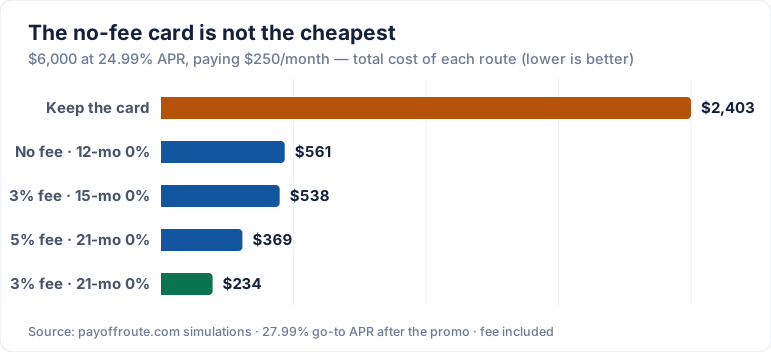
- A no-fee card can be the worst offer on the board. On $6,000 at $250/month, a no-fee card with a 12-month 0% window costs $561 all-in, while a 3%-fee card with 21 months costs $234. The runway is worth more than the fee.
- The payment nobody quotes. To clear a $6,000 transfer inside a 15-month 0% window you must pay $412 a month — more than double the ~$185 first minimum on that balance.
- At a realistic payment, most of the balance survives the promo. Paying $150/month on that same $6,000 transfer leaves $3,930 still owing when the 0% expires, and it then meets the 27.99% go-to rate.
- Transferring $6,000 at 24.99% saves $1,865 versus staying put ($2,403 in interest becomes $538 all-in, fee included) and gets you out 7 months sooner.
(Cite these figures freely with a link to this page.)
The fee, in days of interest
A transfer fee is a one-time charge. Your old card’s interest is a daily meter. So the honest way to price the fee is to ask how many days of that meter it buys back — and the arithmetic collapses to something surprisingly clean:
Break-even days = fee % × 365 ÷ APR
The balance appears in the numerator (the fee is a percentage of it) and in the denominator (the daily interest is a percentage of it), so it cancels. The break-even is a property of the rate and the fee alone:
| Your current APR | 3% fee | 5% fee |
|---|---|---|
| 18% | 61 days | 101 days |
| 22% | 50 days | 83 days |
| 24.99% | 44 days | 73 days |
| 29.99% | 37 days | 61 days |
Read that as: on a card charging 24.99%, a 3% fee costs you the same as six more weeks of carrying the debt where it is. If the balance would take longer than six weeks to clear — and on any balance worth transferring, it will — the fee has already paid for itself. This is the single most useful number in the whole decision, and it is the one no card comparison page prints. Our balance transfer fee calculator computes it for your exact numbers.
What a transfer actually saves
Holding the offer constant — a 3% fee, 0% for 15 months, 27.99% afterwards — and paying $250 a month against a 24.99% card:
| Balance | Keep the card | Transfer (fee included) | You save |
|---|---|---|---|
| $2,000 | 9 mo · $211 | 9 mo · $60 | $151 |
| $3,000 | 1 yr 2 mo · $488 | 1 yr 1 mo · $90 | $398 |
| $6,000 | 2 yr 10 mo · $2,403 | 2 yr 3 mo · $538 | $1,865 |
| $9,000 | 5 yr 8 mo · $7,801 | 3 yr 11 mo · $2,597 | $5,204 |
Two patterns. At $2,000 and $3,000 the balance clears inside the 0% window, so the entire cost of the transfer is the fee — $60 and $90 — and nothing else. At $9,000 the payment is badly outgunned by 24.99% interest, the payoff stretches to nearly six years, and the transfer saves over five thousand dollars. The worse your rate-to-payment ratio, the more a transfer is worth — which is exactly backwards from how people decide, since the people in the deepest trouble are the least likely to be approved.
The cliff nobody mentions
Extend that table one row and it breaks, in a way worth understanding rather than sensationalising. At $12,000 and $250 a month, the model says keeping the card takes 31 yr 8 mo and costs $82,901. That number is real, but it is not a typical outcome — it is the tread-water cliff.
One month’s interest on $12,000 at 24.99% is $249.90. The payment is $250. Ten cents a month goes to principal at the start, so the payoff stretches toward infinity, and the interest total balloons with it. Drop the payment to $249 and the balance never falls at all.
The lesson is not “transfer and save $73,000.” It is that there is a payment below which a balance is mathematically unpayable, and a 0% transfer is one of the very few things that moves it. If your payment is anywhere near one month’s interest, the transfer isn’t an optimisation — it’s the rescue. You can find your own tread-water line in the credit card interest calculator.
The payment the offer never quotes
A 0% window is a deadline, and the deadline implies a payment. To land at zero exactly when the promo ends, you need the transferred balance (fee included) divided by the number of months:
Required payment = balance × (1 + fee %) ÷ months of 0%
| Balance | 12-month 0% | 15-month | 18-month | 21-month |
|---|---|---|---|---|
| $3,000 | $257.50 | $206.00 | $171.67 | $147.14 |
| $6,000 | $515.00 | $412.00 | $343.33 | $294.29 |
| $9,000 | $772.50 | $618.00 | $515.00 | $441.43 |
| $12,000 | $1,030.00 | $824.00 | $686.67 | $588.57 |
The $6,000 / 15-month cell is the one to sit with: $412 a month. The first minimum payment on a $6,000 card balance at 24.99% is about $185 (interest + 1% of the balance). The offer that looks like relief actually demands more than twice the payment you were making — and if you don’t make it, the leftover meets the go-to rate. The balance transfer payoff calculator solves this number for any offer.
What survives the promo — and what it costs
Here is the same $6,000 transfer (3% fee, 15-month 0%, 27.99% afterwards) at payments people actually make:
| Your payment | Left owing when 0% ends | Debt-free in | Total cost (fee + interest) |
|---|---|---|---|
| $150 / mo | $3,930 | 4 yr 8 mo | $2,394 |
| $200 / mo | $3,180 | 3 yr | $1,020 |
| $250 / mo | $2,430 | 2 yr 3 mo | $538 |
| $300 / mo | $1,680 | 1 yr 10 mo | $321 |
| $412 / mo | $0 | 1 yr 3 mo | $180 (the fee, and nothing else) |
At $150 a month — a payment that feels responsible — two-thirds of the balance is still there when the music stops, and it lands on a rate higher than the card you left. The transfer still beats staying put, but it costs $2,394 instead of $180. The gap between those two numbers is entirely a function of the payment, not the offer.
No fee, or a longer runway?
This is the question the “best 0% cards” lists never answer, because answering it requires simulating the tail. Same $6,000, same 24.99% old card, same $250 a month:
| Offer | Fee | Debt-free in | Total cost | Saved vs keeping the card |
|---|---|---|---|---|
| Keep the card | — | 2 yr 10 mo | $2,403 | — |
| No fee · 12-month 0% | $0 | 2 yr 3 mo | $561 | $1,842 |
| 3% fee · 15-month 0% | $180 | 2 yr 3 mo | $538 | $1,865 |
| 5% fee · 21-month 0% | $300 | 2 yr 2 mo | $369 | $2,035 |
| 3% fee · 21-month 0% | $180 | 2 yr 1 mo | $234 | $2,169 |
The no-fee card — the one that looks free — is the most expensive transfer on the list. Its 12-month window ends while $3,000 is still outstanding, and that remainder spends the next year at 27.99%, quietly costing more than the $180 fee it saved you. Even a 5% fee with 21 months beats a 0% fee with 12.
The rule this produces is simple and, as far as we can find, published nowhere else:
Buy runway, not a discount. Choose the longest 0% window you can get, and treat the fee as the price of the runway. The fee is a one-time cost measured in days of interest; the window is measured in months. Months win.
The exception is the case where the fee genuinely dominates: a balance you would clear inside the shorter window anyway. If $6,000 at $600 a month clears in 11 months, the 12-month no-fee card wins outright, because the runway you paid for goes unused.
When a transfer is not worth it
Three cases, and they are narrower than people assume:
- You’ll clear the balance in under the break-even window. At 24.99%, a 3% fee is 44 days of interest — so a balance you’ll wipe out in a month or two doesn’t justify it.
- Your current APR is genuinely low. At 10% APR a 3% fee costs 110 days of interest, and the maths gets thin.
- You’ll keep spending on the old card. Every model here assumes no new purchases. A transfer that frees up a card you then re-load doesn’t reduce your debt; it duplicates it.
Notice what is not on that list: “the fee is too high.” At any rate above roughly 20%, on any balance you can’t clear in a couple of months, the fee is a rounding error next to the interest it retires. The thing that actually decides the outcome is the payment, and the second is the length of the window. The fee is a distant third.
Methodology
Month-by-month simulation: interest accrues at APR ÷ 12 on the current balance, then the payment is applied; the intro APR applies for the promo months and the go-to APR from the month after. Balances are considered cleared below half a cent; simulations cap at 100 years. The transfer fee is a percentage of the transferred balance, added to the new balance on day one, and is included in every “total cost” figure. Break-even days use the old card’s daily interest, balance × APR ÷ 36,500. No new purchases, late fees, penalty APRs, or deferred-interest offers are modeled — store-card “special financing” behaves very differently, and if any balance remains at the deadline it can charge interest retroactively on the entire original amount. Every figure is reproducible in the balance transfer calculator; full assumptions on our methodology page.
Run your own numbers
Balance Transfer Calculator
Is a 0% balance transfer worth the fee? Compare keeping your card vs transferring, month by month.
Open calculator →Balance Transfer Fee Calculator
What the 3–5% transfer fee costs in dollars, how many days of interest it buys back, and the exact balance where it stops being worth paying.
Open calculator →Balance Transfer Payoff Calculator
The exact monthly payment that clears your transferred balance before the 0% window shuts — and what the leftover costs if you miss the deadline.
Open calculator →Disclaimer: This article is for educational purposes only and is not financial advice. Figures are computed with the models described on our methodology page; actual loan terms depend on your lender and circumstances.