What payment clears a balance transfer before 0% ends?
A balance transfer gives you a fixed, interest-free runway — and a hard deadline at the end of it. Whether the deal works comes down to a single figure: the payment that retires the whole balance, fee included, before the runway ends. It isn’t a matter of opinion or willpower; it’s arithmetic you can do in one line.
Required payment = (balance × (1 + fee%)) ÷ intro months
The fee matters because it is added to your balance on day one, so you are paying it down along with everything else. Transfer $6,000 at a 3% fee and you don’t owe $6,000 — you owe $6,180, and that is the number the promo clock is racing. Divide it by the number of intro months and you have the payment that lands you at exactly $0 on the deadline.
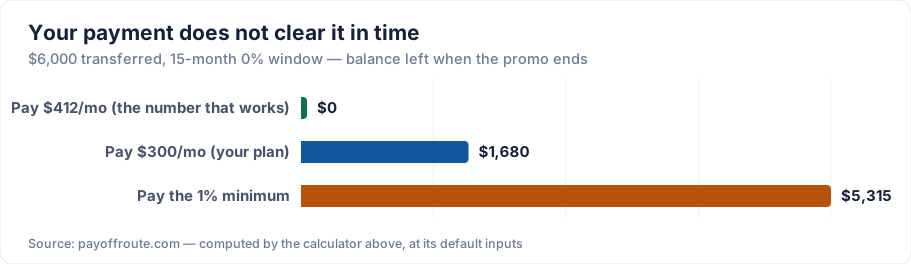
Here is what four different monthly payments do to the same offer — a $6,000 balance, a 3% fee ($180), 0% for 15 months, then 27.99%. These are the figures the calculator above produces:
| Monthly payment | Left when promo ends | Payoff time | Interest paid | Total cost (fee included) |
|---|---|---|---|---|
| $412.00 (required) | $0 | 1 yr 3 mo | $0 | $180 |
| $300.00 | $1,680 | 1 yr 10 mo | $141 | $321 |
| $200.00 | $3,180 | 3 yr | $840 | $1,020 |
| 1% minimum (~$61.80 to start) | $5,315 | — | — | — |
The last row is deliberately blank past the deadline. A shrinking 1%-of-balance minimum barely converges at all, so the calculator models it only through the promo window and reports what it leaves behind rather than inventing a payoff date for it. That number — $5,315 of the original $6,180 still owing — is the whole warning.
One caveat: this clean division only holds when the intro rate is a genuine 0%. If your offer carries a small intro APR — some do — the required payment becomes a standard amortisation payment instead, slightly higher because a little interest is accruing along the way. The calculator above handles both cases; it computes the true amortisation payment whenever the intro APR isn’t zero, so the number it shows is always the one that actually clears the balance in time.
The worked example
Take the calculator’s defaults: a $6,000 balance, a 3% transfer fee, a 0% intro rate for 15 months, and a 27.99% APR waiting on the other side. The moment the transfer posts, the 3% fee — $180 — is added to the balance, so you begin the promo owing $6,180, not $6,000.
Divide $6,180 by 15 months and the required payment is $412 a month. Pay that, set to autopay on the day the account opens, and the balance hits zero precisely as the 0% period expires. Total cost: the $180 fee and not a cent of interest.
Now suppose $412 is more than your budget and you pay $300 a month instead — a perfectly reasonable-sounding number. Over 15 months you pay down $4,500, which leaves exactly $1,680 still owing when the promo ends. That $300 payment is $112 a month short of the mark, and the gap doesn’t vanish — it lands on the far side of the deadline at 27.99%, where it takes seven more months and $141 in interest to clear, pushing the total cost from $180 to $321. The difference between finishing free and finishing in the red was $112 a month you may not have known you needed.
Why the minimum payment is the trap
Every card shows you a minimum payment, and on a 0% balance it is dangerously easy to pay. Minimums are engineered to feel comfortable — typically around 1% of the balance plus any interest — and because a true 0% promo isn’t charging interest, the minimum is often just that 1%. On a $6,180 balance that’s about $62 to start, shrinking every month as the balance falls.
Paying it feels responsible. Nothing is accruing, the statement says the minimum due is covered, and the deadline is comfortably far away. That is exactly the trap. Run the calculator’s 1%-minimum line and you’ll see where comfort leads: making only the shrinking minimum for the full 15 months leaves more than $5,300 of the original $6,180 still owing when the promo ends. You will have spent more than a year barely moving the needle, and then the entire remainder reprices to the standard APR. The minimum payment is not a plan; it is the absence of one, dressed up to look safe.
The cliff
Whatever survives the promo doesn’t drift gently into a normal interest rate. It hits a cliff. The post-promo APR on transfer cards is routinely in the high twenties — often higher than the rate on the card you left. People transfer to escape a 24% card and, if they miss the deadline, land on a 28% one. The offer was never charity; the leftover balance at the standard rate is precisely how the issuer makes its money.
There is a second, quieter clock problem. The intro window almost always starts counting from the day the account is opened, not from the day your transfer posts — and a transfer can take one to three weeks to go through. If your card advertises “15 months,” you may effectively have fourteen by the time the balance actually lands. Assume you have less time than the headline promises, size your payment to the shorter window, and start paying the day the account opens rather than the day the balance shows up.
True 0% vs deferred interest
Not every “0%” offer is the same, and the difference can be brutal. A true 0% promo — the kind on most bank-issued balance transfer cards — means what it says: if a balance remains at the deadline, interest starts accruing on that remainder from that point forward, and only on what’s left. That’s the case the worked example above describes.
Deferred interest is a different animal, common on store cards and “special financing” promotions. Interest is quietly accruing the entire time — it’s just being deferred, not waived. Clear the balance before the deadline and the deferred interest disappears. But leave even a dollar on the books, and the issuer charges you all of that accrued interest retroactively, as a lump, as though the 0% never existed. A promo that looked identical to a true 0% suddenly costs hundreds more.
When you select the deferred option, this calculator estimates that retroactive charge by accruing the post-promo rate on your declining balance through the window — a reasonable middle-ground assumption. Be warned that some issuers are harsher and compute the deferred interest on the full original amount, ignoring every payment you made; that version costs even more, so read your agreement to learn which one you hold. As a rule of thumb: bank balance-transfer cards typically do not defer, while retail store-card financing frequently does.
Set autopay at the required number
If there is one behavioural move that defeats the whole trap, it’s this: on the day the account opens, set up autopay for the required payment — the exact figure the calculator gives you, not the minimum the card suggests. Automate it and the deadline can’t sneak up on you, because the math is already handled every month without a decision to make.
A few guardrails make that autopay stick:
- Don’t spend on the card. New purchases usually don’t get the 0% rate — they accrue at the regular APR from day one — and payment-allocation rules can make the accounting work against you. Treat the transfer card as a payoff vehicle, not a wallet card.
- A single late payment can void the promo. Most agreements let the issuer cancel the 0% rate after one missed due date and reprice your entire balance immediately. Autopay at least the minimum protects the offer itself; autopay the required amount protects the deadline.
- Your transfer limit may be below your credit limit. You might be approved for a card but allowed to move only part of your balance, and you won’t know the number until after approval. Have a plan for the stranded remainder if the full balance won’t fit.
If you can’t afford the required payment
Suppose the calculator says $412 and your honest budget is $300. You are not out of options — but the most honest answer might be that a transfer isn’t the right tool, or isn’t the whole tool. Paying a fee to move debt you can’t clear in time just means paying the fee and facing the cliff.
Two approaches are worth running. The first is a split: transfer only the slice you can realistically pay off inside the window — your monthly budget times the intro months — and handle the rest with a fixed-rate personal loan that amortises on a schedule with no deadline. Each dollar sits at the cheapest rate available to it, and nothing is left exposed to the post-promo cliff. Our personal loan vs balance transfer calculator weighs those two paths against each other with the same budget.
The second is to skip the transfer entirely and attack the debt where it sits. If your current APR isn’t wildly high and you can commit a fixed payment, a disciplined payoff with no new account, no fee, and no deadline can beat a transfer you’d never finish in time. Our credit card payoff calculator shows exactly how fast a given monthly payment clears your existing balance. The point of this tool isn’t to talk you into a transfer — it’s to show you the payment that makes one work, so you can decide with the real number in front of you.
Before you transfer at all
This calculator assumes you’ve already decided to transfer and just need the payment that finishes the job. Two earlier questions are worth settling first. Is the fee even worth paying? Our balance transfer calculator compares keeping your current card against moving to the 0% offer, fee included, so you can see whether the interest you’d avoid actually beats the cost of admission. And how much is that admission in plain dollars? The balance transfer fee calculator turns the fee percentage into the exact amount added to your balance.
It also helps to know what you’re escaping. If you want to see how much your current card is costing you in interest month after month — the ongoing bleed a transfer is meant to stop — our credit card interest calculator lays it out. Settle those questions, then come back here for the one number that decides whether the transfer actually pays off: the payment that clears it before 0% ends.
Frequently Asked Questions
What payment do I need to clear a balance transfer before 0% ends?
Divide the balance you’re transferring, plus the transfer fee, by the number of intro months. A $6,000 balance at a 3% fee becomes $6,180, and over a 15-month promo that’s $412 a month to reach zero exactly on the deadline. If your intro rate isn’t a true 0% but a small positive APR, the figure becomes a standard amortisation payment, slightly higher to cover the interest accruing along the way. The calculator computes both cases and shows the exact payment for your numbers.
What happens to the leftover balance when the promo expires?
On a true 0% offer, whatever remains on the deadline simply begins accruing interest at the card’s standard APR from that day forward — often a rate in the high twenties, higher than the card you left. Nothing is charged retroactively; only the surviving balance is affected. On a deferred-interest offer it’s far worse: the issuer charges all the interest that quietly accrued during the promo as a retroactive lump. Either way, the leftover balance is where transfer offers make their profit, which is why finishing in time matters.
Does the 0% clock start when I open the card or when the transfer posts?
Almost always when the account is opened, not when your balance actually moves. Because a transfer can take one to three weeks to process, a card advertising a 15-month promo may effectively give you fourteen usable months once the balance lands. Treat the headline number as an optimistic ceiling: size your required payment to a slightly shorter window, and begin paying the day the account opens rather than waiting for the transferred balance to appear on your statement. The safety margin costs you nothing and protects the deadline.
What is deferred interest and how do I know if my offer has it?
Deferred interest means interest is accruing during the promo but is only charged if you fail to clear the balance in time — at which point the issuer bills all of it retroactively, as though the 0% never applied. A true 0% offer, by contrast, only charges interest going forward on whatever remains. The tell is usually the source: bank-issued balance transfer cards typically offer true 0%, while store-card “special financing” promotions frequently use deferred interest. The only sure way to know is to read the offer terms — look for the phrase “deferred interest.”
Can I do a second balance transfer for the remainder?
Sometimes, but treat it as a backup rather than a plan. Moving a leftover balance to a fresh 0% card can buy more interest-free time, but it depends on qualifying again at the future date — another hard inquiry, another fee, and no guarantee the new limit will be large enough to hold the remainder. Issuers also watch for repeat transfers. If your credit is strong and an offer is available, it can work; but building your payment around a second transfer you can’t count on is how people end up stranded at the post-promo rate.
Do new purchases get the 0% rate?
Usually not. On most balance transfer cards the 0% applies only to the transferred balance; new purchases accrue interest at the regular APR from the day you make them. Worse, payment-allocation rules often direct anything above the minimum toward the lowest-rate balance first, so your purchase balance can sit and compound while your payments chip away at the 0% portion. The clean fix is simple: don’t spend on the transfer card at all. Use it as a dedicated payoff vehicle and keep everyday spending on a different card.
Is my information stored?
No. All calculations happen in your browser. Nothing you enter is saved or transmitted anywhere.
Read more on this
What Is a Balance Transfer Fee — and How Do You Calculate It?
What a balance transfer fee is, how to work out the exact dollar cost, the typical 3–5% range, when no-fee offers make sense, and the one number that tells you if it is worth paying.
Read →Balance Transfer Break-Even: When the Fee Pays for Itself — The Full Tables
Original data: exactly how many days of interest a 3% or 5% transfer fee buys back, the payment needed to clear the balance before 0% ends, and why a no-fee card can be the most expensive offer on the board.
Read →Related calculators
Credit Card Payoff
Compare the snowball and avalanche strategies across all your cards and see how much interest each plan saves.
Open calculator →Balance Transfer
Is a 0% balance transfer worth the fee? Compare keeping your card vs transferring, month by month.
Open calculator →Loan vs Transfer
The two main escapes from card debt, compared honestly: fixed-rate loan vs 0% intro offer, fees included, same monthly budget.
Open calculator →Disclaimer: This calculator is for educational purposes only and provides estimates based on the numbers you enter. It is not financial, legal, or tax advice. Actual loan terms, rates, and payments depend on your lender and personal circumstances. All calculations run in your browser — nothing you enter is stored or sent anywhere.