0% Financing or the Cash Rebate? The Break-Even Map
Every car dealer runs the same fork: 0% financing, or cash back — pick one. They are the same subsidy from the manufacturer, handed to you in different currencies, and the salesperson is rarely neutral about which you take. So we mapped the decision. Every figure below comes from the same engine that powers our calculators; the methodology is public, and you can reproduce any row in the 0% financing vs cash rebate calculator.
Key findings
- Take the 0%, almost every time. On a $35,000 car with a $2,000 rebate over 60 months, the 0% financing beats the rebate by $4,206 at a 7% alternative loan — and it still wins by $578 at 3%, a rate almost no car buyer is ever offered.
- The whole decision collapses to one number: the break-even rate. On those figures it is 2.3%. Below it, take the rebate. Above it, take the 0%. There is nothing else to weigh.
- The rule of thumb the whole internet repeats is calibrated to a $25,000 car. “A $1,000 rebate is worth about 2% of rate over 48 months” is almost exactly right — at $25,000 (the true figure is 2.0%). On a $50,000 car the true break-even is 1.0%, so the rule overstates the rebate by roughly double — and it errs in the direction that costs you money.
- A longer loan makes the 0% worth more, not less. This inverts the usual rule that longer terms are worse. At 0% there is no interest to pay, so a longer term means more interest avoided.
- The rebate wins in one corner: big rebate, short term. At $5,000 over 36 months the break-even is 10.3% — above a normal auto rate, so there the cash is the better deal.
(Cite these figures freely with a link to this page.)
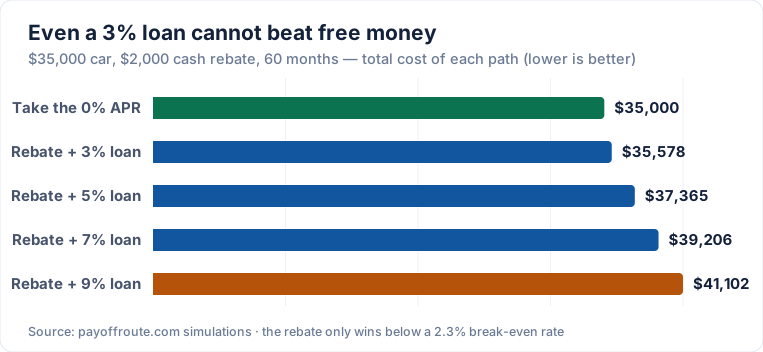
Why free money usually beats a discount
The two offers look comparable because they are both “money off”. They are not comparable at all, because one is a fixed amount and the other is a percentage of a large number, compounded over years.
Take the 0%: you finance the full price and pay no interest, so your total cost is exactly the price. Take the rebate: you finance a smaller amount — but at a real rate, for years.
| Take the 0% APR | Take the $2,000 rebate | |
|---|---|---|
| Amount financed | $35,000 | $33,000 |
| Monthly payment | $583.33 | $653.44 |
| Interest paid | $0 | $6,206 |
| Total cost | $35,000 | $39,206 |
$35,000 car, nothing down, 60 months, 7% alternative loan.
Note the payment column, because it is the trap in miniature: the 0% path is $70 a month cheaper and costs $4,206 less overall. The rebate makes the sticker smaller and the loan bigger. Waiving five years of interest on $35,000 is simply worth more than $2,000 off the price — and it is not close.
The break-even map
There is exactly one rate at which the two offers tie: the rate at which the interest on the discounted price equals the rebate itself. Below it, take the cash. Above it, take the 0%.
Here is that break-even rate across the offers you are likely to be shown, on a $35,000 car with nothing down:
| Cash rebate | 36 months | 48 months | 60 months | 72 months |
|---|---|---|---|---|
| $1,000 | 1.9% | 1.4% | 1.1% | 1.0% |
| $2,000 | 3.9% | 2.9% | 2.3% | 2.0% |
| $3,000 | 5.9% | 4.5% | 3.6% | 3.0% |
| $5,000 | 10.3% | 7.8% | 6.2% | 5.2% |
Now read it against the rate you would actually be offered on a car loan. Most of this table sits below it. That is the whole finding: for ordinary rebates on ordinary terms, the break-even is so far under a real auto rate that the 0% wins without a contest.
The exception lives in the top-left corner — a big rebate on a short term. At $5,000 over 36 months the break-even climbs to 10.3%, above a normal auto rate, and there the cash is worth more than the interest it would have saved you.
The rule of thumb has an expiry date inside it
Search this question and the same shortcut appears everywhere: “a $1,000 rebate is worth about 2% of interest rate over 48 months, or 1.5% over 60.” We ran it against the true break-even, and it is not wrong so much as stale:
| Car price ($1,000 rebate) | True break-even, 48 mo | True break-even, 60 mo |
|---|---|---|
| $25,000 | 2.0% | 1.6% |
| $35,000 | 1.4% | 1.1% |
| $50,000 | 1.0% | 0.8% |
Look at the first row. The rule is almost exactly right — on a $25,000 car. That is the vehicle it was calibrated for, and nobody re-derived it as cars got more expensive.
Push the price to $50,000 and the true break-even falls to 1.0%, meaning the rule overstates the rebate by about double. And it fails in the one direction that costs you money: it argues you into the rebate at rates where the 0% was worth more. The rule ignores the car’s price entirely — and the price is one of the three inputs that decide the answer. That is not a rounding error; it is a missing variable.
The longer the loan, the more the 0% is worth
Here is the finding that surprises people, because it inverts the advice they have absorbed everywhere else: for this decision, a longer term makes the 0% offer better.
Follow the $2,000 row across: the break-even falls from 3.9% at 36 months to 2.0% at 72. A lower break-even means the rebate needs an ever-cheaper loan to compete — which is another way of saying the 0% is winning by more.
The logic is simple once stated. The value of a 0% offer is the interest it waives, and a longer loan has more interest to waive. Stretch the term and you hand the 0% more to save you.
This does not mean you should take a longer loan. It means that given a long loan, the 0% is the more valuable of the two incentives. Keep the decisions separate: choose the incentive with this map, then choose the shortest term you can comfortably afford — a shorter 0% loan costs exactly the same in total, and gets you out of the debt sooner.
Correction: the 2025 tax deduction moves these numbers
Every break-even on this page was computed without a tax deduction that now exists, and we should have caught it sooner.
The 2025 tax law made car loan interest deductible — up to $10,000 a year, for new, US-assembled vehicles, on loans taken after 2024, for tax years 2025 through 2028. And it contains a twist that lands squarely on this page:
0% financing pays no interest. No interest means no deduction. The one offer that looks free is the only one with nothing to write off.
For a single filer at a $90,000 MAGI in the 22% bracket, the rebate path’s $6,206 of interest hands back $1,126 of tax over the three deductible years that remain. The 0% path gets nothing.
- The 0% offer still wins — but by $3,080, not the $4,206 quoted above.
- The break-even rises from 2.3% to 2.9%.
The conclusion of this study does not change: take the 0% almost every time. But the margin is narrower than we said for buyers whose car qualifies, and the map above is the pre-tax map. Our car loan interest deduction study works through this in full — including the fact that a typical car loan’s deduction is worth nothing above a $111,000 MAGI, not the $150,000 everyone reports. The calculator now models the deduction; the figures on this page are what it prints with the deduction switched off.
What actually decides it
Three things, and one that comes before them:
- The size of the rebate — a fixed amount, so it wins when it is large.
- The length of the term — a longer loan gives the 0% more interest to waive.
- The price of the car — the bigger the loan, the more interest the 0% is waiving. This is the variable the rule of thumb forgets.
And before any of it: you have to qualify for the 0%. Those offers are usually reserved for the top credit tier. Cash rebates generally are not credit-gated — the discount is the discount. So for a great many buyers the honest question is not which is better but which one am I actually being offered, and if the answer is the rebate, it is still real money.
One last thing, and it can quietly erase the entire gain: negotiate the price before you choose the incentive. A salesperson who presents “$2,000 off” as their concession — when $2,000 was the manufacturer’s rebate all along — has given you nothing at all. Settle the price as though no incentive existed, then apply this map to the number you agreed.
Methodology
The 0% path finances the price less any down payment at a 0% rate, so its total cost is the price. The rebate path finances the price less the rebate less the down payment, at the stated APR, using the standard amortizing payment; its total cost is the down payment plus every scheduled payment. The break-even rate is found by bisection on the APR at which the two totals are equal, and it always exists, because at a 0% market rate the rebate wins by definition. Taxes, fees, and trade-in equity are excluded — they apply to both paths and do not change which one wins, though a larger down payment does shift the answer toward the rebate, which the calculator accounts for. Full assumptions on our methodology page.
Run your own numbers
Auto Loan Payoff Calculator
Pay the car off early: what extra payments save in interest, and how fast you can get right-side-up on the loan.
Open calculator →Loan Comparison Calculator
Two offers, one honest answer: payments, fees, effective APR, and total cost side by side — even when the terms differ.
Open calculator →0% Financing vs Cash Rebate Calculator
The dealer offers 0% APR or cash back — never both. See which one actually costs less, and the break-even rate below which the rebate wins.
Open calculator →Disclaimer: This article is for educational purposes only and is not financial advice. Figures are computed with the models described on our methodology page; actual loan terms depend on your lender and circumstances.