Is 0% financing better than a cash rebate?
Usually yes — and by more than most buyers expect. The two offers are the same subsidy from the manufacturer, handed to you in different currencies: the 0% pays your interest, the rebate cuts your price. Which is worth more depends on how much interest there was to avoid, and at today’s auto rates there is a lot of it.
The comparison reduces to two totals. Taking the 0%, you finance the full price and pay no interest at all, so your total cost is simply the price. Taking the rebate, you finance a smaller amount — but at a real interest rate:
0% path = price · Rebate path = monthly payment on (price − rebate − down) × months
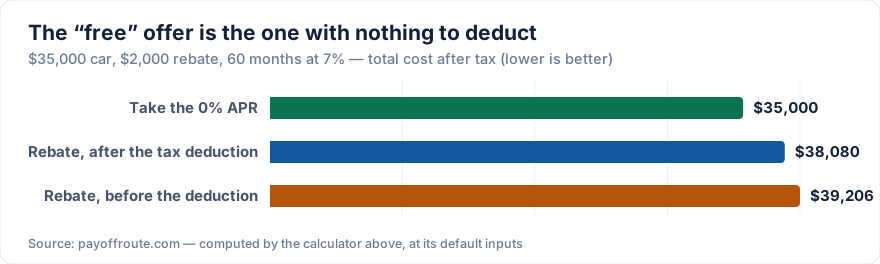
Run the defaults — a $35,000 car, a $2,000 rebate, nothing down, and a 7% loan over 60 months — and the numbers separate fast. The 0% path finances $35,000 at $583.33 a month and costs $35,000. The rebate path finances $33,000 at $653.44 a month, pays $6,206 in interest, and costs $39,206. Free money on $35,000 for five years is worth far more than $2,000 off the sticker.
The break-even rate — the number that settles it
There is exactly one rate at which the two offers tie: the rate where the interest you would pay on the discounted price equals the rebate itself. Below it, take the rebate. Above it, take the 0%. Everything else is noise.
Here is that break-even rate on a $35,000 car with nothing down. Compare it to the rate you would actually be offered:
| Cash rebate | 36 months | 48 months | 60 months | 72 months |
|---|---|---|---|---|
| $1,000 | 1.9% | 1.4% | 1.1% | 1.0% |
| $2,000 | 3.9% | 2.9% | 2.3% | 2.0% |
| $3,000 | 5.9% | 4.5% | 3.6% | 3.0% |
| $5,000 | 10.3% | 7.8% | 6.2% | 5.2% |
Read it against reality. Most of this table sits below the rate an ordinary buyer is offered on a car loan, which is why the 0% wins most of the time. The rebate only claws its way back at the top-left corner — a big rebate on a short term. At $5,000 over 36 months the break-even is 10.3%, comfortably above a normal auto rate, so there the rebate is the right call.
The rule of thumb everyone repeats — and why it costs you money
Search this question and you will meet the same shortcut everywhere: “a $1,000 rebate is worth about 2% of rate over 48 months, or 1.5% over 60.” We tested it against the actual break-even, and it turns out to be a rule with an expiry date hidden inside it:
| Car price ($1,000 rebate) | True break-even, 48 mo | True break-even, 60 mo |
|---|---|---|
| $25,000 | 2.0% | 1.6% |
| $35,000 | 1.4% | 1.1% |
| $50,000 | 1.0% | 0.8% |
The rule is almost exactly right — on a $25,000 car. That is the price it was calibrated for, and nobody updated it as cars got more expensive. On a $50,000 vehicle the true break-even is 0.8–1.0%, so the rule overstates the rebate by roughly double. And it errs in the one direction that costs you money: it talks you into the rebate when the 0% was worth more. The rule ignores the car’s price entirely — and the price is one of the three things that decide the answer.
When the rebate really is the better deal
It is not always the 0%. Three conditions push the answer the other way, and they compound:
- A large rebate. The rebate is a fixed amount of money; the interest you avoid is not. Once the rebate is a serious fraction of the price, it wins.
- A short term. Fewer months means less interest on the rebate path — so less for the 0% to save you. This is the reverse of the usual rule that shorter is better; here a shorter term makes the 0% less valuable.
- A big down payment. Every dollar you put down is a dollar the 0% is not saving you interest on. Pay entirely in cash and the rebate wins outright, because there is no loan left for the 0% to be free on.
And one condition that decides it before you even get to the maths: you have to qualify for the 0%. Those offers are usually reserved for the top credit tier. If you do not qualify, the rebate is not the worse option — it is the only option, and it is still real money. If you are financing the rest at a high rate, the auto loan payoff calculator shows what extra payments claw back, and the loan comparison calculator weighs two outside lenders against each other before you walk into the showroom.
Negotiate the price first — always
One trap worth naming, because it can quietly erase the whole gain. The incentive and the price are separate negotiations, and folding them together is how a weak price gets dressed up as a strong one. A salesperson who presents “$2,000 off” as their concession, when $2,000 was the manufacturer’s rebate all along, has given you nothing.
Settle the vehicle price as if no incentive existed. Only then choose between the 0% and the cash, using the price you actually agreed. The comparison above is only as honest as the number you put into it.
Frequently Asked Questions
Why can’t I take the 0% financing and the cash rebate together?
Because they are the same money, offered two ways. Both are subsidies the manufacturer pays to move the car: one arrives as a cheaper loan, the other as a discount on the price. Dealers present them as alternatives precisely because the maker will fund one incentive per vehicle, not two. A few promotions do allow a small rebate alongside a reduced (not zero) APR, so read the offer sheet — but "0% or cash back" is the normal shape of the deal.
Do I need good credit to get 0% financing?
Usually, yes. Zero-percent offers are typically reserved for buyers in the top credit tier — commonly a score around 700–720 or higher, and often much higher. Cash rebates, by contrast, are generally not credit-gated: the discount is the discount. That asymmetry matters, because it means the honest question for many buyers is not "which is better" but "which one am I actually offered." If you do not qualify for the 0%, the rebate is not a choice — it is the deal.
Is a longer loan term better with 0% financing?
For this comparison, yes — and it is the opposite of the usual advice. A longer term normally costs you more because you pay interest for longer. But at 0% there is no interest to pay, so a longer term means you are avoiding *more* interest than you would have paid on the rebate path. That makes the 0% offer worth more, not less. Just keep the two decisions separate: take the 0%, and if you can afford a shorter term, take that too — a shorter 0% loan costs exactly the same in total.
Does the down payment change which offer wins?
Yes, and in the rebate’s favour. A down payment shrinks the amount you finance, which shrinks the interest on the rebate path — while the 0% path has no interest to shrink. So the more you put down, the more competitive the rebate becomes. Pay entirely in cash and the rebate wins outright, because there is no financing left for the 0% to be free on. The calculator above accounts for this.
Should I negotiate the price before or after choosing?
Before, and separately. Negotiate the vehicle price first, as if no incentive existed, and only then decide between the 0% and the rebate. Salespeople sometimes fold an incentive into the "discount" they appear to be giving you, so the rebate can be quietly used to make a weak price look strong. Settle the price, then apply this comparison to the price you actually agreed.
Is my information stored?
No. Every calculation runs entirely in your browser. Nothing you enter is saved, stored, or sent to any server.
Read more on this
0% Financing or the Cash Rebate? The Break-Even Map
Original data: the exact rate below which taking a car dealer’s cash rebate beats their 0% financing — mapped across every rebate size, term and price. Plus why the rule of thumb everyone repeats is calibrated to a car that barely exists any more.
Read →The Car Loan Deduction Dies at $111,000, Not $150,000 — and 0% Financing Kills It Outright
Original data: the 2025 car loan interest deduction phases out by a flat dollar amount, not a percentage. A typical car loan's deduction is worth nothing above a $111,000 MAGI. And 0% financing, having no interest, has nothing to deduct.
Read →Related calculators
Personal Loan
Monthly payment and true total cost of a personal loan, including the origination fee most calculators ignore.
Open calculator →Loan Payoff
See how much sooner you’ll be debt-free and how much interest you save by adding extra monthly or one-time payments to any loan.
Open calculator →Student Loan Payoff
See when your student loans actually end — and how extra payments or one-time windfalls move the date and shrink the interest.
Open calculator →Disclaimer: This calculator is for educational purposes only and provides estimates based on the numbers you enter. It is not financial, legal, or tax advice. Actual loan terms, rates, and payments depend on your lender and personal circumstances. All calculations run in your browser — nothing you enter is stored or sent anywhere.