Which loan offer is actually cheaper?
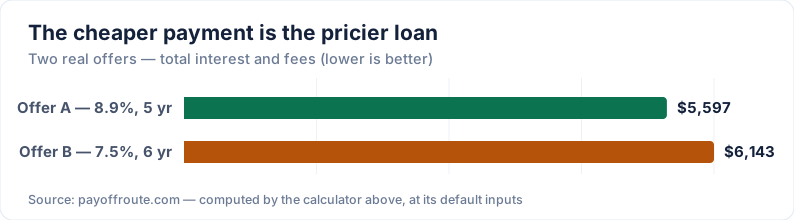
Put two loan offers next to each other and your eye goes straight to the monthly payment — it's the number you'll feel every month, so it seems like the number that matters. But the payment is the easiest figure in lending to manipulate, and the lever is the term. Stretch any loan over more months and the payment drops, no matter how expensive the loan actually is. On the default numbers above, Offer B's payment is about $64 lower than Offer A's — and Offer B still costs roughly $545 more over the life of the loan, because you make twelve extra payments to get that smaller number.
Two short formulas do all the work. The fee is financed here — it rides on top of what you borrow, so you pay interest on the fee itself for the whole term:
Financed balance = amount + (amount × fee %)
Total cost = (monthly payment × months) − amount borrowed
Run the two default offers through both, and the trap is plain to see. Every figure below is what the calculator above returns for a $20,000 loan:
| Offer A | Offer B | |
|---|---|---|
| Advertised APR | 8.9% | 7.5% |
| Term | 5 years (60 months) | 6 years (72 months) |
| Fee financed | $600 (3%) | $1,000 (5%) |
| Monthly payment | $426.62 | $363.09 |
| Total interest + fees | $5,597 | $6,143 |
| Effective APR | ≈ 10.2% | ≈ 9.3% |
Offer B has the lower rate and the lower payment and the lower effective APR — and still costs $545 more. Nothing about it is a bad loan; it is simply being paid for twelve months longer. That is the single most useful thing this table teaches: a cheaper rate and a cheaper loan are different questions, and only the total-cost row answers the second one.
That is why this calculator hands down two separate verdicts instead of one: cheaper per month and cheaper total cost. When the same offer wins both, the decision is easy and the tool says so. When the verdicts split — which happens constantly, because lenders know a low payment sells — the tool spells out exactly what the smaller payment is costing you. A lower payment is a genuine benefit if your budget is tight; it is just not the same thing as a cheaper loan, and conflating the two is the single most common mistake borrowers make when comparing offers.
Effective APR: the one number that includes the fee
The second place comparisons go wrong is the origination fee. Many lenders charge one — commonly 0% to 10% of the loan — and this calculator models it as financed: added on top of what you borrow, so a $20,000 request with a 5% fee starts life as a $21,000 balance. You then pay interest on the fee itself, every month, for the whole term. A loan advertised at 7.5% with a 5% financed fee does not cost you 7.5% a year; it costs meaningfully more.
Three different numbers get called "the rate," and it pays to keep them straight in plain words. The advertised rate is the interest charged on the balance — the big number in the ad. The APR is the legally disclosed figure that folds required fees into an annual cost; it is always the better comparison number, but lenders compute it under Truth in Lending assumptions about how the fee is collected. The effective APR shown above is our version of the same idea, computed consistently for both offers: the annual rate that would produce each offer's actual payment stream on the cash you actually asked for. On the defaults, Offer A's 8.9% advertised rate becomes an effective ≈10.2%, and Offer B's 7.5% becomes ≈9.3%. The gap between sticker and effective is the fee, translated into the only language that allows a fair comparison — a rate.
Notice what the fee does to short loans in particular. A financed fee is a fixed cost, so the fewer months you spread it across, the more it inflates each year's true cost. A 5% fee on a 2-year loan adds roughly five points to the effective rate; on a 7-year loan, barely one and a half. That is why a no-fee offer at a visibly higher rate often wins for short terms — and why you should run the numbers rather than trust intuition.
Same-term or it isn't fair
When two offers carry different terms, comparing their total costs directly is quietly unfair — the longer loan carries more months of interest by construction, not necessarily because it is a worse deal. So the calculator runs one more check automatically: Offer B recomputed at Offer A's term. That single line is often the most revealing number on the page. On the defaults, Offer A wins the raw total-cost comparison — but recompute Offer B at the same 5-year term and it costs about $5,248 in interest and fees against Offer A's $5,597. Offer B is actually the better loan; its longer term was making it look worse. The right move in that situation isn't to take Offer A — it's to ask Offer B's lender for the shorter term, or simply take Offer B and pay it faster.
Is a longer term ever legitimately the right choice? Yes — when cash flow, not total cost, is the binding constraint. If the shorter term's payment would leave you one bad month from a missed payment, the extra interest on the longer term is cheap insurance against late fees and credit damage. But there's a better play if your loan has no prepayment penalty: take the long term and pay it like the short one. You get the low required payment as a safety net and lose almost nothing in interest as long as you keep up the voluntary pace. Our loan payoff calculator shows exactly what paying a fixed extra amount each month does to your payoff date and total interest.
Beyond two offers
Two quotes is a start, not a finish. Nearly every major online lender offers prequalification with a soft credit pull — a real, personalized quote that costs your credit score nothing. Since differences of several percentage points between lenders for the same borrower are routine, collecting four or five soft-pull quotes is the highest-value half hour in the whole process. Then bring your best two back here and compare them properly.
And rate, fee, and term aren't the entire offer. Before you sign, compare three things the calculator can't see. Prepayment penalties: most personal loans have none, but some do, and a penalty converts the pay-it-early strategy above into a trap — read the agreement. Autopay discounts: a 0.25–0.50% rate reduction for automatic payments is common and real money over a multi-year term; make sure both quotes are stated the same way, with or without it. Funding speed: some lenders wire money the next business day, others take a week — worth knowing if the roof is leaking, but never worth accepting a materially higher effective APR for.
If you want to go deeper on a single offer — amortization schedule, the gross-up math when a fee is deducted from your disbursement rather than financed — our personal loan calculator dissects one loan in full. And if the loan you're shopping for would replace several existing debts, the comparison you actually need is loan-versus-current-debts, fees included: that's the debt consolidation calculator's job.
Frequently Asked Questions
What is the difference between APR and interest rate?
The interest rate is what the lender charges on your balance. The APR (annual percentage rate) folds required fees — chiefly the origination fee — into a single annualized cost, which is why U.S. lenders must disclose it under the Truth in Lending Act. Two loans with identical interest rates can have very different APRs if one charges a 5% fee and the other charges none. Always compare APRs, never the headline rates.
Is a no-fee loan at a higher rate better than a low-rate loan with a fee?
Often yes, especially for short terms — a fee is a fixed upfront cost, so the fewer months you spread it over, the more it hurts per year. A 2-year loan at 10% with no fee frequently beats an 8.5% loan with a 5% fee. There is no rule of thumb reliable enough to skip the math: enter both offers above and compare the effective APRs and total costs.
Do prequalification soft pulls hurt my credit score?
No. Prequalification uses a soft inquiry, which is never visible to other lenders and never affects your score. You can prequalify with as many lenders as you like at zero credit cost. Only a full application triggers a hard inquiry, which typically costs a few points for a short time.
How does the rate-shopping window work for hard pulls?
Credit scoring models treat multiple hard inquiries for mortgages, auto loans, and student loans within a window — 14 to 45 days depending on the model — as a single inquiry. Personal loan inquiries usually do not get that courtesy and can each count separately. The practical strategy: use soft-pull prequalification to narrow the field, then submit a full application only to your finalist.
Can I negotiate the origination fee?
Sometimes. Banks and credit unions have more discretion than online lenders, whose fees are usually set by an automated pricing tier. Your best leverage is a competing offer: telling a lender you have a cheaper written quote elsewhere can shake loose a lower fee, a lower rate, or both. It costs nothing to ask before you sign.
Why might your effective APR differ from the lender's disclosed APR?
This calculator assumes the fee is financed — added on top of the amount you borrow, so your starting balance is amount plus fee. Many lenders instead deduct the fee from your disbursement, and the legally disclosed APR follows Truth in Lending rules with their own timing and rounding assumptions. The numbers land close but rarely identical. Ours answers one consistent question: what annual rate would produce this payment stream on the cash you actually wanted?
Does this calculator store my information?
No. All calculations run entirely in your browser. Nothing you type is saved, stored, or sent to any server.
Read more on this
How Do You Calculate Savings From Debt Consolidation?
How to calculate your real savings from debt consolidation by hand, and why a lower monthly payment is not the same as saving money.
Read →0% Financing or the Cash Rebate? The Break-Even Map
Original data: the exact rate below which taking a car dealer’s cash rebate beats their 0% financing — mapped across every rebate size, term and price. Plus why the rule of thumb everyone repeats is calibrated to a car that barely exists any more.
Read →The Car Loan Deduction Dies at $111,000, Not $150,000 — and 0% Financing Kills It Outright
Original data: the 2025 car loan interest deduction phases out by a flat dollar amount, not a percentage. A typical car loan's deduction is worth nothing above a $111,000 MAGI. And 0% financing, having no interest, has nothing to deduct.
Read →Related calculators
Personal Loan
Monthly payment and true total cost of a personal loan, including the origination fee most calculators ignore.
Open calculator →Loan Payoff
See how much sooner you’ll be debt-free and how much interest you save by adding extra monthly or one-time payments to any loan.
Open calculator →Student Loan Payoff
See when your student loans actually end — and how extra payments or one-time windfalls move the date and shrink the interest.
Open calculator →Disclaimer: This calculator is for educational purposes only and provides estimates based on the numbers you enter. It is not financial, legal, or tax advice. Actual loan terms, rates, and payments depend on your lender and personal circumstances. All calculations run in your browser — nothing you enter is stored or sent anywhere.