The refund does not come to you
Almost everything written about cancelling a car warranty stops at the same place: work out the pro-rated refund, send the form, wait for the money. That is fine advice if you paid cash. If the product was rolled into your auto loan — and the finance office rolls it in by default, because a $2,500 warranty presented as “$40 a month” is far easier to sell — then the money is not yours to receive. The lender is the loss payee. The administrator sends the refund to the lienholder, and the lienholder applies it to your principal.
This surprises people so reliably that they often assume the cancellation failed. No cheque arrives. The app still shows the same amount due next month. Nothing visibly happens. And because a principal payment does not re-amortize an auto loan, your monthly payment stays exactly where it was — $569 on the defaults above, before and after, to the cent.
What actually changed is invisible until the very end of the loan, which is precisely why it goes unreported: the balance is smaller, so the same payment clears it sooner, and the last several payments simply never happen. That is the whole benefit, and it is a real one. It is also the number that the industry writing about this question has no reason to compute.
What the industry writes, and where it stops
Search “how to cancel an extended car warranty” and you will find the major personal finance sites have covered it. Read closely and you will notice something. They tell you the refund is pro-rated. They tell you there is a cancellation fee. Some of them will even tell you, in a single passing sentence, that your payment will not drop but you may pay the car off sooner.
And then they stop. Not one of them puts a number on it. There is no calculation of how many months sooner, no figure for the interest you avoid, no payoff date. The sentence is left as a shrug.
It is worth being clear-eyed about why. Those same pages carry paid placements for the companies that sell extended warranties — the buttons are right there in the article, and the referral is worth real money per lead. An article that quantified exactly what you get back for cancelling would be an article arguing against the product it is being paid to place. The arithmetic is not hidden because it is hard. It is missing because computing it costs somebody money.
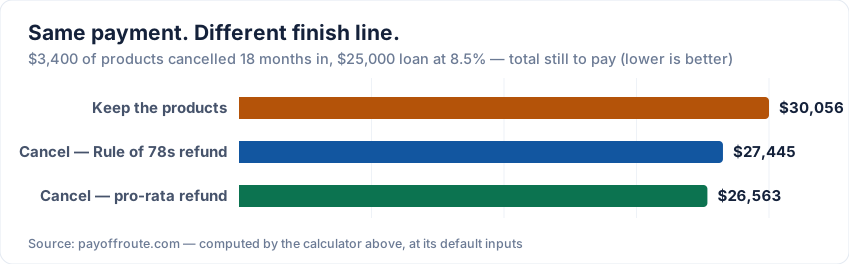
We sell nothing, so here is the arithmetic. Refund of $2,450, applied to a $25,000 balance at 8.5% with a $569 payment: the loan goes from 53 months left to 47. You avoid $1,043 in interest. Add the refunded principal itself and you avoid $3,493 of payments in total. That is what the shrug was worth.
Read the cancellation clause: pro-rata or Rule of 78s
There is more than one way to divide a refund, and the difference is not academic. The fair method — pro-rata — simply splits the price by time: eighteen months into a seventy-two-month contract, you have used a quarter of it, so three quarters comes back. Most states now require pro-rata refunds on GAP, and many require it on service contracts.
The other method is the Rule of 78s, which weights the early months of the contract far more heavily than the late ones. It is the same idea used to make an early loan payoff less rewarding than it should be, applied here to make an early cancellation less rewarding than it should be.
| Cancelling 18 months into a 72-month contract | Pro-rata | Rule of 78s |
|---|---|---|
| Refund, after fees | $2,450 | $1,821 |
| Months cut off the loan | 6 | 4 |
| Interest you never pay | $1,043 | $789 |
| Total payments avoided | $3,493 | $2,611 |
The Rule of 78s hands you $629 less for the identical cancellation — about a quarter of the refund. And because that $629 never reaches your principal, it costs you a further $254 of interest on top. The total damage of one clause you did not read is $882.
So read it. The method is stated in the cancellation section of the contract, and if the wording is the Rule of 78s while your state requires pro-rata on that product, the contract is the thing that is wrong, not you. Switch the selector on the calculator to see what your own paperwork is worth.
If you are paying the loan off, the money is yours
Everything above assumes you are keeping the loan. Pay it off — or sell the car, or trade it in, or refinance — and the picture changes completely, because once the loan is gone there is no lienholder to receive the refund. It comes to you, in cash.
This matters most for GAP, and it is the single most commonly missed refund in consumer lending. GAP exists to cover the difference between what you owe and what the car is worth. The moment the loan is paid off, that difference is zero and the coverage is insuring nothing. The unused premium is yours. It is triggered by an early payoff, a refinance, a sale, or a trade-in — every one of the things people do when they are trying to get out of a car loan.
Lenders are supposed to process this automatically. A great many do not. In November 2023 the CFPB ordered Toyota Motor Credit to pay $60 million, and part of that order was for exactly this failure — not refunding prepaid GAP premiums to customers who ended their finance agreements early. So do not wait to be handed it. When you pay the loan off, write to the lender and the administrator, name the product, name the payoff date, and ask for the unearned premium back.
Cancelling gets less valuable every month
A refund is a claim on the time you have not used, so it shrinks as the time runs out. Here is the same $2,500 warranty and $900 GAP policy against the same loan, cancelled at different points:
| Cancelled after | Refund | Months cut off the loan | Interest you never pay |
|---|---|---|---|
| 6 months | $3,017 | 7 | $1,263 |
| 12 months | $2,733 | 7 | $1,154 |
| 18 months | $2,450 | 6 | $1,043 |
| 24 months | $2,167 | 5 | $930 |
| 36 months | $1,600 | 4 | $698 |
| 48 months | $1,033 | 2 | $458 |
Read it honestly, though, because there is a real trade here and we are not going to pretend otherwise. The refund shrinks because the coverage you are giving up shrinks too — at 48 months in, you are handing back the years of protection you have not yet used, and there are fewer of them. Cancelling is not automatically the right call. It is the right call when you have concluded the coverage is not worth what you are paying to carry it.
What the table does prove is narrower and still useful: if you are going to cancel, the value of doing it today always beats the value of doing it next year. Deciding slowly is itself expensive.
How to actually do it
- Find the contract. It is in the folder from the finance office. You need the price you paid, the term, the administrator’s name, and the cancellation clause — the four things this calculator asks for.
- Cancel in writing. The dealer can process it, but the administrator is the party that owes the money, so write to both and keep a copy. Do not accept a phone call as the record.
- Expect to be talked out of it. The CFPB found Toyota Motor Credit routed roughly 118,000 cancellation calls to a dedicated retention hotline, where staff were instructed to keep pitching until the customer had asked to cancel three separate times — and only then were they told it had to be in writing anyway. Skip the conversation. Start with the letter.
- Check the principal actually dropped. Cancelling is not done when they say yes; it is done when the balance moves. Watch for the credit to post, then confirm the new payoff figure with the payoff amount calculator.
- Keep the payment where it is. Some lenders will offer to re-amortize and lower your bill. That gives back most of the benefit. If you can carry the payment, carry it, and take the earlier finish line instead.
Related tools
- To see how ordinary extra payments move the same finish line, use the auto loan payoff calculator.
- To get the exact figure that closes the loan on a chosen day, use the payoff amount & per-diem calculator.
- If you are still at the dealer and have not signed, the 0% financing vs cash rebate calculator settles the other decision the finance office is about to put in front of you.
Frequently Asked Questions
Do I get the extended warranty refund as cash?
Only if your loan is already paid off. If the warranty was financed into your car loan — and it almost always is, because that is how the finance office sells it — the refund is legally the lender’s money to receive, not yours. It goes to the lienholder and is applied straight to your principal. That is the detail almost nobody explains, and it is why cancelling feels like nothing happened: no cheque arrives, and your monthly payment does not move. What changes is the finish line. The balance drops immediately, so the same payment clears the loan sooner and you skip the last several months of it entirely.
Will cancelling lower my monthly payment?
No. Your payment is fixed by the contract you signed, and a principal reduction does not re-amortize it — the lender simply applies the money to the balance and keeps billing you the same amount. You benefit at the end of the loan, not in the middle of it: the loan runs out of balance early and the final payments never happen. Some lenders will re-amortize on request, which lowers the payment instead of shortening the term, but that hands back most of the interest saving. If your goal is to be free of the loan, leave the payment alone and take the earlier payoff date.
Can I cancel an extended warranty at any time?
Yes. A vehicle service contract is cancellable for the life of the contract, and you are owed a refund for the portion you have not used. There is usually a short "free look" window (often 30 or 60 days) in which you get everything back, and after that you get a pro-rated refund minus a cancellation fee that state law typically caps at $25–$75. You do not need the dealer’s permission and you do not need a reason. You cancel with the administrator named on the contract, or through the selling dealer, in writing.
Am I owed a GAP refund if I pay my car off early?
Yes, and this is the one people miss most often. GAP covers the gap between what you owe and what the car is worth — so the moment the loan ends, the coverage has nothing left to insure and the unused premium is yours. Paying off early, refinancing, selling, or trading in all terminate the contract and all trigger a pro-rated refund. Lenders are supposed to process it automatically. Many do not. The CFPB has repeatedly penalised lenders for exactly this: Toyota Motor Credit was ordered to pay $60 million in 2023, part of it for failing to refund GAP premiums to people who paid off their loans early. Ask, in writing, and keep the paperwork.
What is the Rule of 78s and why does it matter here?
It is a refund formula that front-loads the value of the contract, so cancelling gives you less than a straight pro-rata split would. On this calculator’s defaults it hands back $1,821 instead of $2,450 — $629 less for the identical cancellation. Because that $629 never reaches your principal, it also costs you a further $254 in interest, for a total of $882. Most states now require pro-rata refunds on GAP and many require it on service contracts, but not all contracts follow it, and the method is buried in the cancellation clause. Read that clause before you assume the number: switch the selector above and you will see exactly what the wording is worth.
Is it worth cancelling if the loan is nearly over?
It shrinks fast. A refund is a share of the time you have not used, so the longer you wait the less there is to give back. On the defaults, cancelling at 6 months in returns about $3,017 and saves 7 months of payments; at 48 months in it returns about $1,033 and saves 2. The coverage you are giving up shrinks in step, so the trade does not necessarily get worse — but the money on the table does. If you are going to cancel, the value of doing it today is always higher than the value of doing it next year.
Is my information stored?
No. All calculations happen in your browser. Nothing you enter is saved or transmitted anywhere.
Read more on this
Related calculators
Personal Loan
Monthly payment and true total cost of a personal loan, including the origination fee most calculators ignore.
Open calculator →Loan Payoff
See how much sooner you’ll be debt-free and how much interest you save by adding extra monthly or one-time payments to any loan.
Open calculator →Student Loan Payoff
See when your student loans actually end — and how extra payments or one-time windfalls move the date and shrink the interest.
Open calculator →Disclaimer: This calculator is for educational purposes only and provides estimates based on the numbers you enter. It is not financial, legal, or tax advice. Actual loan terms, rates, and payments depend on your lender and personal circumstances. All calculations run in your browser — nothing you enter is stored or sent anywhere.