How do you calculate a loan payoff amount?
The number on your monthly statement and the number it actually takes to close your loan are almost never the same — and the difference trips people up right when it matters most, at a closing table or a title office. Your statement balance is a snapshot. It records the principal you owed on one particular billing date and then stops updating. Your payoff amount is a live figure: it is what the lender needs to receive to mark the loan paid in full and release its claim, and it includes every dollar of interest that has accrued since that last statement was cut.
Because interest builds every single day, the payoff quote is always a little higher than the balance you last saw, and it keeps climbing until the money lands in the lender’s account. That is why a payoff is described as “good through” a specific date rather than printed as one flat number. Ask for a payoff on Monday and pay on Friday, and you owe four more days of interest than the quote showed. The gap is usually small in dollar terms over a short window, but it is real, it is never zero, and it is the entire reason this calculator exists: to turn your balance, your rate, and your target date into the single figure that closes the loan.
Per-diem interest, explained
The mechanism behind a payoff quote is per-diem interest — Latin for “per day.” Instead of thinking about interest as a monthly charge, the lender reduces it to a daily rate and multiplies by the number of days the loan stays open. The formula is short: take your balance, multiply by your annual rate, and divide by the number of days in the lender’s year.
Per-diem = balance × APR ÷ day-count (365 or 360)
Payoff amount = balance + (per-diem × days)
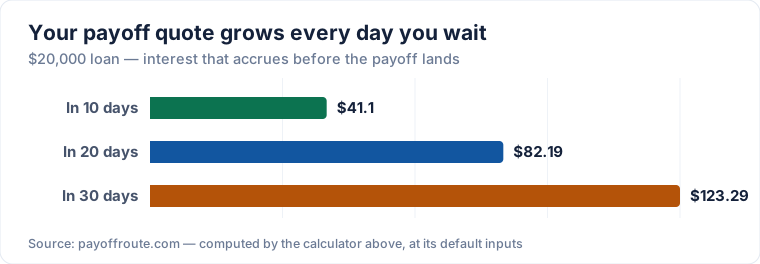
On the defaults — a $20,000 balance at 7.5% divided over a 365-day year — that works out to $4.11 a day ($20,000 × 0.075 ÷ 365). Wait ten days to pay and you add $41.10; wait a month and you add $123.29. The per-diem itself does not change from day to day while the principal is fixed, which makes the arithmetic reassuringly simple: payoff equals balance plus per-diem times days. Multiplied out across the windows lenders actually quote, the same $20,000 loan at 7.5% looks like this — the identical figures the calculator’s table returns:
| Days until payoff | Interest accrued (at $4.11/day) | Payoff amount |
|---|---|---|
| 10 days | $41.10 | $20,041 |
| 15 days | $61.64 | $20,062 |
| 20 days | $82.19 | $20,082 |
| 30 days | $123.29 | $20,123 |
This daily nature is also why a payoff quote comes with an expiration date. A lender will issue a figure that is valid for a set window — commonly 10 to 20 days — because beyond that window the accrued interest would make the quoted number wrong. If you slip past the date, you do not get penalized; you simply request a fresh quote that carries a few more days of per-diem. The quote is a promise about a specific day, not a permanent price tag.
One nuance worth naming: the per-diem is flat only while the principal holds still. The moment a payment reduces the balance, the daily figure drops too, because the same rate is now applied to a smaller number. That is why lenders recalculate the per-diem from the balance on the day the quote is prepared rather than from an old statement, and why paying down a chunk of principal right before you request a payoff shrinks both the balance and the daily interest riding on top of it. For a single lump-sum payoff on a chosen date, though, the balance does not move until the day you close, so the simple “balance plus per-diem times days” arithmetic the tool uses is exactly right.
The 360-day “banker’s year”
Here is the detail that quietly raises a lot of payoff quotes: not every lender divides by 365. Many auto lenders and mortgage servicers use a 360-day year, an old convention often called the banker’s year. Spreading the same annual interest over 360 days instead of 365 means each day carries a slightly larger share, so the per-diem rises by about 1.4%.
It sounds trivial, and on a short window it nearly is — but it is not nothing. On the same $20,000 at 7.5%, the 365-day method gives about $4.11 a day while the 360-day method gives about $4.17 a day. Over a handful of days the difference is pocket change; over the full life of a mortgage the same convention compounds into real money. The calculator above deliberately shows you both daily figures side by side in its second notice, so you can see the spread rather than assume the friendlier one.
You do not have to guess which method applies to you. The day-count convention is spelled out in your loan agreement, disclosed under the federal Truth in Lending rules that govern how a lender’s finance charges are stated. If your payoff quote looks a touch higher than your own 365-day math predicts, a 360-day divisor is the usual explanation. Match the day-count selector to your agreement and the tool’s per-diem will line up with the lender’s.
When you actually need a payoff amount
Most of the time you never think about a payoff figure — you just make the monthly payment. A payoff amount becomes the number that matters in a handful of specific moments, and in every one of them precision counts.
- Selling a financed car. The buyer, and often the DMV, needs the lien cleared before the title can transfer. You need to know the exact amount to send the lender so the loan closes and the title comes free.
- Refinancing. Your new lender pays off the old loan directly, and it needs a payoff good through the funding date so the old balance is wiped cleanly with nothing left dangling.
- Paying off a mortgage at closing. When you sell or refinance a home, the closing agent orders a payoff statement from your servicer that is valid through the closing date, per-diem included.
- Clearing any loan early. Coming into a bonus or a windfall and want the debt gone? You need the payoff, not the statement balance, or you will leave a few dollars of interest behind and the loan will not actually close.
In each case the right move is the same: ask the lender for a written payoff good through a specific date, then pay that exact amount on or before that date. Use this calculator to sanity-check the figure the lender sends, so an unexpected day-count or an extra week of per-diem never catches you off guard.
A written quote matters more than a number read over the phone, because it commits the lender to an amount and a deadline you can hold them to. It also protects you from the small timing traps that cost people money at the finish line — a payment that posts a day after the quote expires, a weekend that delays a wire, or a 360-day day-count you did not expect. Plan the payment to land a day or two inside the window, keep the confirmation, and confirm the loan shows a zero balance and a released lien afterward. The payoff is only truly done once the lender records it and, where a title or lien is involved, files the paperwork that frees the asset.
This tool vs. the others
This page answers one narrow question — the single figure to close a loan on a given day — and it is worth being clear about what it does not do, because the sister tools on this site tackle different questions entirely.
- To understand the ongoing cost of carrying a credit-card balance rather than an installment loan, use the credit card interest calculator.
- To see how extra monthly payments shorten a loan and cut total interest — a full amortization schedule, not a single date — use the loan payoff calculator, the auto loan payoff calculator, or the mortgage payoff calculator.
Those calculators model a schedule of payments stretching over months or years. This one does something plainer and more surgical: it takes today’s balance and tells you the exact amount to hand the lender to make the loan disappear on the day you pick. If your question is “how much do I send to close this out,” you are in the right place. If it is “how much sooner can I be debt-free,” one of the payoff calculators above is the tool you want.
Frequently Asked Questions
Why is my payoff amount higher than my balance?
Because interest keeps accruing every day. Your statement balance is a snapshot from your last billing date, but interest has been building on that balance every day since. A payoff quote closes the loan out, so it rolls in all the interest accrued from your last statement up to the exact day the lender receives the money. On a $20,000 loan at 7.5% that is about $4.11 a day — a small figure that adds up to $41 over ten days and more the longer you wait.
What is per-diem interest?
Per-diem simply means "per day." It is the amount of interest your loan charges for a single day, and it is the engine behind every payoff quote. The formula is your balance times your annual rate, divided by the number of days the lender uses in a year — either 365 or 360. Multiply the per-diem by the number of days until you pay, and you have the interest that gets added to your balance to reach the final payoff figure. It stays flat day to day until the principal changes.
What is a 10-day payoff quote?
A 10-day payoff quote is a written figure from your lender that is guaranteed valid for a set window — often 10, 15, or 20 days from the date it is issued. Because interest accrues daily, a payoff amount is only accurate for the specific date it names, so the lender builds in a cushion and tells you the amount is "good through" a particular day. If you pay within that window, that number closes the loan; if you miss it, you request a fresh quote with more per-diem added.
Do lenders use a 360- or 365-day year?
Both are common, and it depends on the loan. Many everyday consumer loans divide by 365, but a large share of auto lenders and mortgage servicers use a 360-day "banker’s year." Dividing the same annual interest by 360 instead of 365 spreads it over fewer days, so each day’s per-diem is roughly 1.4% higher. The convention your loan uses is disclosed in your loan agreement under Truth in Lending. If you are not sure, the calculator above shows the daily figure both ways so you can compare.
Does my payoff amount change if I pay a few days later?
Yes. Each extra day you wait adds exactly one more per-diem to the total. If your per-diem is $4.11, paying three days late adds about $12; paying two weeks late adds around $58. This is why lenders quote a payoff that is "good through" a specific date rather than a flat number — the figure is a moving target that climbs by one daily interest charge for every day the loan stays open. Pay on or before the quoted date and you owe the quoted amount, not a penny more.
Is the payoff amount the same as my current balance?
No, and treating them as the same is a common surprise at closing. Your current balance is the principal you owe as of your last statement. The payoff amount is that balance plus the interest that has accrued since — and sometimes small items like unpaid fees. The gap is usually modest on a short window, but it is never zero unless you happen to pay on the exact day interest was last posted. Always pay the lender’s official payoff quote, not the balance you see in your app.
Is my information stored?
No. All calculations happen in your browser. Nothing you enter is saved or transmitted anywhere.
Read more on this
Related calculators
Personal Loan
Monthly payment and true total cost of a personal loan, including the origination fee most calculators ignore.
Open calculator →Loan Payoff
See how much sooner you’ll be debt-free and how much interest you save by adding extra monthly or one-time payments to any loan.
Open calculator →Student Loan Payoff
See when your student loans actually end — and how extra payments or one-time windfalls move the date and shrink the interest.
Open calculator →Disclaimer: This calculator is for educational purposes only and provides estimates based on the numbers you enter. It is not financial, legal, or tax advice. Actual loan terms, rates, and payments depend on your lender and personal circumstances. All calculations run in your browser — nothing you enter is stored or sent anywhere.