The Refund That Never Reaches You: What Cancelling a Car Warranty Actually Does
There is a sentence that appears, almost word for word, in every major article about cancelling a car warranty: your payment won’t drop, but you may pay the car off sooner.
Then the article ends.
Nobody says how much sooner. Nobody prices the interest. Nobody names the date. We ran the numbers that sentence is standing in for, and they are not small. Every figure below comes from the engine behind our extended warranty & GAP refund calculator, and the methodology is public.
Key findings
- The refund does not come to you. If the product was financed — and the finance office finances it by default — the lender is the loss payee. The money goes to the lienholder and lands on your principal. No cheque arrives, and your monthly payment does not change.
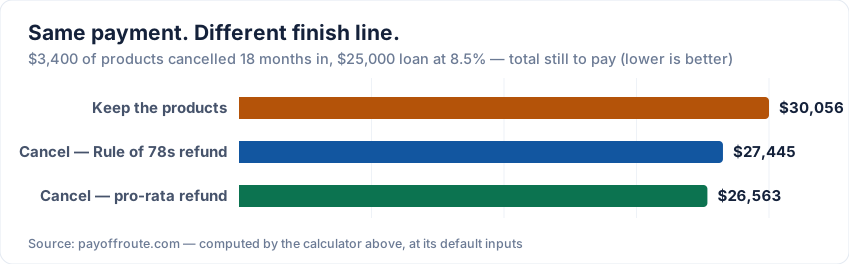
- What changes is the finish line. On a $2,500 warranty and a $900 GAP policy cancelled 18 months into a 72-month term, against a $25,000 balance at 8.5% with a $569 payment: the refund is $2,450, the payment stays $569 to the cent, the loan ends 6 months early, and you never pay $1,043 of interest. Total payments avoided: $3,493.
- One unread clause is worth $882. A contract that refunds by the Rule of 78s instead of pro-rata pays $629 less on the identical cancellation — and because that $629 never reaches your principal, it costs a further $254 of interest.
- Cancelling gets cheaper to delay and more expensive to postpone. The same cancellation returns $3,017 at 6 months in and $1,033 at 48 months in. If you are going to do it, today always beats next year.
- If the loan is already paid off, the refund is cash — and lenders routinely fail to send it. The CFPB ordered Toyota Motor Credit to pay $60 million (November 2023), including $9.9 million to customers who tried to cancel and could not.
(Cite these figures freely with a link to this page.)
Why nothing seems to happen when you cancel
The confusion is structural, not personal. When the finance office sells you a vehicle service contract, it does not sell you a $2,500 product. It sells you forty dollars a month — a figure small enough to disappear into a payment you have already decided you can afford. To make that possible, the $2,500 is added to the amount financed. It becomes part of the loan.
Which means the lender has an interest in it. On cancellation, the administrator does not owe the money to you; it owes it to the lienholder, who applies it to your balance. You will not receive a cheque. And because a lump-sum principal credit does not re-amortize an auto loan, the lender keeps billing you the same amount as before.
So from the driver’s seat, cancelling looks like this: you send the form, you wait, no money arrives, and next month’s payment is identical. It is extremely easy to conclude that nothing happened.
Something did happen. It happened at the end of the loan, where you cannot see it.
What actually happened
| Do nothing | Cancel | |
|---|---|---|
| Loan balance | $25,000 | $22,550 |
| Monthly payment | $569 | $569 (unchanged) |
| Months left | 53 | 47 |
| Interest still to pay | $5,056 | $4,013 |
| Total still to pay | $30,056 | $26,563 |
$2,500 warranty + $900 GAP, both 72 months, cancelled at month 18; $50 cancellation fee each.
The payment column is the entire point of this study, and it is the column everyone skips. It does not move. It cannot move — that is not a flaw in the cancellation, it is how the loan works.
Look at the last row instead. $3,493 of payments you were going to make simply never happen. Some of that is the refund itself, knocked off the principal. But $1,043 of it is pure interest you never pay, because the balance the interest was riding on got smaller.
That is the number sitting behind the phrase “you may pay the car off sooner.”
Why nobody publishes the number
It is worth asking why an arithmetic this simple is missing from every large personal finance site that covers the question.
We went and looked. The major guides to cancelling an extended car warranty do get the basics right: the refund is pro-rated, there is a fee, and — in one passing clause — the payment will not drop though you may finish sooner. What none of them contains is a single dollar figure attached to that clause. No months. No interest. No payoff date. No calculator.
The same pages carry paid placements for the companies that sell extended warranties. The buttons are inside the article. The referral is worth real money per lead.
An article that computed exactly what you get back for cancelling would be an article arguing against the product it is being paid to place.
We are not suggesting anyone is lying. The sentence they print is true. It is just that the sentence is where the writing stops, and the stopping point is not an accident. The arithmetic is not hard. It is expensive.
That is the entire reason this page exists. We sell no warranties, no loans, and no leads, so we can afford to finish the sentence.
The clause that costs $882
Not every contract divides a refund the same way, and the difference is larger than anyone tells you.
Pro-rata is the fair method: split the price by time. Eighteen months into seventy-two, you have used a quarter, so three quarters comes back. Most states now require pro-rata refunds on GAP, and many require it on service contracts too.
The Rule of 78s front-loads the contract’s value, weighting the early months far more heavily than the late ones. It is the same device used to make an early loan payoff less rewarding than it should be, pointed here at an early cancellation.
| Cancelling 18 months into a 72-month contract | Pro-rata | Rule of 78s |
|---|---|---|
| Refund, after fees | $2,450 | $1,821 |
| Months cut off the loan | 6 | 4 |
| Interest you never pay | $1,043 | $789 |
| Total payments avoided | $3,493 | $2,611 |
The Rule of 78s hands back $629 less — about a quarter of the refund — for the identical cancellation on the identical day.
And the damage does not stop there, which is the part we have not seen computed anywhere. That $629 was going to land on your principal. It never does. So it never stops any interest either, and that costs you $254 more.
One clause. $629 of refund, $254 of interest. $882 for a paragraph nobody reads.
It is in the cancellation section of the contract. If it says Rule of 78s and your state requires pro-rata on that product, the contract is what is wrong, not you.
The refund decays, and so does the coverage
A refund is a claim on time you have not used, so it shrinks as the time runs out:
| Cancelled after | Refund | Months cut off the loan | Interest you never pay |
|---|---|---|---|
| 6 months | $3,017 | 7 | $1,263 |
| 12 months | $2,733 | 7 | $1,154 |
| 18 months | $2,450 | 6 | $1,043 |
| 24 months | $2,167 | 5 | $930 |
| 36 months | $1,600 | 4 | $698 |
| 48 months | $1,033 | 2 | $458 |
We want to be honest about what this table does not prove. The refund shrinks because the coverage you are giving up shrinks too. At 48 months in, the protection you are handing back is a thinner thing than it was at 6. Cancelling is not automatically correct, and a service contract you genuinely value is not a scam because it was expensive.
What the table does prove is narrower: if you have decided to cancel, deciding slowly is itself a cost. Every month you spend thinking about it takes roughly $47 off the refund and puts interest back on the loan.
If you have paid the loan off, the money is yours
Everything above assumes you keep the loan. Pay it off — or refinance, sell, or trade in — and the mechanism inverts, because there is no lienholder left to receive anything. The refund comes to you, in cash.
This matters most for GAP, and it is the most commonly missed refund in consumer lending. GAP exists to cover the difference between what you owe and what the car is worth. The instant the loan is gone, that difference is zero. The coverage is insuring nothing, and the unused premium is yours.
Which is to say: the very act of paying a car off early creates a refund — and almost nobody collects it.
Lenders are supposed to process it automatically. Enforcement history says otherwise:
- Toyota Motor Credit, November 2023 — $60 million ($48 million in redress, $12 million in penalties). The CFPB found it “failed to refund prepaid GAP and CLAH premiums to consumers who paid off the loan or ended the lease before the end of the contract.”
- $9.9 million of that went to customers who tried to cancel and were prevented from doing so.
- Wells Fargo, December 2022 — $3.7 billion ($2 billion in redress, $1.7 billion in penalties). Among the failures: not ensuring customers received GAP refunds when they paid loans off early or the vehicle was repossessed.
- The CFPB’s special-edition auto finance Supervisory Highlights (October 2024) flagged the failure to refund unearned GAP after early payoff as an unfair practice across the industry — not one firm’s mistake.
They will try to talk you out of it, and it is on the record
The Toyota order contains a detail worth quoting, because it tells you what to expect on the phone.
Between 2016 and 2021, roughly 118,000 consumer calls were routed to a dedicated retention hotline. Representatives there were instructed to keep promoting the products until the customer had verbally asked to cancel three separate times — and only then were they told that cancelling was possible only by submitting a written request anyway.
Read that sequence again. The written request was required the whole time. The three refusals bought nothing but three more attempts to sell you.
If cancelling were harmless to them, there would be no retention hotline.
The bundled products in that case added between $700 and $2,500 to each loan, across nearly 5 million customer accounts.
What to do
- Find the contract. You need four things, all of them on it: the price, the term, the administrator’s name, and the cancellation clause.
- Read the clause. Pro-rata or Rule of 78s. That single word is worth $882 on the figures above.
- Cancel in writing. The dealer can process it, but the administrator owes the money — write to both, keep copies, and skip the phone call entirely.
- Check the balance actually moved. Cancelling is not done when someone says yes; it is done when the principal drops. Confirm the new figure with the payoff amount calculator.
- Do not let them re-amortize. Some lenders will kindly offer to lower your payment instead. That hands most of the benefit back. Keep the payment; take the earlier finish line.
- If the loan is already gone, ask for the GAP money. In writing, naming the payoff date. It will not arrive on its own.
Methodology
Refunds are computed on the unused share of the contract term, under the two methods contracts actually use: pro-rata, which is linear in time; and the Rule of 78s, whose unused fraction is u(u+1) ÷ n(n+1) for u unused months of an n-month term. A cancellation fee is subtracted per product, and a refund cannot go below zero. The resulting figure is applied to the loan as a one-off principal credit, and the loan is then amortized at the unchanged monthly payment — because a principal credit does not re-amortize an auto loan — until the balance clears. Months saved and interest saved are the difference between that schedule and the schedule with no credit applied. Where a payment is too small to cover the monthly interest, the loan never clears and the tool says so rather than printing a number. Contracts that pro-rate on the greater of time or mileage are handled by converting mileage used into equivalent months. Full assumptions on our methodology page. This is arithmetic, not legal advice; cancellation rights and refund methods are set by your contract and your state.
Run your own numbers
Auto Loan Payoff Calculator
Pay the car off early: what extra payments save in interest, and how fast you can get right-side-up on the loan.
Open calculator →Payoff Amount & Per-Diem Interest Calculator
Your exact payoff amount today — and why it’s more than your statement balance. Per-diem interest, your 10-day payoff quote, and the 360-day trick that raises it.
Open calculator →Extended Warranty & GAP Refund Calculator
Cancel a financed warranty or GAP policy and the refund goes to your lender, not to you. See what it does instead: how many months earlier your loan ends, and the interest you never pay.
Open calculator →Disclaimer: This article is for educational purposes only and is not financial advice. Figures are computed with the models described on our methodology page; actual loan terms depend on your lender and circumstances.