Why HELOCs are built to linger
A HELOC is one of the few debts that does not shrink on its own. During the draw period — typically the first ten years — the required payment is usually interest-only. Pay exactly what the statement asks, every single month, and after a decade you owe precisely what you owed on day one. A $40,000 balance at 9% costs $300 a month in interest, forever, until you decide otherwise. The minimum payment services the debt; it never retires it.
Then comes the part that catches people off guard: when the draw period ends, the line closes to new borrowing and the entire remaining balance converts to principal-and-interest payments over the repayment period. The required payment jumps — often by 30–100% — in a single billing cycle. That jump is the payment cliff, and it is baked into the product’s design, not a fine-print surprise. If you want to see exactly how big your cliff would be on required payments alone, our HELOC payment calculator models both phases side by side.
This calculator answers the opposite question: what happens if you refuse to coast? Add extra principal on top of the interest-only payment and the balance — which was designed to sit still — starts falling every month. The results above show how far that takes you.
Should I pay extra principal on my HELOC during the draw period?
Yes — and the reason is visible in the one formula that defines the draw period. The required payment is simply the interest the balance generated, which is why the balance never moves:
Interest-only payment = balance × APR ÷ 12
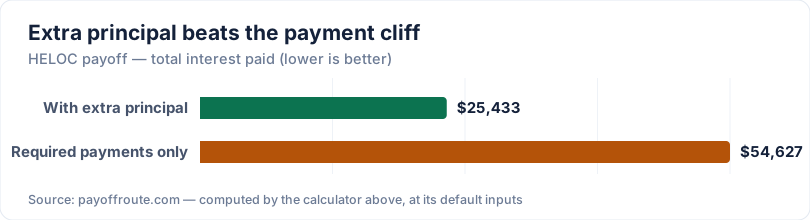
$40,000 × 9% ÷ 12 = $300 a month, and $0 of it is principal. Anything you send above that $300 is the only thing that ever shrinks the debt. Here is what different extra amounts do to the default line — $40,000 at 9%, 6 years of draw left, 15-year repayment period:
| Extra principal / month | Debt-free in | Total interest | Interest saved | Repayment-phase payment |
|---|---|---|---|---|
| $0 (minimum only) | 21 yr | $54,627 | $0 | $405.71 |
| $100 | 15 yr 5 mo | $35,560 | $19,067 | $332.68 |
| $200 | 12 yr 1 mo | $25,433 | $29,194 | $259.65 |
| $400 | 8 yr | $15,008 | $39,619 | $113.60 |
The last column is the payment cliff shrinking in real time: every dollar of principal you retire during the draw comes straight out of the payment you will be handed on conversion day. Push the extra to about $600 a month and the balance hits zero before the draw period even ends — there is no repayment phase, and therefore no cliff at all.
Extra principal on a HELOC during the draw period does three jobs at once, which is more than it does on almost any other loan:
- Less interest, starting immediately. HELOC interest is charged on the outstanding balance, so every dollar of principal you retire stops billing you at your APR from that day forward. Pay $200 extra this month at 9% and next month’s interest charge is $1.50 smaller — and the month after, and the month after that, compounding quietly in your favor for the entire life of the line.
- A smaller cliff — or none at all. The repayment-phase payment is calculated from whatever you owe on the day the draw period ends. Walk into that day owing $25,000 instead of $40,000 and the required payment is recalculated on the smaller number. Clear the balance entirely before the draw ends and there is no cliff at all — the fourth stat above tells you which outcome your plan produces.
- The money stays reachable. Unlike extra payments on a mortgage or auto loan, principal paid on a HELOC during the draw period becomes available credit again. If the roof fails six months after you paid the line down, you can re-draw. That makes aggressive paydown far less risky than it feels — with one honest caveat: the re-draw feature is also how HELOC balances refuse to die. If you pay $10,000 down and borrow $10,000 back for a kitchen upgrade, you have run in place. The flexibility is a safety net, not a spending plan.
The variable-rate angle
Nearly every HELOC floats with the prime rate, which means your interest cost can rise without you borrowing another cent. That turns principal paydown into something more than a savings play — it is rate-risk insurance. Interest-rate exposure is simply your balance times whatever rates do: a $40,000 balance gains $67 a month in interest cost if rates rise two points, while a $15,000 balance gains $25. You cannot control the Federal Reserve, but you control the balance, and shrinking it shrinks every future rate surprise in exact proportion.
A practical habit: after you run your real numbers above, run them again with the rate 2 percentage points higher. If the accelerated plan still looks livable at the stressed rate, your plan is robust. If it only works at today’s rate, treat that as a signal to push harder on principal now, while the rate is on your side.
Draw period ending soon? Your options
If your draw period ends within the next couple of years and the balance is still large, you have three realistic moves, and they are not mutually exclusive:
- Pay down hard now. Every dollar of principal you clear before conversion comes straight out of the recalculated repayment payment. This is the only option that costs nothing, requires no approval, and works at any credit score. Use the one-time field above to test what a tax refund or bonus does to your cliff.
- Ask about a fixed-rate lock. Many lenders let you convert some or all of the balance to a fixed rate and fixed term, sometimes without refinancing at all. It doesn’t shrink the debt, but it removes the variable-rate wildcard from the repayment phase and makes the payment predictable.
- Refinance the balance into a home equity loan. A fixed-rate HEL replaces the floating balance with a fixed payment on your schedule — effectively building your own repayment phase on better-known terms. Our HELOC vs home equity loan calculator compares the two structures directly so you can see whether the switch actually saves money.
Whichever route you take, the arithmetic is the same: the smaller the balance on conversion day, the smaller every payment that follows. Paying down first makes every other option cheaper.
Where the extra money does the most
Before committing hundreds a month to the HELOC, rank it against your other debts — by APR, not by emotion. Extra dollars save interest at the rate of whatever debt they hit:
- Credit cards first. A card at 22–29% APR outranks any HELOC. If you carry card balances, send the extra there and pay the HELOC’s required interest in the meantime — our credit card payoff calculator shows what the same monthly amount does against a card.
- The HELOC usually comes next. At typical HELOC rates it beats most auto loans, student loans, and virtually every mortgage — and it carries two extra reasons to jump the queue: the variable rate (your APR can rise) and the fact that your house is the collateral.
- Low fixed rates last. Prepaying a 3% mortgage while a 9% variable-rate HELOC sits untouched is a losing trade every month it continues.
One more ordering rule that outranks all of the above: keep an emergency fund before accelerating anything. The HELOC’s re-draw feature softens this — paid-down principal can be re-borrowed during the draw period — but lenders can freeze lines when home values fall, so treat re-draw as a backup, not as your savings account. Run your real numbers above, then rerun them with an extra amount you could sustain even in a bad month. A number you can hit every month beats a heroic number you abandon by spring.
Frequently Asked Questions
Can I re-draw money after paying down my HELOC?
Yes — during the draw period. A HELOC is a revolving line, so every dollar of principal you pay back becomes available credit again, just like paying down a credit card. That flexibility ends when the draw period closes: in the repayment phase the line is frozen and payments only go one direction. It is one reason paying principal early is lower-risk than it feels — the money is not locked away the way an extra mortgage payment is.
If I pay my HELOC to zero, does that close the line?
No. Paying the balance to zero keeps the line open with its full credit limit available — you simply owe nothing and pay no interest. The line stays open until the draw period ends on its own schedule or until you formally ask the lender to close it (which may involve a release of the lien on your home). Some people deliberately keep a zero-balance HELOC open as inexpensive standby access to funds.
Are there fees for paying off or closing a HELOC early?
Paying extra principal itself almost never triggers a penalty. Closing the line entirely can: many lenders charge an early-closure or "reimbursement" fee — often a few hundred dollars, sometimes the closing costs they waived — if you terminate the line within the first two to five years. If your plan is to pay to zero, you can usually avoid the fee by leaving the line open at a zero balance instead of formally closing it.
What happens if I still owe money when the draw period ends?
The line converts to the repayment phase: no new borrowing, and your remaining balance amortizes over the repayment period with principal-and-interest payments. The required payment is recalculated from whatever you owe at that moment — which is exactly why paying principal during the draw shrinks the payment jump. This calculator shows you the recalculated payment for your plan.
Should I pay extra on my HELOC or on my credit cards first?
Almost always the credit cards. Extra dollars save interest at the rate of the debt they hit, and card APRs in the 20s beat typical HELOC rates in the high single digits or low teens. Send minimums everywhere, then point every spare dollar at the highest APR. Once the cards are gone, redirect that entire payment stream at the HELOC.
Do extra payments help during the repayment period too?
Yes. Once the line is amortizing, extra principal works exactly like prepaying any fixed loan: each extra dollar stops generating interest for the remaining term and pulls the payoff date closer. The earlier the extra arrives, the more months it has to work — but it is never too late for it to help.
Is anything I enter here stored?
No. All calculations run entirely in your browser. Nothing you type is saved, stored, or sent to any server.
Related calculators
Home Equity Loan
See how much you can borrow against your home and what the monthly payment would be, with a full amortization schedule.
Open calculator →HELOC Payment
Estimate your HELOC payments during the interest-only draw period and the repayment period that follows.
Open calculator →HELOC vs HEL
Same equity, two very different loans. Compare payments and lifetime cost side by side — including what happens to the HELOC if rates rise.
Open calculator →Disclaimer: This calculator is for educational purposes only and provides estimates based on the numbers you enter. It is not financial, legal, or tax advice. Actual loan terms, rates, and payments depend on your lender and personal circumstances. All calculations run in your browser — nothing you enter is stored or sent anywhere.