Is a HELOC cheaper than a personal loan?
On the rate, nearly always. A HELOC is secured — the lender can take your home if you default — so it is priced several points below an unsecured personal loan. That is not generosity; it is the price of your collateral.
On total cost, not always, and the reason is the fee structure. A personal loan’s origination fee is a percentage, so it scales with what you borrow. A HELOC’s closing costs — appraisal, title search, recording — are largely flat: roughly the same whether you draw $5,000 or $50,000. Fixed costs are brutal on small borrowings.
HELOC cost = interest + flat closing costs · Loan cost = interest + % origination fee
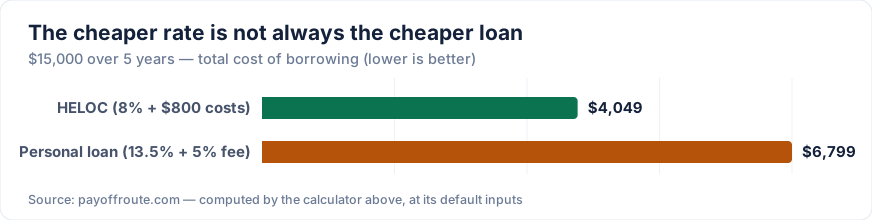
That asymmetry produces a threshold: the break-even amount. Below it, the HELOC’s closing costs cost more than its cheaper rate saves. On the defaults — a HELOC at 8% with $800 of costs against a 13.5% personal loan with a 5% fee, over five years — that line sits at about $3,380. Above it, the HELOC wins, and on a real renovation it usually wins comfortably: at $15,000 it is $2,750 cheaper.
The break-even map
The threshold moves with two things: how much the HELOC costs to open, and how cheap your personal loan is. Borrow less than the figure in your cell and the personal loan is the cheaper deal. (HELOC at 8%, five-year term, 5% origination fee on the loan.)
| Your personal loan rate | HELOC costs $500 | $1,000 | $1,500 | $2,500 |
|---|---|---|---|---|
| 9% (excellent credit) | $5,293 | $10,585 | $15,878 | $26,463 |
| 11% | $3,192 | $6,385 | $9,577 | $15,962 |
| 13.5% | $2,113 | $4,225 | $6,338 | $10,563 |
| 20% (weak credit) | $1,095 | $2,190 | $3,284 | $5,474 |
Read the corners, because they say something uncomfortable.
The better your credit, the less sense a HELOC makes
Look at the top row. With excellent credit, a personal loan near 9% leaves the HELOC almost no rate advantage to recover its costs with — so at $1,500 of closing costs you would have to borrow $15,878 before the HELOC pulled ahead. Below that, the unsecured loan is cheaper and risks nothing.
Now look at the bottom row. The borrower a HELOC saves the most money is the one whose credit forces them to a 20% personal loan — and that is precisely the borrower least able to survive losing the collateral. The people a HELOC helps most are the people who can least afford what it puts at risk. No calculator can resolve that, and any page that presents the HELOC as simply "the cheaper option" is not telling you the whole thing you are buying.
Two traps in the fine print
- The interest-only draw period. Most HELOCs let you pay interest alone for years — often a decade. The payment feels tiny because none of it touches the balance, and when the draw ends the loan re-amortizes over what remains, so the payment can leap. This calculator amortizes the HELOC over the same term as the loan, which is the only honest comparison and the only way a HELOC actually gets repaid. See what the cliff looks like in the HELOC payment calculator.
- The rate can move. A HELOC is normally variable, tied to prime; the personal loan is fixed. You are comparing a rate that can rise against one that cannot. Run this again with the HELOC two or three points higher and see how much of the advantage survives — if it doesn’t, you were never really comparing like with like.
If a fixed rate and a fixed payoff date matter more to you than the last few hundred dollars, a home equity loan gives you the lower secured rate without the variable rate and the draw-period trap — and the HELOC vs home equity loan calculator compares those two directly.
When the personal loan is the right answer
It is not merely the consolation prize. Take the unsecured loan when:
- You are borrowing below the break-even — the HELOC's costs never get earned back.
- Your credit is strong — the rate gap is too thin to pay for the closing costs.
- You need the money quickly — a personal loan can fund in days; a HELOC involves an appraisal and can take weeks.
- Your income is uncertain — an unsecured default wrecks your credit; a secured default can take your home. That is not a rounding error in the comparison. It is the comparison.
Price both honestly, including the fee each one hides, and then ask the question the numbers cannot answer: is the saving worth the collateral? On a $15,000 project the HELOC is $2,750 cheaper. Only you can say whether $2,750 is the right price for putting your house behind a kitchen.
Frequently Asked Questions
Is a HELOC always cheaper than a personal loan?
On rate, almost always — a HELOC is secured by your home, so lenders price it lower. On total cost, not always, because a HELOC carries closing costs a personal loan does not. Those costs are largely fixed (appraisal, title, recording), so on a small borrow they can swamp the rate advantage. That is what the break-even amount above tells you: borrow less than that figure and the personal loan wins despite its higher rate.
Why does good credit make a HELOC less attractive?
Because good credit is precisely what makes the unsecured loan cheap. If your credit gets you a personal loan near the HELOC rate, the HELOC has almost no rate advantage left to earn back its closing costs — so you would have to borrow a great deal before it paid for itself. The uncomfortable corollary is that the people a HELOC saves the most money are the ones with the weakest credit, who are also the least able to afford losing the collateral. That trade-off is the real decision, and it is not a maths problem.
What happens during a HELOC’s draw period?
Most HELOCs let you pay interest only during a draw period, often ten years. It feels wonderfully cheap, and it is a trap: the balance does not fall at all, and when the draw ends the loan re-amortizes over the remaining term, so the payment can jump sharply. This calculator deliberately amortizes the HELOC over the same term as the personal loan, which is the honest apples-to-apples comparison — and also the only way a HELOC actually gets repaid.
Is the HELOC rate fixed?
Usually not. HELOC rates are variable, typically tied to the prime rate, so the payment you are quoted today is not a promise. A personal loan is normally fixed for its whole term. When you compare the two, remember you are comparing a rate that can move against a rate that cannot — run this calculator again with the HELOC rate two or three points higher to see how much of its advantage survives a rate rise.
Can I deduct the interest?
Sometimes, on the HELOC only. Under current US rules, interest on home equity borrowing is deductible only when the money is used to buy, build, or substantially improve the home securing the loan — and only if you itemise. Personal loan interest is never deductible. If your project is a genuine home improvement and you itemise, that can tilt the maths further toward the HELOC. Check IRS Publication 936, or ask a tax professional; this calculator does not model tax.
Is my information stored?
No. Every calculation runs entirely in your browser. Nothing you enter is saved, stored, or sent to any server.
Read more on this
Related calculators
Home Equity Loan
See how much you can borrow against your home and what the monthly payment would be, with a full amortization schedule.
Open calculator →HELOC Payment
Estimate your HELOC payments during the interest-only draw period and the repayment period that follows.
Open calculator →HELOC vs HEL
Same equity, two very different loans. Compare payments and lifetime cost side by side — including what happens to the HELOC if rates rise.
Open calculator →Disclaimer: This calculator is for educational purposes only and provides estimates based on the numbers you enter. It is not financial, legal, or tax advice. Actual loan terms, rates, and payments depend on your lender and personal circumstances. All calculations run in your browser — nothing you enter is stored or sent anywhere.