Should you use a HELOC to pay off credit card debt?
Moving credit card debt onto a home equity loan or HELOC changes three things at once, and almost everyone focuses on the first one only. The rate falls — a card at 20–30% becomes a loan around 8–9%, which sounds like an obvious win. The term explodes — a balance you were grinding down in three or four years is re-papered as a 10-, 15-, or 20-year loan, and stretching the same principal over four or five times as many months quietly undoes much of what the lower rate gives back. And the debt changes its legal character — it stops being unsecured money you merely owe and becomes a lien against your house, which is precisely why the lender can afford the friendlier rate.
Only the rate shows up in the sales pitch. The term and the collateral are where both the hidden cost and the real danger live, and they are the two things a calculator has to make visible before you sign. A lower interest rate is not the same as a lower total cost, and a cheaper monthly payment is not the same as a cheaper debt. The point of the tool above is to separate those ideas, because a home equity loan can be all three — lower rate, lower payment, higher total cost — at the same time.
The term trap
Run the defaults and watch the trap spring. You owe $12,000 at 24.99% and you are paying $400 a month. Left alone, that card is gone in 4 yr and costs you $7,023 in interest — unpleasant, but finite, and getting smaller every month. Now move it to a 15-year home equity loan at 8.5%, with $500 of closing costs financed in, for a loan of $12,500. The lender’s required payment is the standard amortisation figure:
Loan payment = P × r ÷ (1 − (1 + r)−n)
where P is the principal (your balance plus the financed closing costs), r is the monthly rate (the APR ÷ 12), and n is the term in months. For $12,500 at 8.5% over 180 months that comes to only $123.09 a month.
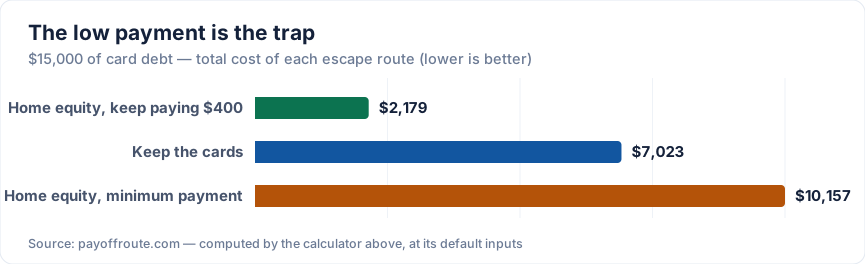
That drop from $400 to $123.09 is the product being sold. It is the number in the advertisement, the relief you can feel immediately, the reason the offer is tempting. And it is exactly what costs you the most. Pay that minimum for the full 180 months and you hand the lender $9,657 in interest; add the $500 in costs and the loan totals $10,157. You will have paid more than the $7,023 you were trying to escape — at a rate a third as high — because the term more than tripled. The low rate lost to the long calendar.
There is exactly one way to make the home equity loan win, and it is not a better rate or a shorter term on paper. It is refusing the payment relief. Keep paying your old $400 on the same 8.5% loan and the balance clears in 3 yr for only $1,679 in interest — $2,179 all-in, barely a fifth of what the minimum-payment version costs and well under the do-nothing case too. All three paths, side by side:
| Monthly payment | Payoff time | Total interest | Closing costs | Total cost | |
|---|---|---|---|---|---|
| Keep the cards ($12,000 at 24.99%) | $400.00 | 4 yr | $7,023 | $0 | $7,023 |
| Home equity — lender’s minimum | $123.09 | 15 yr | $9,657 | $500 | $10,157 |
| Home equity — keep paying $400 | $400.00 | 3 yr | $1,679 | $500 | $2,179 |
Same loan, same rate, same principal. The only variable is whether you spend the money the lower payment frees up or throw it back at the debt. That single choice is worth $7,977 here, which is why the calculator treats “keep paying today’s payment” as its own column instead of assuming you will.
Unsecured becomes secured
The dollars are only half the story; the other half is what kind of debt you now hold. Credit card debt is unsecured. If it all goes wrong, the worst the issuer can do is send it to collections, sue you, win a judgment, and damage your credit for years — painful, but nobody takes your home to satisfy a Visa balance. Unsecured debt is also generally dischargeable in bankruptcy, which is the ultimate backstop when a financial life genuinely collapses.
A home equity loan or HELOC is secured by a lien on your house. That lien is the whole reason the rate is low: the lender is not taking the same risk, because if you stop paying it can foreclose. And a secured lien is far harder to escape when things go badly — a second lien on your home generally survives bankruptcy where the very same dollars, left on the cards, might have been wiped out. So the true trade is not “24.99% for 8.5%.” It is “a debt that can wreck my credit for a debt that can take my house.” Sometimes that trade is worth it. It should never be made without noticing you made it. If bankruptcy is even a distant possibility for you, consult a bankruptcy attorney about your own situation before you convert dischargeable card debt into a lien on your home — this page is a calculator, not legal advice.
The tax myth
You will hear, constantly, that home equity interest is tax-deductible and that this tilts the math toward borrowing against the house. For paying off credit cards, that is simply false, and correcting it is the most useful sentence on this page. Since the 2017 tax law, home equity interest is deductible only when the borrowed money is used to buy, build, or substantially improve the home that secures the loan. That is the actual test, spelled out in IRS Publication 936.
Paying off credit cards does not qualify — it is not buying, building, or improving the house. Neither does paying for a car, a wedding, tuition, or a vacation. The money has to go into the home that secures the loan, or the interest is not deductible at all, no matter that the loan is a “home” loan sitting behind a mortgage. So do not pencil in a tax break to make this move look cheaper than the calculator shows. When the proceeds retire card debt, the interest is ordinary non-deductible interest — same tax treatment as the cards you left behind, just secured by your house now. Confirm the specifics with a tax professional and read Publication 936 rather than any lender’s marketing.
HELOC or home equity loan for this job?
If you have decided to borrow against the house anyway, the fixed-versus-variable choice matters more than usual here, because you are carrying the balance for years. A home equity loan is a lump sum at a fixed rate with a fixed payment and a fixed end date. Whatever the calculator shows is what you pay; the contract cannot reprice on you. A HELOC is a revolving line at a variable rate, and that rate can drift upward month after month while a five-figure balance sits on it — the stress-test box above shows what even a couple of points does to the payment and the total.
For a one-time consolidation of a known balance, the fixed loan is usually the better tool: you are trying to kill a fixed pile of debt, and a fixed payment is the honest match. A HELOC’s flexibility is genuinely useful for staged, unpredictable spending — but flexibility is the opposite of what a consolidation wants, and an open, reusable credit line sitting where your card debt used to be is its own temptation. If you are weighing the two products directly, the HELOC vs home equity loan calculator lays the structures side by side.
When it genuinely makes sense
This is not a “never” page. There is a version of this move that is clearly smart, and it has a specific shape. It makes sense when the balance is large enough that the rate cut is worth real money; when you have a genuine equity cushion so you are not borrowing against your last dollar of home value; when you take a fixed rate so the cost cannot climb; when you choose the shortest term you can actually carry rather than the longest one you are offered; and — above all — when you commit to keep paying the old payment instead of pocketing the relief.
Notice that those conditions are mostly about discipline, not arithmetic. The math is easy; the rate really is lower. What determines whether this works is behavioral: do you use the lower required payment to get out of debt faster, or to free up cash today? The default numbers above answer that question in dollars — $2,179 if you keep paying $400, $10,157 if you slide to the $123.09 minimum. Same house, same loan, wildly different outcomes. If you cannot honestly promise yourself the higher payment, assume you will drift to the minimum and price the decision on that basis.
The relapse
There is one more failure mode that no interest rate can fix, and it is the most common reason consolidation disappoints. The day the loan funds, your cards go to a $0 balance — with their limits still wide open. Nothing about the home equity loan closes those accounts or removes the temptation that filled them the first time. A meaningful share of people run the cards back up, and now they carry the home equity payment and fresh card debt: the one result strictly worse than doing nothing. Behavioral relapse after consolidating is widely cited as the number-one reason these plans fail.
Be honest with yourself about whether the spending that created the balance has actually stopped. If it has not, borrowing against the house does not solve the problem — it collateralizes it. A safer first step is to attack the debt where it sits, with a fixed payment and no new credit line at all; our credit card payoff calculator shows what your budget achieves without borrowing another dollar or risking the house.
Try the cheaper, safer doors first
Before you put a lien on your home, exhaust the moves that risk no collateral. A 0% balance transfer can beat any home equity rate outright for a year or two, and the worst case if it goes wrong is a repriced card balance — not a foreclosure. An unsecured personal loan gives you a fixed rate and a fixed end date much like a home equity loan, but if life falls apart the lender has no claim on your house. Both leave your home entirely out of it, which is worth a great deal even when their rate is a little higher.
Run those doors first: the balance transfer calculator and the balance transfer payoff calculator show what a promo window can retire, the personal loan vs balance transfer calculator weighs the two unsecured escapes against each other, and the debt consolidation calculator compares a consolidation loan against your whole current lineup. If none of them can do the job — the balance is too big, the credit is too thin, the budget is too tight — then a home equity loan may be the answer. But it should be the tool you reach for after the safer ones fall short, not the first one off the shelf, and only if you can promise yourself the payment that actually makes it pay.
Frequently Asked Questions
Is the interest tax-deductible if I use it to pay off credit cards?
No. Since the 2017 tax law, home equity interest is deductible only when the borrowed money is used to buy, build, or substantially improve the home that secures the loan — the 'buy, build, or improve' test spelled out in IRS Publication 936. Using a HELOC or home equity loan to pay off credit cards, a car, or tuition fails that test, so none of the interest is deductible, even though the loan is secured by your house. Many people assume 'mortgage interest is always deductible' covers this; it does not. Confirm your own situation with a tax professional.
Can I lose my house over a home equity loan?
Yes. A home equity loan or HELOC is secured by a lien on your home, which is exactly what lets the lender offer a lower rate than an unsecured card. If you fall far enough behind, the lender can foreclose and force a sale to recover what it is owed — even though the money went to pay off credit cards rather than to buy the house. Unsecured card debt carries no such power: the issuer can sue you and damage your credit, but it cannot take your home directly. That trade is the entire risk of this move, and no interest rate makes it go away.
Will paying off my cards this way raise my credit score?
Often in the short term, but it is not free. Moving revolving card balances onto an installment loan lowers your credit utilization, a large scoring factor, so your score may rise within a month or two. Working against that: the new account lowers your average account age and the application adds a hard inquiry, each shaving a few points temporarily. The deeper point is that a score reflects risk, and the debt has not disappeared — it has only changed form and is now secured by your home. A higher number is not the same as being better off.
HELOC or home equity loan for card debt?
For paying off a fixed pile of card debt, a home equity loan is usually the safer fit: a lump sum at a fixed rate, with a fixed payment and a fixed end date, so the cost is locked in. A HELOC is a variable-rate revolving line — its rate can climb while you carry the balance, and its open credit line invites fresh borrowing, the same behavior that built the card debt in the first place. A HELOC can suit someone who wants flexibility and can absorb rate swings, but for a one-time consolidation, fixed usually wins. The HELOC vs home equity loan calculator compares them side by side.
What if my home value falls?
Your loan balance does not shrink when your home's value does. If prices fall far enough, you can owe more on your first mortgage plus the home equity loan than the house is worth — being 'underwater.' That is not an immediate crisis as long as you keep paying, but it removes your escape hatches: you cannot easily sell, because the sale would not cover both loans, and you cannot refinance, because there is no equity left to borrow against. Credit card debt never puts you underwater on an asset. This is why lenders cap borrowing at a share of your equity, and why leaving a cushion matters.
What happens if I sell the house before it's paid off?
The home equity loan or HELOC has to be paid off at closing, out of the sale proceeds, before you receive anything. It is a lien on the property, so the title cannot transfer clean until it is cleared. In a normal sale with enough equity, the closing agent simply pays it from the proceeds alongside your first mortgage and you keep the rest. The hard case is a sale that does not raise enough to cover both loans — then you have to bring cash to closing or negotiate a payoff with the lender. A second lien does not vanish because you move; it follows the house until it is satisfied.
Is my information stored?
No. All calculations happen in your browser. Nothing you enter is saved or transmitted anywhere.
Related calculators
Credit Card Payoff
Compare the snowball and avalanche strategies across all your cards and see how much interest each plan saves.
Open calculator →Balance Transfer
Is a 0% balance transfer worth the fee? Compare keeping your card vs transferring, month by month.
Open calculator →Loan vs Transfer
The two main escapes from card debt, compared honestly: fixed-rate loan vs 0% intro offer, fees included, same monthly budget.
Open calculator →Disclaimer: This calculator is for educational purposes only and provides estimates based on the numbers you enter. It is not financial, legal, or tax advice. Actual loan terms, rates, and payments depend on your lender and personal circumstances. All calculations run in your browser — nothing you enter is stored or sent anywhere.