The number your illustration does not contain
An illustration is a beautiful document. It shows your premium, your death benefit, and a column of cash values marching upward year after year. Every figure on it is true, and the one figure that decides the whole question is missing: what annual return does that column represent?
It is not a hard calculation. You paid a known amount, for a known number of years, and ended with a known balance. That is an internal rate of return, and it is the same arithmetic anyone applies to a savings account. The reason it is not on the page is that it is not a flattering number.
$20,000 a year × 20 years = $400,000 paid in → $619,000 of cash value = 3.99% a year
Note that we have been generous. Three point nine nine percent is roughly what the industry itself claims for a well-designed policy over a long horizon — we did not pick a bad policy to beat up. Put your own illustration’s number in the box above and see what yours says.
Does infinite banking beat buying term and investing the difference?
Same death benefit. Same money out of your pocket. The only difference is where it goes.
| The policy | Term + invest the difference | |
|---|---|---|
| Out of pocket, per year | $20,000 | $20,000 |
| Of which, insurance | bundled | $350 (term) |
| Of which, invested | — | $19,650 |
| Death benefit | $500,000 | $500,000 |
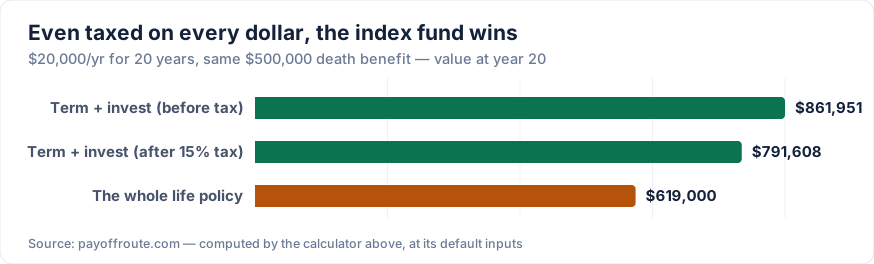
| Value after 20 years | $619,000 | $861,951 |
| After capital gains tax | $619,000 | $791,608 |
| Real annual return | 3.99% | 7% |
Buying term and investing the difference finishes $172,608 ahead — and that is after we taxed every dollar of its gain at 15%, which is harsher than reality, since you would only pay tax on what you actually sold. We handed the policy its best argument and it still lost.
The break-even makes it starker. Your investments would need to earn just 4.7% a year to match this policy. Not to beat it — to tie it. A boring bond fund clears that. And that comparison is against a taxable brokerage account; a 401(k) or an IRA is also tax-deferred, costs a fraction of a percent a year, and does not take a decade and a half to break even.
“You pay the interest to yourself”
This is the sentence the entire strategy is built on, and it is false.
A policy loan is a loan from the insurance company. Your cash value is the collateral. The interest you pay is the insurer’s revenue, and not one cent of it is credited to you. If it were, the insurer would be lending you money for free, which is not a business.
What is true — and this calculator models it — is that many policies are non-direct recognition: your full cash value keeps earning dividends even while it is pledged against the loan. So if the loan costs 6% and the cash value is still being credited 5%, the net cost of borrowing is about 1%. That is a genuinely cheap loan. It is a real feature and we will not pretend otherwise.
But you bought that 1% loan by giving up $242,951 of growth.
That is the whole trade, stated honestly. You can borrow against your own money very cheaply, after spending twenty years earning 3.99% on it instead of 7%. Every dollar of the loan’s cheapness was pre-paid, at a markup, in foregone returns. If a cheap line of credit is what you actually want, our HELOC vs personal loan calculator prices two of them without a twenty-year entry fee.
“But the death benefit lasts forever”
It does — and if you die during the term, the term policy pays the same $500,000 for $350 a year. So the death benefit only becomes the deciding argument if you live, and the term expires.
Look at what you are holding on that day. After twenty years, the invested difference is worth $791,608 after tax — against a $500,000 death benefit. You have more money than the insurance would ever have paid out. You do not need the insurance any more.
That is not a hole in the argument for term. That is the argument for term: you buy cover for the years your family would be ruined without you, and you use the money you saved to make those years finite.
The part of the pitch that never gets a slide
Whole life is front-loaded. Commissions and expenses come out of the earliest premiums, so the cash value in year one is a fraction of what you paid, and surrender charges can run for a decade or more. Enter an early year above — with the cash value from your own illustration — and read the annual return it produces. It is usually deeply negative.
This matters more than it looks, because a large share of policies are surrendered. If there is any real chance your income drops, your circumstances change, or you simply lose patience with a 3.99% return, you are not buying the policy on this page. You are buying the early years of it, and paying full price for the worst part of the product.
Two honest caveats before you leave. First, whole life is not a fraud — it is a legitimate, heavily-regulated product that does what it says: it pays a guaranteed death benefit and accumulates cash slowly and safely. If your goal is a guaranteed estate for a dependant who will need it whatever happens, that is a real use, and this calculator is not arguing with it. What is being sold as infinite banking is something else: the claim that this is a superior way to build and access wealth. That claim is what the numbers above refuse.
Second, and this is the one that should decide it for most people: the strategy is almost always sold by someone paid a commission of a large share of your first year’s premium. That does not make them liars. It does mean the person explaining the maths to you is the last person who can afford to run it — so run it yourself, on your own illustration, with the numbers above.
Frequently Asked Questions
Why does this calculator ask for numbers off my illustration instead of just modelling the policy?
Because we cannot model your policy honestly and neither can anyone else on the internet. A whole life policy’s cash value depends on the carrier’s dividend scale, its internal cost of insurance, its expense loads and its surrender schedule — figures that are proprietary, vary enormously between carriers, and change. Any site that claims to simulate "a typical policy" is publishing an assumption dressed as a fact. Your illustration already contains the real numbers. Bring three of them, and the arithmetic we do on them is exact.
Is “you pay the interest to yourself” true?
No. It is the central claim of the pitch and it is simply false. A policy loan is a loan from the insurance company, secured by your cash value as collateral. The interest is the insurer’s revenue; not a cent of it is credited to you. What IS true — and we model it — is that many policies are "non-direct recognition", meaning your full cash value keeps earning dividends even while it is pledged against the loan. That makes the NET cost of the loan genuinely low, often around one percent. It is a real feature. It is not the same thing as paying yourself, and the difference is the insurer’s profit.
What about the tax advantages? Cash value grows tax-deferred and policy loans are tax-free.
That is the strongest card in the pitch, so this calculator hands it to them: it taxes every dollar of the index-fund gain at your capital gains rate, which is harsher than reality (you would only pay on what you sell). On the defaults, buying term and investing the difference still finishes $172,608 ahead after that tax. And this compares against a taxable brokerage account — most people should fill a 401(k) or IRA first, which is also tax-deferred, costs a fraction of a percent a year, and does not take fifteen years to break even.
But the policy pays a death benefit forever. Term expires.
It does, and that matters if you die young — which is exactly what the term policy is for, and it pays the same death benefit for a fraction of the premium. The question is what happens if you live. On the defaults, at the end of the twenty years the invested difference is worth $791,608 after tax, against a $500,000 death benefit. You have more money than the insurance would have paid, so you no longer need the insurance. That is not a loophole in the argument for term. That is the entire argument for term.
What if I surrender the policy early?
It is the worst outcome available to you, and the pitch never dwells on it. Whole life is front-loaded: commissions and expenses come out of the earliest premiums, so the cash value in the first years is far below what you have paid in, and surrender charges can run for a decade or more. Enter an early year in this calculator with the cash value from your own illustration and it will show you the real annual return on those years — it is usually deeply negative. Industry lapse rates are high, which means a large share of buyers do exactly this.
Does this calculator store my information?
No. Every calculation runs entirely in your browser. Nothing you enter is saved, stored, or sent to any server.
Read more on this
Does Infinite Banking Work? Your Policy Earns 3.99%. The Illustration Just Never Says So.
Original data: we gave the policy the return its own sellers claim, and taxed the index fund on every dollar of gain. Buying term and investing the difference still finished $172,608 ahead.
Read →The IUL Column Your Agent Did Not Show You Earns −9.98% a Year
Original data: every indexed universal life illustration prints two columns on the same page. One is a projection. The other is a promise. We computed the real annual return of both.
Read →Related calculators
Personal Loan
Monthly payment and true total cost of a personal loan, including the origination fee most calculators ignore.
Open calculator →Loan Payoff
See how much sooner you’ll be debt-free and how much interest you save by adding extra monthly or one-time payments to any loan.
Open calculator →Student Loan Payoff
See when your student loans actually end — and how extra payments or one-time windfalls move the date and shrink the interest.
Open calculator →Disclaimer: This calculator is for educational purposes only and provides estimates based on the numbers you enter. It is not financial, legal, or tax advice. Actual loan terms, rates, and payments depend on your lender and personal circumstances. All calculations run in your browser — nothing you enter is stored or sent anywhere.