How much personal loan can I get on my salary?
A personal-loan decision is really two questions: are you likely to repay (your credit history), and can you afford the payment (your capacity)? The affordability half runs almost entirely on one number — your debt-to-income ratio, or DTI. The lender adds up your fixed monthly debt obligations, divides by your gross monthly income, and checks the result against a ceiling. Most personal-loan lenders draw that line somewhere around 40–45%; the classic comfort zone sits at 36%. This calculator runs that math in reverse: instead of reporting your DTI, it starts from the lender’s ceiling and backs out the largest new payment — and therefore the largest loan — that still fits underneath it.
Everything hangs on one subtraction. Whatever is left after your existing obligations is the room a new loan payment has to fit into:
Room for a new payment = (gross monthly income × DTI limit) − existing debts − housing
Reverse-amortize that room at your APR and term and you have the maximum principal. Here is what the calculator’s defaults — $450 of debts, $1,200 of housing, a 43% DTI limit, 12.5% APR over 5 years — produce across four incomes. Only the salary changes:
| Gross annual income | Allowed total debt at 43% | Left for a new payment | Maximum loan |
|---|---|---|---|
| $45,000 | $1,613 | None — already at 44.0% DTI | $0 |
| $60,000 | $2,150 | $500.00 | $22,224 |
| $80,000 | $2,867 | $1,216.67 | $54,079 |
| $100,000 | $3,583 | $1,933.33 | $85,934 |
Notice how violently non-linear this is. Income rises by two-thirds from $60,000 to $100,000, but the loan it supports nearly quadruples — from $22,224 to $85,934 — because your debts and housing are subtracted first, and everything above that fixed floor flows straight into borrowing capacity. The same effect runs in reverse at the bottom: at $45,000 the identical obligations already consume 44.0% of income, past the 43% ceiling, and the answer is nothing at all until a payment is freed up.
Two details trip people up. First, lenders use gross income — your pay before taxes and deductions — not your take-home. A 43% DTI on gross income can feel like half of the money that actually lands in your account. Second, only certain bills count: housing (rent, or mortgage plus property tax and insurance), loan payments, credit-card minimums, and court-ordered support such as alimony and child support. Groceries, utilities, insurance premiums, phone bills, and subscriptions do not. If you want to see the ratio the other way around — your current DTI and which approval tiers you clear — use our debt-to-income ratio calculator. This page is its inverse: the same rules, solved for the loan.
The mechanics are straightforward. Your gross monthly income is your salary divided by twelve. The lender’s DTI limit, applied to that income, is the most total debt they’ll let you carry. Subtract what you already pay each month plus your housing, and whatever is left is the room for a new loan payment. Reverse-amortize that payment at your APR and term, and you have the maximum principal a lender at that limit would extend.
Salary is the start, not the answer
The search that brings many people here — “personal loan for a $23,000 salary” — has no single answer, because salary alone doesn’t decide it. Two people earning $23,000 can qualify for wildly different amounts.
Take someone earning $23,000 with no debt payments who lives rent-free with family. Gross monthly income is about $1,917. At a 43% limit, a lender would allow roughly $824 a month in total debt — and because this person owes nothing, all $824 is available for a new payment. Reverse-amortized at 12.5% over five years, that supports a loan of $36,633. On a $23,000 salary. DTI math permits borrowing more than 1.5× annual income, because DTI knows nothing about the balance — only the monthly payment.
Now try a $45,000 earner carrying $450 in existing debt payments and a $1,200 housing payment. Gross monthly income is $3,750, and 43% of that is $1,612.50 — but the $450 in debts plus $1,200 in housing already total $1,650. That is a 44% DTI before a single dollar of new borrowing. There is no room left; the tool reports that this borrower is already past the ceiling and would need to free up payments before a new loan fits. The person earning half as much qualifies for tens of thousands; the person earning twice as much qualifies for nothing — purely because of existing obligations. That is the whole point: existing debt, not salary, is usually the binding constraint.
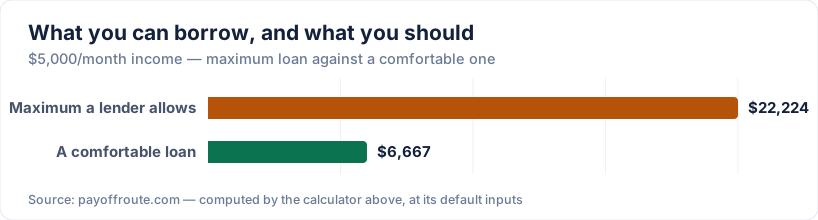
The calculator opens on a middle case — $60,000 of income against the same $450 of debts and $1,200 of housing — which leaves exactly $500.00 of monthly room and supports a $22,224 loan. Nudge any one of those inputs and watch the ceiling move.
It cuts both ways. Drop that $45,000 borrower’s housing to $900 and clear the $450 in debt payments, and the same salary suddenly opens $712.50 of monthly room — a $31,670 loan at the same rate and term. Nothing about the paycheck changed; the obligations did. So the honest answer to “how much can I borrow on X salary” is “enter your debts and housing too, because those move the number far more than the salary does.”
The max is a ceiling, not a target
The calculator reports two figures on purpose. The maximum is the lender’s ceiling — the biggest loan that squeezes under their DTI limit. The comfortable figure uses 36%, the zone lenders and budgeters have leaned on for decades. The gap between them is the honest part, and it is where the earlier $23,000 example gets its reality check: that same borrower’s comfortable number at 36% is $30,669, and even that is a lot of unsecured debt against a modest income.
Borrowing to your ceiling means every dollar of your allowable debt capacity is committed. A 43% or 45% DTI leaves almost nothing between your obligations and the lender’s line — so the first unexpected expense (a car repair, a medical bill, a slow month for variable income) has nowhere to go except a credit card at 20%+, which then pushes your DTI even higher. Maxing out the ratio also means the next lender you approach — for a car, an apartment, eventually a mortgage — sees a borrower with no headroom left. Staying near 36% preserves a buffer for exactly the emergencies that borrowing is supposed to prevent, not create. Treat the maximum as information about the outer wall of the room, and the comfortable figure as where you’d actually put the furniture.
What else the lender checks
DTI decides whether the payment fits; it doesn’t decide the whole application. Approval and pricing also turn on a handful of other factors.
Credit score. Your score sets the APR, and the APR changes how much loan a given payment buys. As rough guideposts: excellent credit (~740+) sees about 6–12%, good (~670–739) about 12–18%, fair (~580–669) about 18–28%, and below ~580 runs about 28–36%. A higher APR shrinks the principal a fixed monthly payment can support, so weaker credit is penalized twice — a smaller maximum and a higher cost per dollar. Once you know your likely amount here, price it with our personal loan calculator, which also folds in the origination fee most lenders quietly deduct from your disbursement.
Income documentation. Lenders count documented, stable income — W-2 wages, and self-employment or side income backed by a track record, often two years of tax returns. Cash that never hits a return doesn’t exist to an underwriter, and brand-new side income usually can’t be counted yet. If you’re planning to borrow, make sure the income you’re counting on is the income you can prove.
Loan purpose and amount. Some lenders ask what the loan is for and price or limit accordingly; debt consolidation and home improvement are generally viewed more favorably than speculative uses. Very small and very large requests can each face tighter rules, and the term you request interacts with the amount — which is the next lever worth understanding.
Ways to raise the number honestly
If the amount comes back lower than you need, three levers actually move it — without misrepresenting anything on the application.
Free up a monthly payment. Because DTI counts payments, not balances, eliminating one whole payment does more than shaving a little off several. Knocking out a $150 card minimum on the $45,000 example turns a maxed-out ratio into real borrowing room almost overnight. Our credit card payoff calculator shows how quickly you can retire a specific balance to open that space — and targeting the smallest balance you can kill entirely frees the most monthly room per dollar.
Add a co-borrower. A creditworthy co-borrower or co-signer adds their income to the application — and ideally little debt — which can lift the ceiling and sometimes improve the rate. But they are equally on the hook, and the loan lands on their credit report too, so this is a favor with real weight.
Stretch the term — carefully. A longer term lowers the monthly payment, so the same DTI room supports a larger principal: the maximum rises. The catch is that every extra month is more interest, so the loan that’s cheaper per month is the more expensive loan overall. See exactly what a longer term costs against a shorter one with our loan comparison calculator before you trade total cost for a bigger headline number.
Frequently Asked Questions
Can I get a personal loan on a $23,000 salary?
Yes. A $23,000 salary can support a personal loan — sometimes a surprisingly large one — but the amount depends far more on your existing debts and housing than on the salary itself. Someone earning $23,000 with no other debt payments can qualify for more than a higher earner who is already stretched. Enter your numbers in the calculator to see the figure; just remember the comfortable amount is usually well below the maximum.
Do lenders use gross or net income?
Gross income — your pay before taxes, insurance, and retirement deductions come out. That is true for DTI at essentially every lender, which is why a ratio that looks fine on paper can feel tight against your take-home pay. A 43% DTI on gross income can easily consume half of your actual paycheck.
Does rent count in DTI for a personal loan?
Yes. Unlike a mortgage application — where the lender swaps your current rent for the proposed new mortgage payment — a personal-loan lender counts your existing housing payment (rent, or mortgage plus property tax and insurance) as part of your DTI. That is why this calculator asks for housing as its own input rather than folding it into other debts.
Is there a minimum income requirement for a personal loan?
Many personal-loan lenders set a minimum annual income, often somewhere in the low-to-mid five figures, but there is no universal number — some approve incomes around $20,000–$25,000, and the threshold varies by lender and loan size. Meeting the minimum only gets you in the door; your DTI and credit score still decide the actual amount and rate you are offered.
Does a co-signer or co-borrower raise the amount?
It can. Adding a co-borrower who has income and little debt improves the combined debt-to-income ratio, which can raise the maximum loan and sometimes the rate you are offered. The trade-off is real: a co-signer or co-borrower is legally responsible for the debt, and the loan appears on their credit report too, so a missed payment damages both of you.
Will applying hurt my credit score?
Checking your rate usually will not. Most online lenders let you prequalify with a soft credit pull that does not affect your score, so you can compare several real offers risk-free. Only a full application triggers a hard inquiry, which typically dips your score a few points for a short time. The lasting damage to credit comes from missed payments, not from shopping for a loan.
Does this calculator store my information?
No. All calculations run entirely in your browser. Nothing you type is saved, stored, or sent to any server.
Read more on this
Related calculators
Personal Loan
Monthly payment and true total cost of a personal loan, including the origination fee most calculators ignore.
Open calculator →Loan Payoff
See how much sooner you’ll be debt-free and how much interest you save by adding extra monthly or one-time payments to any loan.
Open calculator →Student Loan Payoff
See when your student loans actually end — and how extra payments or one-time windfalls move the date and shrink the interest.
Open calculator →Disclaimer: This calculator is for educational purposes only and provides estimates based on the numbers you enter. It is not financial, legal, or tax advice. Actual loan terms, rates, and payments depend on your lender and personal circumstances. All calculations run in your browser — nothing you enter is stored or sent anywhere.