The Solar Loan Trap: A Fee You Were Not Allowed To Be Told, and a Payment That Jumps 47%
Two things are sold in a solar sale. One of them generates electricity. The other one is the loan, and it is where the money is made.
This study is only about the second. Every figure comes from the engine behind our solar loan calculator; the methodology is public.
Key findings
- The low rate is not a discount. You bought it. A system costing $22,000 in cash is written up at $29,000 when financed at 2.99%. The $7,000 gap is a dealer fee — the lender’s charge for the below-market rate, passed straight back to you inside the price.
- The true APR is 5.6%, not 2.99%. The advertised rate is arithmetically true against the inflated $29,000. Against what the system actually costs, the same payments are 5.6%.
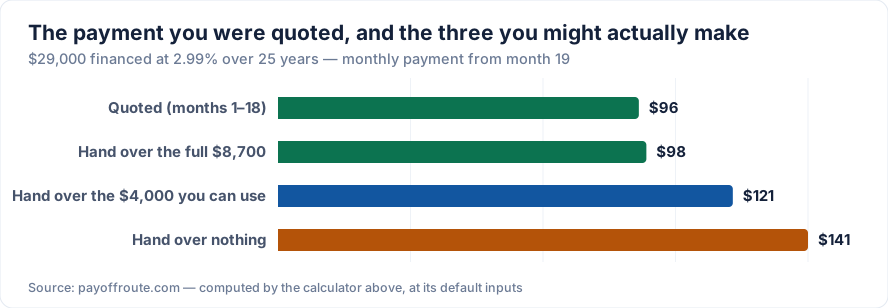
- The quoted payment is a teaser. $96 a month assumes you hand the lender a $8,700 lump sum — your tax credit — by month 18. Miss it and the loan re-amortizes to $141: a jump of 46.8%.
- The credit is capped by your tax bill, and nobody models this. Section 25D is non-refundable. A household owing $4,000 of federal income tax can use only $4,000 of the $8,700. Its payment lands at $121 — up 26.2% — having done everything it was told.
- After 31 December 2025 there is no credit at all. Section 25D was repealed for expenditures made after that date, and the law counts the date installation was completed. Sign in October 2025, get installed in February 2026, and your lump sum is $0 while your loan still expects $8,700.
- The fee was allegedly a secret by contract. The Minnesota Attorney General’s March 2024 suit alleges the lenders prohibited installers from disclosing the dealer fee to customers.
(Cite these figures freely with a link to this page.)
Part one: the fee you were not allowed to be told about
Lenders pay installers to originate loans, and they charge for a low rate. The mechanism is a dealer fee: to write your loan at 2.99% instead of 8%, the lender takes a cut of the amount financed, and the installer — who is not going to absorb it — adds it to your price.
You are not being given cheap credit. You are buying it, and the price is buried in principal, where no disclosure has to name it.
This is not inference. On 8 March 2024 the Minnesota Attorney General sued four of the largest solar lenders — GoodLeap, Sunlight Financial, Solar Mosaic and Dividend Solar Finance — over more than 5,000 Minnesota installations. The complaint alleges:
- The hidden fees raised borrowers’ costs by 15% to 30% — about $35 million in Minnesota alone.
- GoodLeap’s average fee was 19.32% of the loan — $7,552.19 per borrower.
- Solar Mosaic wrote $85.5 million of loans to 2,147 Minnesotans at an average dealer fee of 17.6%, taking $12.6 million.
- And the allegation that turns a pricing practice into something else: the lenders contractually prohibited installers from disclosing the dealer fee to consumers.
A fee you are forbidden from being told about is not a pricing decision. It is the product.
There is a coda worth reporting, because it says something about how much protection an enforcement action actually buys you. A year later the Attorney General won a judgment: the companies were banned from operating in Minnesota, and consumers received $310,000 in restitution.
Against $35 million in fees, that is under one percent. The enforcement worked. It did not make anybody whole. Which is the entire argument for knowing the number before you sign.
What the fee does to the rate
| Cash | Financed at 2.99% | |
|---|---|---|
| Price of the system | $22,000 | $29,000 |
| Dealer fee inside the price | — | $7,000 (31.8% on top) |
| Advertised APR | — | 2.99% |
| True APR, against the cash price | — | 5.6% |
| Total paid over 25 years | $22,000 | $41,525 |
The advertised 2.99% is not a lie. It is a correct rate on a fictional principal. Measured against what the system costs — the only number that is real — the money costs 5.6%.
Which means the question that breaks the whole structure is one sentence long, and you ask it before anything is signed:
“Is this price the same if I pay cash?”
If the answer is no, the difference is the fee, and you have just made them say it out loud.
Part two: the payment you were quoted is not the payment
The second half arrives eighteen months later, in the post, and it surprises people who have done nothing wrong.
Solar loans are written around an assumption: that you will receive the 30% federal tax credit and hand it straight to the lender as a lump sum. The monthly payment you are quoted is calculated as if you already had — it is the payment on 70% of the balance, not on the balance.
Miss the deadline and the lender re-amortizes. It takes what you actually still owe, spreads it across what is left of the term, and bills you the payment that was correct all along.
| What you hand the lender by month 18 | Lump sum | New payment | Change |
|---|---|---|---|
| The full 30% the loan assumed | $8,700 | $98 | +2.0% |
| Only the credit you can actually use | $4,000 | $121 | +26.2% |
| Nothing | $0 | $141 | +46.8% |
Nothing has malfunctioned when this happens. That is the contract performing exactly as written.
The number nobody asks you for: your tax liability
Look again at the middle row, because it is the finding, and we have not found it computed anywhere.
Section 25D is non-refundable. It can wipe your federal income tax down to zero. It cannot hand you more than you owed. So when the credit is $8,700 and your federal income tax for the year is $4,000, the amount you can use is $4,000.
The remainder carries forward to future tax years, and we are not going to call a carryforward worthless — it is real relief. But it is not money you can put in an envelope by month 18.
The loan’s deadline does not carry forward.
So the household sold this on the promise of a $98 payment lands on $121 — up 26.2% — having followed every instruction it was given. To use an $8,700 credit in one tax year you must owe $8,700 in federal income tax. Retirees, single-income families, anyone whose withholding lands them near a refund: many simply do not.
The sales pitch quotes the credit. The loan is priced off the credit. Your ability to use it is priced off nothing at all — nobody in the transaction ever asks to see line 24 of your 1040.
Why the 2026 version is worse
The residential clean energy credit was repealed for expenditures made after 31 December 2025. And the statute is precise about timing: an expenditure is treated as made when the original installation is completed — not when you signed, not when you paid a deposit, not when the panels were delivered.
So take the household that signed in October 2025, waited on a utility interconnection, and had the crew finish in February 2026.
Their credit is $0.
Their loan does not know that. It was written to assume a 30% paydown at month 18, and it still assumes it. When the lump sum does not arrive — because it cannot arrive — the loan re-amortizes and the payment rises the full 46.8%, from $96 to $141.
They did nothing wrong. They were not late. The paperwork was correct. The credit was repealed while their permit was in a queue.
What eighteen months of payments actually bought
One last figure, because it explains why the jump is so violent.
| The first 18 months | Amount |
|---|---|
| Teaser payment you were quoted | $96 / month |
| Total you have paid by month 18 | $1,731 |
| How much of that came off the principal | $439 |
| Balance still owed at month 18 | $28,561 |
Eighteen payments. $1,731 handed over. The balance moved $439.
The teaser is set so low that it barely outruns the interest — which is precisely why, when the lump sum fails to appear, there is a full $28,561 to re-spread over a shorter remaining term. The low payment was not a kindness. It was the mechanism.
None of this says solar is a bad idea
We want to be exact about the limits of this study, because the opposite claim is easy to make and we are not making it.
Panels generate electricity worth real money for twenty-five years. This page has nothing to say about whether a system pays for itself. It may well. That is a separate calculation, and an honest installer can show you a real one.
What this page says is narrower and, we think, more useful: the financing is a second product, sold at the same moment, and it is where the margin lives. Keep the two decisions apart.
- Ask the one question: “Is this price the same if I pay cash?”
- Settle the cash price before a monthly payment is ever mentioned.
- Then shop the borrowing separately. A home equity loan at a higher stated rate is very often cheaper than a 2.99% solar loan, because it does not carry a 30% fee inside the principal. Compare them honestly with the loan comparison calculator.
- Look at line 24 of your Form 1040 before you count on the credit — and if you were installed in 2026, there is no credit to count on.
Methodology
The dealer fee is the difference between the amount financed and the cash price of the system. The teaser payment is the standard amortizing payment on the financed amount less the paydown the contract assumes, over the full term — which is how these loans are quoted. The balance at the re-amortization month is obtained by amortizing the full financed amount at that teaser payment, because the lump sum has not been made yet. Each scenario then re-amortizes the remaining balance, less the lump sum actually paid, over the remaining term. The usable credit is the lesser of the credit and your federal income tax liability, because Section 25D is non-refundable; the excess carries forward but cannot be paid to the lender by the deadline. True APR is found by bisection on the monthly rate at which the present value of the payment stream equals the cash price — computed with no tax credit on either side, deliberately, because a cash buyer receives the credit too, so it cancels out of the comparison and what remains is the pure cost of the financing. Putting the credit on only one side of the ledger would flatter the loan. Credit rules verified against the text of 26 U.S.C. §25D and the Congressional Research Service; dealer-fee figures are as alleged in State of Minnesota v. GoodLeap, LLC et al. (filed 8 March 2024). This is arithmetic, not tax or legal advice.
Run your own numbers
Home Equity Loan Calculator
See how much you can borrow against your home and what the monthly payment would be, with a full amortization schedule.
Open calculator →Loan Comparison Calculator
Two offers, one honest answer: payments, fees, effective APR, and total cost side by side — even when the terms differ.
Open calculator →Solar Loan Calculator — Dealer Fee & the Month-18 Payment Jump
The 2.99% is bought with a dealer fee hidden in your price, and the payment assumes you hand over your tax credit by month 18. See the true APR — and what the payment becomes when the lump sum never arrives.
Open calculator →Disclaimer: This article is for educational purposes only and is not financial advice. Figures are computed with the models described on our methodology page; actual loan terms depend on your lender and circumstances.