The rate is not cheap. You bought it.
Nothing about a 2.99% solar loan is a favour. Lenders charge the installer a dealer fee for writing a loan at a below-market rate, and the installer does the only thing it can: adds the fee to your price. The system that costs $22,000 if you pay cash is written up at $29,000 when it is financed.
You did not get a cheap loan. You bought one, for $7,000, and the payment for it is buried in principal where no disclosure has to name it.
This is not an inference. In March 2024 the Minnesota Attorney General sued four of the largest solar lenders — GoodLeap, Sunlight Financial, Solar Mosaic and Dividend Solar Finance — over more than 5,000 Minnesota installations. The complaint alleged the fees raised borrowers’ costs by 15% to 30%, some $35 million in that state alone; that GoodLeap’s average fee was 19.32% of the loan, or $7,552 a borrower; and — the part worth pausing on — that the lenders contractually prohibited installers from disclosing the fee to customers.
A fee you are forbidden from being told about is not a pricing decision. It is the product.
The payment you were quoted is not the payment
The second half of the structure is the one that arrives by post, eighteen months later, and it surprises people who have done nothing wrong.
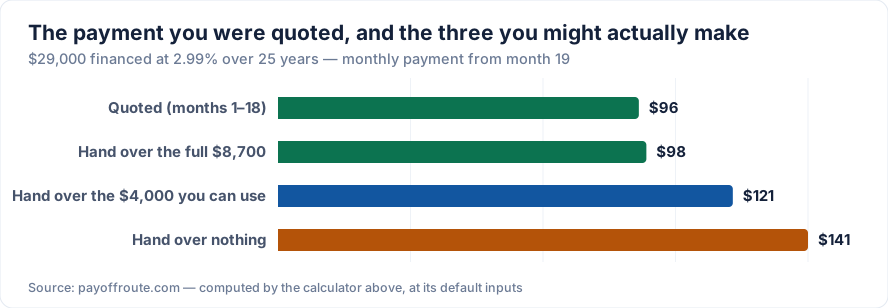
Most solar loans are written around an assumption: that at some point you will receive the 30% federal tax credit and hand it straight to the lender as a lump sum. The monthly payment you are quoted is calculated as if you already had — it is the payment on 70% of the balance, not on the balance. Miss the deadline and the lender re-amortizes: it takes what you actually still owe, spreads it over what is left of the term, and bills you the payment that was always correct.
| What you pay the lender by month 18 | Lump sum | New payment | Change |
|---|---|---|---|
| The full 30% the loan assumed | $8,700 | $98 | +2.0% |
| Only the credit you can actually use | $4,000 | $121 | +26.2% |
| Nothing | $0 | $141 | +46.8% |
Reported jumps of 30–50% are common, and on these figures the tool prints 46.8%. Nothing has malfunctioned. That is the contract performing exactly as written.
The number nobody asks you for: your tax liability
Here is the middle row of that table, and the reason this calculator asks a question the others do not.
Section 25D is non-refundable. It can wipe your federal income tax down to zero. It cannot hand you more than you owed. So if the credit is $8,700 and your federal income tax for the year is $4,000, the amount you can actually use is $4,000.
The remainder carries forward to future tax years, and that is real relief — we are not going to call a carryforward worthless. But it is not money you can put in an envelope by month 18. The loan’s deadline does not carry forward. So the household that was sold this on the promise of a $98 payment lands on $121 instead, up 26.2%, having done everything it was told.
To use an $8,700 credit in a single year you need to owe $8,700 in federal income tax. Plenty of the households targeted for solar — retirees, single-income families, anyone whose withholding lands them near a refund — simply do not.
If you were installed in 2026, the lump sum does not exist at all
This is the sharpest version of the trap, and it is live right now.
The residential clean energy credit was repealed for expenditures made after 31 December 2025. And the statute is specific about timing: an expenditure is treated as made when the original installation is completed — not when you signed, not when you paid a deposit.
So consider the household that signed in October 2025, waited on a permit, and had the crew finish in February 2026. Their credit is $0.
Their loan does not know that. It still assumes a 30% paydown at month 18, because that is what it was written to assume. When the paydown does not arrive — because it cannot arrive — the loan re-amortizes and the payment goes up the full 46.8%, from $96 to $141. Switch the selector at the top of this page to see it.
What eighteen months of payments actually bought
One last figure, because it explains why the jump is as violent as it is.
| The first 18 months | Amount |
|---|---|
| Teaser payment you were quoted | $96 / month |
| Total you have paid by month 18 | $1,731 |
| How much of that came off the principal | $439 |
| Balance still owed at month 18 | $28,561 |
Eighteen payments, $1,731 handed over, and the balance has moved by $439. The teaser payment is set so low that it barely outruns the interest — which is precisely why, when the lump sum fails to appear, there is a full $28,561 left to re-spread over a shorter remaining term.
Follow the whole thing to the end and, with no lump sum, you pay $41,525 for a system that costs $22,000 in cash. The advertised rate was 2.99%. The rate you actually paid, measured against what the thing costs, was 5.6%.
None of this says solar is a bad idea
It is worth being straight about the limits of this page. Panels generate electricity worth real money for twenty-five years, and this calculator has nothing to say about whether a system pays for itself. It may well. That is a separate calculation, and a good installer can show you a real one.
What this page says is narrower: the financing is a second product, sold at the same time, and it is where the money is being made. Keep the two decisions apart.
- Ask the one question. “Is this price the same if I pay cash?” If it is not, the difference is the dealer fee, and you have just made them say it out loud.
- Settle the cash price first, before any conversation about monthly payments begins.
- Then price the borrowing separately. A home equity loan or a credit union personal loan at a higher stated rate can easily be cheaper than a 2.99% solar loan, because it does not carry a 30% fee inside the principal. Compare them honestly with the loan comparison calculator.
- Check your Form 1040 before you count on the credit — and if you were installed in 2026, there is no credit to count on.
Related tools
- Home equity loan calculator — the usual honest alternative to a dealer-fee solar loan.
- Loan comparison calculator — compare two offers on effective APR and total cost, even when the terms differ.
- 0% financing vs cash rebate — the same trick, at a car dealership: a subsidised rate paid for out of your price.
Frequently Asked Questions
What is a solar loan dealer fee?
It is a fee the lender charges the installer for offering you a low advertised rate — and the installer adds it straight back onto your price. A system that costs $22,000 in cash is written up at $29,000 when it is financed at 2.99%. You are not getting a cheap loan; you are buying the rate, and paying for it in principal. In March 2024 the Minnesota Attorney General sued four of the largest solar lenders — GoodLeap, Sunlight Financial, Solar Mosaic and Dividend — alleging these fees raised borrowers’ costs by 15% to 30%, totalling $35 million in that state alone. GoodLeap’s average fee was 19.32% of the loan, or $7,552 per borrower. The suit alleged the lenders contractually forbade installers from telling customers the fee existed.
Why did my solar payment go up after 18 months?
Because the payment you were quoted was never the real payment. Most solar loans are written on the assumption that you will hand the lender a lump sum — your 30% federal tax credit — by around month 18. The advertised payment is calculated as if that lump sum has already been paid. If it is not paid by the deadline, the lender re-amortizes what is actually left over what is left of the term, and the payment jumps to what it should have been all along. On this calculator’s defaults that is a rise from $96 to $141 a month — 46.8% — and nothing has gone wrong. That is the loan working exactly as written.
The federal solar tax credit ended — what does that do to my loan?
The residential clean energy credit under Section 25D was repealed for expenditures made after 31 December 2025, and the law treats an expenditure as made when the installation is completed. So if you signed in late 2025 but the crew finished in 2026, your credit is zero. The loan does not care. It still assumes a 30% paydown at month 18, and when it does not arrive the payment re-amortizes upward anyway. This is the sharpest version of the trap: the lump sum the loan was built around no longer exists, and the payment jumps the full 46.8% regardless.
Can I always use the full 30% tax credit?
No, and this is the part almost nobody models. Section 25D is non-refundable: it can reduce your federal income tax to zero, but it cannot pay you more than you owed. If the credit is $8,700 and your federal tax liability for the year is $4,000, you can only use $4,000 of it. The rest carries forward to future tax years — which is genuine relief, but it is not money you can hand the lender by month 18. Your loan’s deadline does not carry forward. That is why this calculator asks for your tax liability and not just the credit: on the defaults, that single input moves the payment from $98 to $121.
What is my “true APR” on a solar loan?
It is the rate you are really paying once you measure the payments against what the system actually costs — the cash price — rather than the inflated financed price. The advertised 2.99% is arithmetically true against the $29,000 they wrote on the contract. Against the $22,000 the system costs in cash, the same payment stream is 5.6%. That is the honest number, and it is the one the dealer fee exists to hide. Ask one question at the quote: “Is this price the same if I pay cash?” If the answer is no, the difference is the fee.
Is solar a bad deal, then?
No — and we are not going to pretend it is. Solar panels generate electricity worth real money for decades, and this calculator has nothing to say about whether the system pays for itself. What it says is narrower and separate: the way the system is financed can quietly add 15–30% to the price, and the payment you were quoted may not be the payment you end up making. Those are two different questions, and the second one is the one nobody puts a number on. Settle the cash price first, ask what it costs to pay cash, and only then decide how to borrow.
Is my information stored?
No. All calculations happen in your browser. Nothing you enter is saved or transmitted anywhere.
Read more on this
Related calculators
Home Equity Loan
See how much you can borrow against your home and what the monthly payment would be, with a full amortization schedule.
Open calculator →HELOC Payment
Estimate your HELOC payments during the interest-only draw period and the repayment period that follows.
Open calculator →HELOC vs HEL
Same equity, two very different loans. Compare payments and lifetime cost side by side — including what happens to the HELOC if rates rise.
Open calculator →Disclaimer: This calculator is for educational purposes only and provides estimates based on the numbers you enter. It is not financial, legal, or tax advice. Actual loan terms, rates, and payments depend on your lender and personal circumstances. All calculations run in your browser — nothing you enter is stored or sent anywhere.