Where the minimum comes from
The minimum payment on your statement looks like a number the bank chose for you, but it isn’t. It is the output of a formula written into your cardmember agreement, applied to your balance every billing cycle. Two formulas dominate the U.S. market. The first is a flat percentage of the balance — commonly 1% to 3% — so a 2% minimum on a $5,000 balance is $100. The second is interest plus a slice of principal:
Minimum = (balance × APR ÷ 12) + 1% of balance
The issuer charges you all of the month’s interest, then adds about 1% of the balance on top so a little principal always goes down. On a 22.99% card that formula turns a $5,000 balance into a first minimum of $145.79 — $95.79 of interest plus $50.00 of principal.
Both formulas are then subject to a dollar floor, almost always in the $25 to $35 range. The floor is why a nearly-paid-off card still asks for a fixed small payment instead of a few cents: once the percentage falls below the floor, the floor takes over. Which formula your card uses, and where its floor sits, are the two levers that decide how long a minimum-only payoff will take — and they are spelled out in the agreement you accepted when you opened the account, usually under a heading like “how we calculate your minimum payment.” The calculator above lets you set both and see the number your specific card would produce.
Why the minimum shrinks every month
Here is the mechanism that makes the minimum so quietly dangerous: it is a percentage of a number that is falling, so it falls too. Pay down the balance and next month’s minimum is calculated on a smaller balance, so next month’s minimum is smaller. The payment that felt manageable at the start keeps getting easier — and that is precisely the problem. A shrinking payment is a decelerating payoff. Each month the bank asks for less, so most people pay less, and the balance inches down instead of dropping.
There is a second, subtler shift. At the start, a large share of your minimum is going to principal; near the end it is mostly interest and floor. Because the minimum tracks the balance, the early payments do real work and the later ones barely move the needle. Watch the two numbers the calculator surfaces: your first minimum and how much of it is interest. On the defaults, that first $145.79 minimum is already about two-thirds interest — and as the balance falls, the payment shrinks toward the $25 floor while the interest share climbs. You end up making dozens of small payments that are almost entirely interest, which is how a mid-sized balance quietly stretches across fifteen or twenty years. The declining minimum isn’t a feature that rewards progress; it is the throttle that keeps you in debt.
This is also why two people with the same balance and the same APR can have wildly different payoff timelines. The one whose card uses a slightly lower percentage, or a lower floor, is handed a smaller minimum — and if that is all they pay, they stay in debt longer and pay more, purely because their formula asked for less. Nothing about their situation changed except the number the statement printed. That is the quiet unfairness of anchoring to the minimum: the figure is engineered to be affordable, and affordability, month after month, is exactly what keeps the balance alive.
How long does paying only the minimum take?
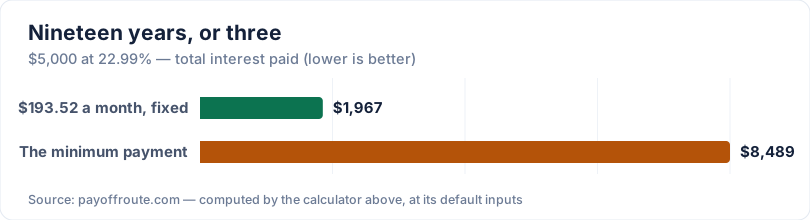
Walk the calculator’s defaults: a $5,000 balance at 22.99% APR, an interest-plus-1% minimum, a $25 floor. Your first minimum is $145.79, and paying only the shrinking minimum from there clears the balance in 19 yr 4 mo while costing $8,489 in interest — more than the balance you started with. You would pay back $13,489 to retire a $5,000 debt, one small declining payment at a time.
That is not a quirk of the $5,000 figure. Here is the same 22.99% card, the same interest-plus-1% formula and $25 floor, across four balances — each compared against a level three-year payment on the identical debt:
| Balance at 22.99% APR | First minimum | Minimum-only payoff | Interest, minimum only | 3-year fixed payment | Interest, fixed |
|---|---|---|---|---|---|
| $3,000 | $87.48 | 15 yr 2 mo | $4,657 | $116.11 | $1,180 |
| $5,000 | $145.79 | 19 yr 4 mo | $8,489 | $193.52 | $1,967 |
| $8,000 | $233.27 | 23 yr 3 mo | $14,236 | $309.64 | $3,147 |
| $10,000 | $291.58 | 25 yr 1 mo | $18,068 | $387.05 | $3,934 |
Read the $5,000 row across: the fixed payment is only $47.73 a month more than the first minimum, and it cuts the payoff from 19 yr 4 mo to 3 yr and the interest from $8,489 to $1,967 — a $6,522 saving. The gap between the two columns is never about affording a much larger payment. It is about refusing to let the payment shrink.
Now change the formula to a flat 2% and raise the APR to 24.99%, and something worse happens. The monthly interest rate on a 24.99% card is about 2.08% — the APR divided by twelve. A flat 2% minimum on a $5,000 balance is $100, but that month’s interest is about $104. The payment does not even cover the interest, so the balance grows, and next month’s 2% minimum is calculated on a bigger number. The minimum-only plan never pays the balance off. The rule is simple and unforgiving: whenever the flat minimum percentage is below the monthly rate — roughly whenever the APR exceeds about twelve times that percentage — you go backwards forever. The calculator detects this and reports “Never” rather than an invented number.
Data bears out how common the slow version of this is. Our minimum-payment statistics study collects the research on how many households carry balances and pay at or near the minimum, and our explainer on how your minimum payment is calculated breaks down the exact formulas issuer by issuer.
What actually gets you out
The escape is almost embarrassingly simple: stop letting the payment shrink. Pick a fixed monthly amount and pay it every single month, regardless of what the statement’s minimum falls to. The most natural starting point is your minimum today — hold that same dollar figure flat instead of letting it decline, and you break the shrinking-minimum cycle entirely. Anything higher is better still. Because a fixed payment keeps hammering the balance at full force while the required minimum melts away beneath it, the payoff accelerates instead of decelerating.
The contrast is stark. On the defaults, holding a fixed payment of $193.52 a month — only $47.73 more than the first minimum — clears the same $5,000 in 3 yr and saves $6,522 in interest versus the minimum-only path. That is the whole game: a level payment, not a declining one. If you are juggling more than one card, our credit card payoff calculator handles several balances at once and compares the snowball and avalanche orderings so you know which card to attack first. To see how a given fixed payment splits between interest and principal on a single card, the credit card interest calculator lays out the monthly detail. The point is always the same: choose the number, hold it flat, and let the arithmetic work for you instead of against you.
Two habits make a fixed payment stick. First, automate it: set an autopay for your chosen dollar amount rather than for “the statement minimum,” so the payment can never quietly shrink underneath you. Second, resist the temptation to spend the room that opens up as the balance falls — the whole advantage of a level payment is that the gap between it and the dwindling minimum is doing the heavy lifting. Every month you hold the line, more of your payment reaches principal, and the payoff date pulls closer instead of receding. A flat payment you barely notice will beat a shrinking one you agonize over.
If you can’t clear it fast
Sometimes the balance is too large or the APR too high for a fixed payment alone to feel doable. When the interest itself is the enemy, the strongest move is to stop it. A 0% balance transfer moves your balance to a card that charges no interest for an introductory window — often 12 to 21 months — so every dollar you pay during that window goes entirely to principal instead of feeding interest. Used deliberately, it can turn a two-decade minimum-only grind into a balance you actually clear.
A transfer only wins if you finish before the 0% window closes, and there is usually a transfer fee to weigh. Our balance transfer calculator compares keeping your current card against moving to the offer, fee included, so you can see whether the interest you’d avoid beats the cost of admission. Once you’ve decided to transfer, the balance transfer payoff calculator gives you the single monthly payment that lands the balance at zero exactly when the promo expires. Between a held-flat fixed payment and a well-timed transfer, the minimum-payment trap is entirely avoidable — but only if you refuse to let the payment shrink.
One note on the rules behind all of this. In the United States, the Truth in Lending Act and its Regulation Z — strengthened by the CARD Act — require the minimum on a general-purpose credit card to at least cover fees and interest plus some portion of the principal, which is why a straight interest-only minimum is not permitted on these cards. The Consumer Financial Protection Bureau and the Federal Reserve oversee those requirements and publish consumer guidance on how minimums work. The details vary by issuer and product, so the specifics of your card live in your agreement — but the through-line is the one this tool exists to show: the minimum is the least you may pay, never a plan for getting out.
Frequently Asked Questions
How is my minimum payment calculated?
Your issuer sets it with a formula written into your cardmember agreement, not a number they pick by hand. The two most common formulas are a flat percentage of your balance — usually 1% to 3% — or your accrued interest plus 1% of the principal. Both are then subject to a dollar floor, typically $25 to $35, so a tiny balance still triggers a small fixed payment. Because both formulas are tied to your balance, the minimum falls as the balance falls. This calculator lets you pick either formula and see the exact number for your card.
Why does my minimum payment keep going down?
Because the minimum is a percentage of your balance, and your balance is shrinking. A minimum set at, say, interest plus 1% of principal is largest when the balance is largest — at the very start — and gets smaller every month as you pay the balance down. It only stops falling once it reaches the issuer’s dollar floor, often $25 to $35. That declining payment feels like progress, but it is exactly what stretches a minimum-only payoff across many years: each month you are asked to pay a little less, so a little less is what most people pay.
Can paying only the minimum ever fail to pay off the balance?
Yes — with a flat-percentage minimum on a high-APR card. If your minimum is a flat percent of the balance and that percent is below the monthly interest rate, the payment does not even cover the interest, so the balance grows every month instead of shrinking. A 2% minimum on a card whose monthly rate is about 2.08% (roughly a 25% APR) is a live example: the balance goes backwards and the minimum-only plan never clears it. Formulas that add 1% of principal on top of interest always pay something toward the balance, so they eventually converge — but they can still take two decades.
Is it bad to pay the minimum?
Paying at least the minimum on time is important — it keeps your account current and protects your credit. The problem is paying only the minimum, month after month, as your whole strategy. Because the payment shrinks with the balance, a minimum-only plan drags a mid-sized balance out for fifteen to twenty years and can cost more in interest than the original balance itself. The minimum is a floor the issuer will accept, not a plan to get out of debt. Treat it as the least you may pay, then pay meaningfully more whenever you can.
What is the fastest way to escape the minimum-payment trap?
Stop letting the payment shrink. Pick a fixed monthly amount — your minimum today held flat is a fine start, and anything higher is better — and pay that same number every month regardless of what the statement asks for. Because a fixed payment keeps attacking the balance while the required minimum falls away beneath it, the balance clears in a fraction of the time. If the APR is high, a 0% balance transfer can stop the interest entirely while you pay the principal down. The calculator above shows exactly how many years and dollars a fixed plan saves versus the minimum.
Does paying the minimum hurt my credit?
Making the minimum on time each month does not hurt your credit on its own — on-time payment history is the single biggest factor in your score, and the minimum keeps you current. The indirect risk is what a minimum-only habit leaves behind: a balance that lingers for years keeps your credit utilization high, and high utilization weighs on your score. So the on-time minimum protects payment history while the persistent balance quietly drags on utilization. Paying more than the minimum both clears the debt faster and lowers utilization, which tends to help the score.
Is my information stored?
No. All calculations happen in your browser. Nothing you enter is saved or transmitted anywhere.
Related calculators
Credit Card Payoff
Compare the snowball and avalanche strategies across all your cards and see how much interest each plan saves.
Open calculator →Balance Transfer
Is a 0% balance transfer worth the fee? Compare keeping your card vs transferring, month by month.
Open calculator →Loan vs Transfer
The two main escapes from card debt, compared honestly: fixed-rate loan vs 0% intro offer, fees included, same monthly budget.
Open calculator →Disclaimer: This calculator is for educational purposes only and provides estimates based on the numbers you enter. It is not financial, legal, or tax advice. Actual loan terms, rates, and payments depend on your lender and personal circumstances. All calculations run in your browser — nothing you enter is stored or sent anywhere.