A home equity loan is a fixed-rate second mortgage
A home equity loan hands you a single lump sum up front and charges it back at a fixed interest rate over a set number of years — five, ten, fifteen, or twenty are the common terms. It is an installment loan, structured almost exactly like your first mortgage: the same equal monthly payment every month, part interest and part principal, until the balance reaches zero on a known date. Because it sits behind your primary mortgage in line, it is often called a second mortgage.
That fixed structure is what makes early payoff so predictable. A HELOC is a different animal: it is a revolving line of credit with a variable rate, and during its draw period it often lets you pay interest only. With a HELOC, a rate increase can quietly cancel out the extra you send, and the balance can climb again every time you draw. A home equity loan has none of that ambiguity. The rate is locked, the payment is locked, and the finish line does not move — so every extra dollar you pay produces a permanent, calculable reduction in both the payoff date and the total interest. You never have to wonder whether a rate reset will undo your progress.
This calculator models exactly that fixed-rate case. It takes your current balance, your rate, and the years remaining, works out the scheduled payment that would retire the loan on time, and then simulates the loan month by month with your extra payments layered on top. The gap between the two paths — the scheduled path and the accelerated path — is your savings.
How much does $100 extra a month save on a home equity loan?
Your scheduled payment does two jobs each month. First it covers the interest your balance generated that month; only whatever is left over reduces the balance itself. An extra payment is different, and this is the whole trick: the month’s interest is already paid by the scheduled payment, so every extra dollar goes 100% to principal. That is the entire engine, in one line:
Principal paid this month = (scheduled payment + extra) − (balance × rate ÷ 12)
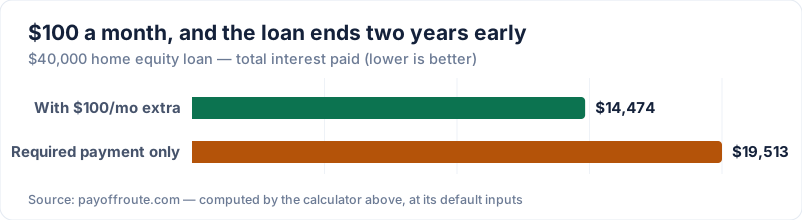
Here is that loop run to payoff on the calculator’s defaults — a $40,000 balance at 8.5% with 10 years left, scheduled payment $495.94 — at four different extra amounts:
| Extra per month | You actually pay | Debt-free in | Total interest | Interest saved |
|---|---|---|---|---|
| $0 (schedule) | $495.94 | 10 yr | $19,513 | $0 |
| $100 | $595.94 | 7 yr 8 mo | $14,474 | $5,039 |
| $200 | $695.94 | 6 yr 3 mo | $11,544 | $7,969 |
| $300 | $795.94 | 5 yr 3 mo | $9,619 | $9,894 |
The returns are real but they taper: the first $100 buys $5,039 of savings, the second $100 buys another $2,930, the third only $1,925. Each extra dollar still earns a guaranteed 8.5%, but there is progressively less interest left in the loan for it to kill — which is the arithmetic behind the advice to start early rather than to start big.
Removing principal has a second, larger effect. Each dollar you knock off the balance stops generating interest for the entire remaining life of the loan. So when you pay $100 extra on an 8.5% loan, you don’t just save $8.50 — you save 8.5% of that $100 compounding for years, because next month’s interest is calculated on a smaller balance, which frees a little more of the scheduled payment for principal, which shrinks the following month’s interest, and so on. Prepaying is compound interest finally working for you instead of against you.
Walk the calculator’s default numbers to see it. A $40,000 balance at 8.5% with 10 years left carries a scheduled payment of about $496 a month, and on that schedule you would pay roughly $19,500 in interest over the full 120 months. Add just $100 extra every month — paying about $596 instead of $496 — and the loan is gone in about 92 months instead of 120. That is roughly 28 months sooner and about $5,000 less interest, from an extra amount most budgets can absorb. Because the effect is front-loaded, the same extra started this month is worth far more than one started three years from now: early extras spend the most time suppressing interest. If you are going to accelerate the loan, the best month to begin is this one.
One practical caution before you send that first extra amount: make sure it actually lands on principal. Some servicers default to treating extra money as an early next payment, which advances your due date but barely dents the balance. When you pay online, look for an “apply to principal” option; if you mail a check or use your bank’s bill pay, write “apply to principal” in the memo, then check your next statement to confirm the balance dropped by the full extra amount. On a home equity loan the payment usually covers only principal and interest — there is typically no escrow for taxes and insurance the way a first mortgage often has — so the whole extra belongs to the balance if the servicer posts it correctly.
Lump sums and recasting
A one-time payment — a tax refund, a bonus, the proceeds of a sale — drops straight onto principal and produces an immediate, satisfying fall in the balance. Enter it in the one-time field above and watch the payoff date jump closer. In the calculator, that lump sum hits principal in the first month, so it starts suppressing interest right away.
There is a second thing a lump sum can do that many borrowers miss. Some lenders let you recast — also called re-amortizing — after a large principal payment. Instead of keeping your payment the same and shortening the term, a recast recalculates a new, lower required payment spread over the loan’s original end date. You keep the original payoff timeline but free up monthly cash flow. Recasting usually costs a small fee and is not offered by every home equity lender, so ask before you count on it. Our mortgage recast calculator shows how a lump sum plus a recast changes the required payment, which is the natural companion to the “shorten the term” math on this page. The choice is really about your goal: extra payments and a shorter term save the most interest, while a recast trades some of that saving for a smaller bill each month.
Should you pay it off early?
Prepaying any loan is an investment with a guaranteed, risk-free return equal to the loan’s rate. Paying down an 8.5% home equity loan is effectively an 8.5% guaranteed return, tax-free in most cases — and very little else in your financial life is both guaranteed and pays that well. Weigh that rate honestly against the other uses of the money: an emergency fund you don’t yet have, higher-rate debt like credit cards, or a diversified investment that might earn more but carries risk. If the home equity rate is higher than what you could reliably earn elsewhere, prepaying usually wins on the math; our prepay vs. invest calculator puts those two paths side by side.
There is also a risk dimension that a pure return comparison misses. A home equity loan is secured by your home. That security is why the rate is far lower than an unsecured debt would be — but it is also why the stakes are higher: fall far enough behind and the lender can foreclose, even if your first mortgage is perfectly current. Paying the loan down faster shrinks that exposure and builds equity you actually own. If you are weighing whether to move unsecured balances onto home equity in the first place, read our home equity vs. credit card debt calculator before you pledge the house against a balance that isn’t currently tied to it.
One tax note worth getting right: interest on a home equity loan is tax-deductible only when the borrowed money is used to buy, build, or substantially improve the home that secures the loan, and only if you itemize within the overall mortgage-debt limits (IRS Publication 936). If you spent the funds on anything else, the interest is not deductible — so don’t assume a write-off is softening the cost unless your situation qualifies.
Related payoff tools
This page is deliberately the fixed-rate home equity loan case of a general extra-payment payoff engine — same month-by-month simulation, reframed for a second mortgage with a locked rate and a set term. If your debt looks different, use the tool built for it so the assumptions match:
- For a HELOC — a revolving, variable-rate line with a draw period and a payment cliff — use the HELOC payoff calculator, which models the parts a fixed loan doesn’t have.
- For any other fixed-rate loan — auto, personal, student, or a first mortgage — use the general loan payoff calculator, which is the same engine with the inputs left generic.
Saying that plainly is the point: this is not a hidden duplicate of the loan payoff tool, it is the version tuned to how a home equity loan actually works — the term picker matches the standard 5-, 10-, 15-, and 20-year offerings, the guidance speaks to a second lien on your home, and the scheduled payment is derived for you rather than typed in. Pick the page whose framing fits your debt, and the numbers will be the ones you can act on.
Frequently Asked Questions
Is there a penalty for paying off a home equity loan early?
Usually not. Most fixed-rate home equity loans have no prepayment penalty, so you can send extra principal or pay the balance in full without an extra charge. The exception to watch for is an early-closure or early-termination fee — some lenders reimburse themselves for closing costs they waived up front if you pay off and close the account within the first two or three years, often a few hundred dollars or a small percentage of the original loan. Read your loan agreement or ask your servicer before sending a large payoff, and time a full payoff after any early-closure window ends.
Home equity loan vs. HELOC — which pays off faster?
A fixed-rate home equity loan is easier to attack because both the rate and the payment are locked, so every extra dollar produces a predictable, permanent reduction in interest and payoff time. A HELOC has a variable rate and, during the draw period, often lets you pay interest only — which means a rising rate can quietly offset your extra payments. If you have a HELOC, the payoff math works differently; our HELOC payoff calculator handles the draw period, the payment cliff, and the changing rate. For a fixed second mortgage, the calculator on this page is the right tool.
Should I make extra payments or recast the loan?
They solve different problems. Extra principal payments shorten the loan and cut total interest but leave your required payment unchanged — best if your goal is to be debt-free sooner and pay the least interest. A recast (re-amortization) applies a lump sum to principal and then recalculates a lower required payment over the original end date — best if your goal is lower monthly cash flow. Not every lender offers recasting on home equity loans, and those that do usually charge a small fee. Extra payments always save more interest; a recast trades some of that saving for breathing room in your monthly budget.
Does paying off a home equity loan early help my credit?
The effect is usually small and mixed. Paying down the balance lowers how much you owe, which can help, but closing an installment account can cause a minor, temporary dip because it trims your mix of active credit and ends that account’s stream of on-time payments. Any dip typically fades within a few months, and the interest you stop paying is real money that never comes back. Almost no one should keep a home equity loan open purely to nudge a credit score — the guaranteed interest savings outweigh a few points that recover on their own.
What happens to my home’s title when the loan is paid off?
A home equity loan places a lien (a legal claim) against your property. When you pay the balance in full, the lender releases that lien — usually by filing a release or reconveyance with your county land records — and the second mortgage no longer clouds your title. Ask your lender to confirm the release was recorded, and keep the paperwork. Until the release is filed, the lien can still show up in a title search, so if you are selling or refinancing soon after payoff, verify the record has been cleared.
Is the interest on a home equity loan tax-deductible?
Only in specific cases. Under current federal rules, interest on a home equity loan is deductible only when the borrowed money is used to buy, build, or substantially improve the home that secures the loan, and only if you itemize and stay within the overall mortgage-debt limits (see IRS Publication 936). Interest on money you spent on other things — a car, a vacation, paying off credit cards — is not deductible. Because the deductible cases are narrow and depend on how you used the funds, confirm your situation with a tax professional rather than assuming the interest is written off.
Is my information stored?
No. All calculations happen in your browser. Nothing you enter is saved or transmitted anywhere.
Related calculators
Home Equity Loan
See how much you can borrow against your home and what the monthly payment would be, with a full amortization schedule.
Open calculator →HELOC Payment
Estimate your HELOC payments during the interest-only draw period and the repayment period that follows.
Open calculator →HELOC vs HEL
Same equity, two very different loans. Compare payments and lifetime cost side by side — including what happens to the HELOC if rates rise.
Open calculator →Disclaimer: This calculator is for educational purposes only and provides estimates based on the numbers you enter. It is not financial, legal, or tax advice. Actual loan terms, rates, and payments depend on your lender and personal circumstances. All calculations run in your browser — nothing you enter is stored or sent anywhere.