The ceiling nobody mentions
Start with the constraint that quietly settles this argument for most buyers: you usually cannot spend your cash on points even if you want to. A discount point costs 1% of the loan amount, and lenders stop selling them somewhere around three or four — beyond that, the rate sheet simply has no more rows. So the points bucket has a hard ceiling of roughly 4% of the loan, which is about 3.6% of the purchase price.
Now put that next to the advice everyone gives — “if you are under 20% down, put the cash toward the down payment instead and get rid of PMI.” Take a buyer on a $400,000 home holding exactly the cash that advice requires: enough to reach 20% down. How much of it can the points bucket actually swallow?
| Your down payment | Cash needed to reach 20% | Most of it points can absorb | Forced into the down payment anyway |
|---|---|---|---|
| 5% | $60,000 | $13,333 | $46,667 |
| 10% | $40,000 | $13,333 | $26,667 |
| 15% | $20,000 | $13,333 | $6,667 |
| 17% | $12,000 | $12,000 | $0 — a genuine either/or |
Read the last column. A buyer at 10% down who has scraped together the $40,000 that reaching 20% requires can divert at most $13,333 of it into points — the rate sheet has no more rows. The other $26,667 goes into the down payment no matter which option they “choose.” To absorb that whole $40,000 in points they would have to buy 11.1 points. Lenders sell four.
So the decision is not $40,000 into points or $40,000 into the house. It is: should I divert the $13,333 the cap allows? The stake is a third of what it appears to be — and the choice only becomes a true either/or once you are within about three percentage points of 20%, where the cash needed is finally small enough to fit inside the points bucket.
This is what the calculator models: fill the points bucket to your lender’s cap, and whatever will not fit goes down anyway. It is why the “buy points” column often shows a bigger down payment too. On the defaults, $20,000 of spare cash buys the maximum 4 points for $14,167, and the remaining $5,833 has nowhere to go but the down payment.
How do you compare points against a down payment fairly?
Both paths hand the lender exactly the same cash on closing day, so the cash cancels and the comparison reduces to what happens afterwards. There is one term almost every comparison leaves out, and it decides the whole thing: the balance you still owe on the day you sell. Money spent on points is gone forever. Money put into the down payment is still in the house, and it comes straight off what you have to pay back.
Total cost = principal & interest paid + PMI paid + balance still owed when you leave
Run the defaults and watch what that term does. The points path takes the bigger loan ($354,167) at the lower rate (5.75%); the down-payment path takes the smaller loan ($340,000) at the full 6.75%. Here is the awkward part for anyone who thinks a lower payment settles it:
| Buy points | Bigger down payment | |
|---|---|---|
| Cash at closing | $60,000 | $60,000 |
| Down payment | $45,833 (11.5%) | $60,000 (15.0%) |
| Spent on points | $14,167 (4 points) | $0 |
| Loan amount | $354,167 | $340,000 |
| Rate | 5.75% | 6.75% |
| Monthly payment incl. PMI | $2,229.15 | $2,361.07 |
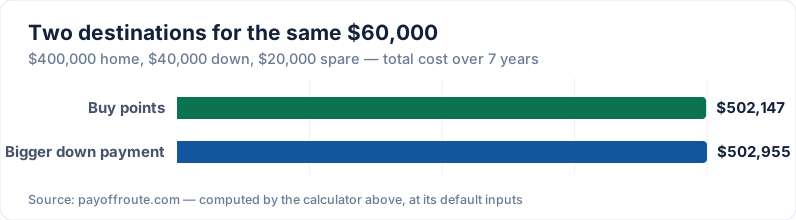
| Total cost over 7 years | $502,147 | $502,955 |
The points path has the lower monthly payment — by $131.92 — and it still loses at every horizon under 6 yr 9 mo. That is the whole lesson in one row. The lower payment is real, but you bought it with cash that no longer exists, while the other buyer’s cash is sitting inside the house waiting to be handed back at closing. Sell in year three and the down-payment buyer walks away $6,572 ahead despite having paid more every single month.
| If you leave after… | Buy points | Bigger down payment | Winner |
|---|---|---|---|
| 3 years | $419,925 | $413,353 | Down payment by $6,572 |
| 5 years | $462,282 | $460,530 | Down payment by $1,752 |
| 7 years | $502,147 | $502,955 | Points by $808 |
| 10 years | $554,901 | $563,690 | Points by $8,788 |
| 30 years | $756,555 | $802,922 | Points by $46,368 |
The number that decides it is not the rate
Everybody shops the rate. The rate turns out to be nearly irrelevant to this decision. What matters is the rate reduction per point — the price your lender charges for the discount, which sits in a line on your Loan Estimate that most buyers never read. Hold the pricing at 0.25% per point and move the rate from 5.5% to 8%, and the break-even barely stirs: 5 yr 2 mo, 5 yr 5 mo, 5 yr 9 mo. Now hold the rate and move the pricing instead, and it detonates: at 0.125% per point the break-even is 15 yr 10 mo — longer than almost anyone keeps a loan, meaning the points are simply a loss — while at 0.375% per point it collapses to 3 yr 3 mo.
A 2.5-point swing in the rate moves the answer by seven months. A quarter-point swing in the pricing moves it by twelve years. So when you are handed a Loan Estimate, the question that actually matters is not “what rate did I get?” but “what does one point buy me here?” — and it is worth asking two or three lenders on the same day, because point pricing varies far more between lenders than rates do. If a point buys you only an eighth of a percent, the answer is already no; put the cash into the loan and stop reading. Our mortgage points calculator takes the points decision on its own if you have no spare-cash trade to make.
When the PMI cliff is genuinely in play
If you are close enough to 20% that the cash actually gets you there, the picture changes — and the size of the change is worth knowing precisely. Take a buyer at 18% down with exactly enough spare cash to reach 20%. Killing PMI outright pushes the points break-even out from 5 yr 5 mo to 7 yr 10 mo: the mortgage-insurance cliff is worth 29 extra months of required tenure before points can catch up. For a buyer who honestly expects to move or refinance inside a decade, that is often the ballgame.
Two cautions, though, because the cliff is smaller than its reputation. First, PMI is not permanent even if you do nothing: on the defaults it falls off by itself at month 58 on the down-payment path and month 77 on the points path, as the balance amortizes down to 80% of the price. You are not buying your way out of a lifetime cost — you are buying your way out of about five years of one. Second, this is conventional PMI. FHA mortgage insurance plays by different rules and on most modern FHA loans never comes off at all, which is a reason to reach 20% and take a conventional loan, not a reason to buy points.
And if you are already at or above 20%, the PMI question disappears entirely and this becomes a clean bet on your horizon. In that case, look hard at whether the cash should be going into this decision at all — a shorter term does more for total interest than either option here, as our 15 vs 30 year mortgage calculator shows, and cash kept liquid has value that no spreadsheet on this page can price.
The honest version of the decision
Strip away the arithmetic and there are three cases. If you can reach 20% down, do it — the cliff plus the smaller balance is a lot to overcome, and you get the cash back when you sell. If you cannot reach 20% and you are confident you will hold this exact loan past the break-even month above, buy the points — but say the number out loud first, because “this exact loan” means no move, no refinance, no job in another city. If you are unsure, put it down. The down-payment path is the reversible one: that money is still yours, sitting in the house, and it comes back at closing. Points are a bet you cannot unwind.
One last thing this calculator deliberately does not model, and you should weigh it yourself: keeping the cash. Neither column here is the emergency fund, and a buyer who spends their last liquid dollar on a slightly better mortgage has bought a small, certain saving with a large, uncertain risk. If the spare cash is genuinely spare, run the numbers above. If it is your entire cushion, the right answer is a third one that is not on this page.
Frequently Asked Questions
Why can’t I just put all my spare cash into points?
Because a point costs 1% of the loan and lenders stop selling them at around three or four, so the points bucket has a hard ceiling of roughly 4% of the loan. It is usually far too small to hold the cash in question. A buyer at 10% down on a $400,000 home who has the $40,000 that reaching 20% requires can divert at most $13,333 of it into points — absorbing the whole sum would take 11.1 points, and nobody sells that. The other $26,667 goes into the down payment whichever option they pick. The calculator models exactly that: it fills the points bucket to your lender’s cap and puts every leftover dollar into the down payment.
Doesn’t a bigger down payment always win by killing PMI?
Only if it actually reaches 20%, and the points path usually cannot get there — because the cash it cannot absorb is the only cash that raises your down payment. The 10%-down buyer above who spends the maximum on points still lands at 16.7% down: they bought a lower rate and kept the mortgage insurance. The PMI cliff is only a live either/or if you start within roughly three percentage points of 20%. Below that, both paths pay PMI, and the decision comes down to the rate discount versus the smaller balance — which is exactly what the break-even month above measures.
How is “total cost” calculated here?
Both options spend identical cash at closing, so the cash cancels out and we compare what happens afterwards: principal and interest paid through your horizon, plus PMI paid, plus the balance you would still owe on the day you sell or refinance. That last term is the one most comparisons forget, and it is decisive — money spent on points is gone, while money put into the down payment is still sitting in the house, reducing what you have to pay off. The house sells for the same price either way, so the lower total is the better deal.
When does PMI actually come off?
This calculator assumes you request cancellation the month your scheduled balance reaches 80% of the purchase price, which is your right under the Homeowners Protection Act if your payments are current. If you never ask, the servicer must terminate it automatically at 78% — later, and more expensive. Appreciation can also get you there sooner, but that route needs an appraisal and your lender’s agreement, so we do not model it. Note this is conventional-loan PMI: FHA mortgage insurance follows different rules and, on most modern FHA loans, never comes off at all.
Does the rate I am quoted change the answer much?
Far less than you would expect. Hold the point pricing at 0.25% per point and the break-even barely moves as the rate goes from 5.5% to 8% — a few months at most. Change the pricing instead, from 0.125% to 0.375% per point, and the break-even swings from roughly sixteen years to three. The number that decides this trade is the rate reduction per point on your Loan Estimate, not the headline rate everyone shops on.
Does this calculator store my information?
No. Every calculation runs entirely in your browser. Nothing you enter is saved, stored, or sent to any server.
Read more on this
Related calculators
Home Equity Loan
See how much you can borrow against your home and what the monthly payment would be, with a full amortization schedule.
Open calculator →HELOC Payment
Estimate your HELOC payments during the interest-only draw period and the repayment period that follows.
Open calculator →HELOC vs HEL
Same equity, two very different loans. Compare payments and lifetime cost side by side — including what happens to the HELOC if rates rise.
Open calculator →Disclaimer: This calculator is for educational purposes only and provides estimates based on the numbers you enter. It is not financial, legal, or tax advice. Actual loan terms, rates, and payments depend on your lender and personal circumstances. All calculations run in your browser — nothing you enter is stored or sent anywhere.