What points buy, exactly
A discount point is prepaid interest: you hand the lender 1% of the loan amount at closing, and in exchange the lender lowers your interest rate — permanently, for every month you hold the loan. On a $350,000 mortgage, one point costs $3,500 and typically trims the rate by roughly a quarter of a percentage point. Buy two points, pay $7,000, get roughly half a point off. The reduction is baked into the note itself; it never expires and never needs renewing.
That permanence is what separates discount points from a product they are constantly confused with: the temporary buydown. A 2-1 buydown, for example, lowers your payment by two points in year one and one point in year two — and then the rate snaps back to the full note rate for the remaining 28 years. Temporary buydowns are a cash-flow bridge, usually funded by a seller or builder concession, and they answer a different question entirely. This calculator models permanent discount points only. If a loan officer pitches you a “buydown,” your first question should be: permanent or temporary? The math for the two is not remotely the same.
One more thing worth knowing before you model anything: the 0.25%-per-point figure is a rule of thumb, not a law. Lender pricing varies with the market, the loan program, your credit tier, and even the day of the week the rate sheet was printed. Some days a point buys 0.375%; in choppy markets it may buy only 0.125%. The exact trade you are being offered appears on your Loan Estimate — the standardized disclosure every lender must provide within three business days of your application — as a specific rate paired with a specific dollar cost. Enter those real numbers here, not the rule of thumb, and the break-even below becomes your actual break-even rather than an approximation.
How long does it take to break even on mortgage points?
Points are an investment with a known price and a known monthly return, which means the whole decision reduces to a single number: the month the accumulated savings finally cover the upfront cost. Two lines of arithmetic produce it:
Points cost = loan amount × points %
Break-even month = points cost ÷ monthly payment savings
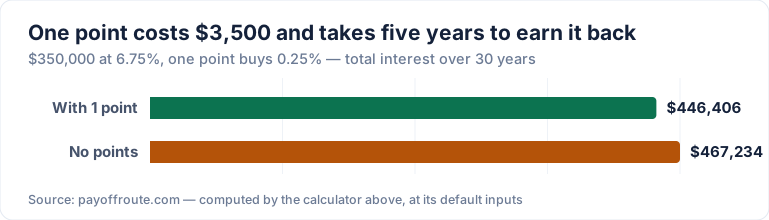
Run this calculator’s defaults and watch it work. A $350,000 loan at 6.75% over 30 years costs $2,270.09 a month. One point — $3,500 at closing — buys the rate down to 6.5%, and the payment falls to $2,212.24. That is $57.86 a month in savings, so $3,500 ÷ $57.86 = 61 months: the cost is earned back at month 61, 5 yr 1 mo. Before that month you are behind; after it, every payment is profit — about $20,800 of interest saved over the full 30 years, for a net gain of $17,328.
Here is the same $350,000 loan at 6.75% over 30 years at every point level, with the rate dropping 0.25% per point:
| Points | Cost at closing | Rate | Monthly payment | Break-even | Lifetime net |
|---|---|---|---|---|---|
| 0 (baseline) | $0 | 6.75% | $2,270.09 | — | $0 |
| 0.5 | $1,750 | 6.625% | $2,241.09 | 5 yr 1 mo | $8,692 |
| 1 | $3,500 | 6.5% | $2,212.24 | 5 yr 1 mo | $17,328 |
| 2 | $7,000 | 6.25% | $2,155.01 | 5 yr 1 mo | $34,430 |
Notice that the break-even barely moves as you buy more points — at a constant 0.25% per point, the cost and the monthly saving scale together, so the payback period stays near five years whether you buy half a point or two. The break-even is set by the pricing, not by how many points you buy. That means the size of the purchase is a question about how much cash you want to commit; only the horizon decides whether to buy at all.
Most realistic point purchases break even somewhere in the four-to-seven-year range. That is a long time, and it is why the honest version of this decision is a question about your life, not about interest rates: will you still be holding this exact loan in year six? Not just still living in the house — holding the loan. A job offer in another city resets the clock. Outgrowing the house when the second kid arrives resets the clock. And — the one people forget — refinancing resets the clock too, because the moment you replace the loan, the rate you paid cash to buy is gone. If any of those feel plausible before your break-even month, the points are a bad bet no matter how satisfying the lower rate sounds at the closing table.
When points make sense
The profile of a good point buyer is specific: a long horizon and high certainty about it. The buyer of a forever home in a settled career, planning to raise kids through the local school district, will hold the loan far past any plausible break-even — and for that buyer, points are among the safest returns available, a guaranteed reduction in a cost they will definitely pay for decades. Points also pair naturally with loans you intend to keep to maturity, which is worth checking against term choice itself — our 15 vs 30 year mortgage calculator shows how much of the interest problem the term decision solves before points even enter the picture.
Now the catch that matters most in a high-rate era: if you are buying when rates are high and expecting to refinance when they drop, points often lose — and this deserves more attention than it gets. Every borrower who took a 7%+ mortgage telling themselves “marry the house, date the rate” is planning, by definition, to abandon this loan the moment rates fall. Points paid on a loan you plan to abandon are points you plan to throw away: when you refinance at year two or three, the bought-down rate dies with the old note, likely before break-even ever arrived. The very market condition that makes a lower rate feel most tempting — rates near a peak — is exactly the condition under which paying for one is most likely to be wasted. If your quiet plan is to refi when rates drop, keep your cash, take the higher rate, and run the eventual offer through our refinance break-even calculator when the day comes. Alternatively, skip the points and put the same cash toward principal instead — our mortgage payoff calculator shows what that does to your payoff date, and unlike points, principal payments keep their full value through any future refinance.
And if the cash in question could just as easily become a bigger down payment, that is a genuinely different question — one with a hard constraint most buyers never hear about. Points are capped at roughly 4% of the loan, so a buyer with enough cash to reach 20% down has far more than they could ever spend on points; the two are not the rivals they are usually presented as. Our mortgage points vs down payment calculator prices both destinations for the same dollars, with PMI and the point cap modelled, and gives you the month one finally overtakes the other.
Negative points and lender credits
The trade runs in reverse, too. Negative points — usually marketed as lender credits — mean you accept a rate perhaps 0.25% higher than the going rate, and in exchange the lender hands you cash toward your closing costs. It is the mirror image of buying points: instead of paying now to save monthly, you are paid now and give some of it back every month for as long as you hold the loan.
Everything this page says about horizon flips with the trade. Lender credits are the short-horizon buyer’s tool: if you expect to sell or refinance within a few years, the higher rate has very little time to cost you, and the upfront cash is money you actually keep. A first home you expect to outgrow, a purchase during a rate spike you fully intend to refinance out of, a buyer whose savings were drained by the down payment — these are the cases where taking the credit beats paying the points, sometimes by thousands. The same break-even logic applies, just inverted: the credit is winning until the month the accumulated extra interest overtakes it, and losing after. Short stay, take the credit; long stay, consider the points; unsure, take the middle and pay for neither.
Points and taxes
Discount points are prepaid interest, and the IRS generally treats them that way — which creates a modest side benefit worth knowing about, with two very different rules. On a home purchase, points paid on your primary residence are often deductible in full in the year you pay them, provided you itemize deductions and meet the IRS tests (the loan is secured by your main home, paying points is an established practice in your area, and the amount is in line with local norms). On a refinance, the rule is stingier: points generally must be amortized over the life of the loan — one 360th of the cost per month on a 30-year note — though any remaining undeducted balance can typically be written off in the year you pay that loan off or refinance again with a different lender.
Two honest caveats. First, the deduction only helps if you itemize, and most taxpayers now take the standard deduction — in which case the tax benefit of points is zero. Second, this calculator deliberately leaves taxes out of the break-even math, because the benefit varies from “nothing” to “your marginal rate” depending on your return. Treat any tax savings as a bonus that shortens the break-even somewhat, not as a reason to buy points that don’t pencil on their own — and confirm your specific situation with a tax professional before counting on it.
Frequently Asked Questions
Are discount points the same as origination fees?
No. Discount points are optional prepaid interest — you choose to pay them in exchange for a lower rate. Origination fees (sometimes confusingly quoted in "points") are the lender's charge for making the loan, and paying them buys you nothing but the loan itself. Your Loan Estimate separates the two on page two: Section A lists origination charges, and discount points appear there as their own labeled line. Only the discount-point line lowers your rate.
Can I negotiate points?
Yes — point pricing is part of the lender's rate sheet, and rate sheets differ meaningfully between lenders. The most effective negotiation is comparison shopping: request Loan Estimates from two or three lenders at the same point level on the same day (rates move daily, so same-day quotes are the only fair comparison) and ask each to beat the best offer. You can also ask what the same rate costs at different point levels; the trade is rarely symmetric, and some lenders price the first point much better than the second.
Do points affect the break-even on a refinance too?
Yes, and doubly so. Points paid on a refinance are part of your total cost to close, so they push the refinance break-even month further out. They also deepen the loss if you refinance again later — you would be abandoning a rate you paid cash for. When comparing refinance offers, run the version with points and the version without through our refinance break-even calculator and keep whichever costs less over the years you realistically expect to hold the loan.
Can I buy fractional points?
Usually, yes. Most lenders price in increments of 0.125 or 0.25 points, so you can buy half a point or a point and a quarter rather than committing to whole points. Fractional pricing is worth exploring because the rate reduction per point often shrinks as you buy more — the first half point may be the best-priced piece of the whole trade.
Can the seller pay my points?
Yes. Seller concessions can be applied toward discount points, subject to loan-program caps (typically 3–9% of the price, depending on loan type and down payment). Seller-paid points can be a smart use of a concession in a buyer's market: rather than a small price cut that barely moves your payment, the same dollars spent on points lower every payment for the life of the loan. The break-even math in this calculator still applies — it just gets dramatically better when the cost isn't yours.
Should I put spare cash toward points or a bigger down payment?
That is a different calculation, and we built a tool for it rather than leaving you to guess: the mortgage points vs down payment calculator prices both destinations for the same cash. Two things surprise most people. First, points are capped at around 4% of the loan, so if you have enough cash to reach 20% down you have far more than you could ever spend on points — the two are not really rivals. Second, the down-payment path wins at short horizons even when its monthly payment is higher, because money spent on points is gone while money put down is still in the house when you sell.
Does this calculator store my information?
No. All calculations run entirely in your browser. Nothing you type is saved, stored, or sent to any server.
Read more on this
Related calculators
Home Equity Loan
See how much you can borrow against your home and what the monthly payment would be, with a full amortization schedule.
Open calculator →HELOC Payment
Estimate your HELOC payments during the interest-only draw period and the repayment period that follows.
Open calculator →HELOC vs HEL
Same equity, two very different loans. Compare payments and lifetime cost side by side — including what happens to the HELOC if rates rise.
Open calculator →Disclaimer: This calculator is for educational purposes only and provides estimates based on the numbers you enter. It is not financial, legal, or tax advice. Actual loan terms, rates, and payments depend on your lender and personal circumstances. All calculations run in your browser — nothing you enter is stored or sent anywhere.