How long does it take a refinance to pay for itself?
Refinancing has one honest test, and it fits on a napkin:
Break-even months = closing costs ÷ monthly savings
Spend $6,000 in fees to save $262.91 a month and you are behind for the first 22 months and ahead from month 23 on — a break-even of 1 yr 11 mo. Before that date, the refinance has cost you money; after it, every month is profit. Everything else — the advertised rate, the lender’s enthusiasm, the pleasant shock of a smaller payment — is noise until you know that date.
But break-even is only half the test, and the calculator computes both. Here are the defaults — a $280,000 balance at 7.25% with 25 years left, refinanced at 6.25% with $6,000 of costs financed — against the two terms you could take:
| Option | Monthly payment | Payoff time | Total interest + costs |
|---|---|---|---|
| Keep the current loan (7.25%) | $2,023.86 | 25 yr | $327,158 |
| Refinance to 30 years at 6.25% | $1,760.95 | 30 yr | $353,942 |
| Refinance to 25 years at 6.25% | $1,886.65 | 25 yr | $285,996 |
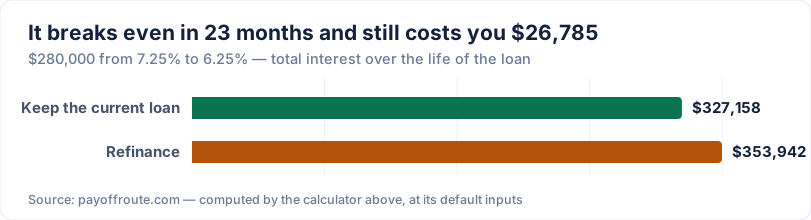
The middle row is the trap. It has the lowest payment — $262.91/mo of savings, break-even in under two years — and it is the most expensive option on the table, costing $26,785 more than doing nothing at all. The bottom row saves $137.20 a month instead, and $41,161 over the life of the loan. Same lender, same rate, same fees; the only thing that changed was the term.
The input that matters is the cost figure on your Loan Estimate, the standardized three-page disclosure every lender must send within three business days of your application. Not the rate ad, not the “no-cost refinance” banner, not the loan officer’s verbal ballpark — the actual dollar total of origination charges, appraisal, title work, and recording fees on page two. Those fees typically run 2–5% of the loan amount, and they are real money whether you write a check at closing or quietly roll them into the new balance and pay interest on them for decades.
For most rate-and-term refinances, break-even lands somewhere between 18 and 48 months. Shorter than 18 months usually means the rate drop is unusually large; longer than 48 means the savings are thin relative to the fees, and the deal only works if you are certain you will stay put for years. That is why the calculator pairs the break-even month with a blunt companion rule: if there is a real chance you will sell the house or refinance again before that month arrives, don’t do it. You would be paying the full cost and collecting only part of the benefit.
The term-reset trap
Here is the part the payment comparison hides, and the reason this calculator computes lifetime totals instead of stopping at the break-even month. When you refinance, you don’t just change the rate — you restart the clock. If you have 25 years left and take a new 30-year loan, you have signed up for five extra years of payments. The monthly number falls for two reasons at once: partly the lower rate (real savings) and partly the longer runway (an illusion — you’re just repaying more slowly).
Run the calculator’s default numbers and watch it happen. A $280,000 balance at 7.25% with 25 years left costs about $2,024 a month and roughly $327,000 in remaining interest. Refinance into a 30-year loan at 6.25% with $6,000 of costs rolled in, and the payment drops to about $1,761 — $263 a month freed up, break-even in under two years. Looks like a clear win. But the new loan runs 360 months instead of 300, and the lifetime total comes to roughly $354,000 in interest and fees — about $27,000 more than simply finishing the loan you already have. Lower payment, higher lifetime cost, both at the same time. A full percentage point of rate improvement, completely swallowed by five extra years of interest.
The honest comparison is the same-term refinance: match the new loan to the years you have left. Those same defaults refinanced into 25 years instead of 30 cost about $1,887 a month — still $137 below the current payment — and roughly $286,000 over the life of the loan, saving about $41,000 instead of losing $27,000. Same rate, same fees, wildly different outcome, and the only variable that moved was the term. When your selected new term is longer than what you have left, this calculator runs that matching-term math automatically and shows it below the results. Many lenders will write odd-length terms, or you can take the 30-year loan and voluntarily pay the 25-year amount — which keeps the interest savings and adds a safety valve, since you can drop back to the lower required payment in a bad month.
No-closing-cost refis
“No closing costs” does not mean the costs vanished; it means they moved into the rate. The lender covers your fees with a lender credit and charges you a rate perhaps 0.25–0.5 points higher than you would otherwise get. You are financing the closing costs through the rate instead of the balance — and unlike a financed balance, a marked-up rate never gets paid off. It applies to every dollar you owe for as long as you hold the loan.
That trade has a legitimate use case: a short expected stay. If you think you will sell or refinance again within two or three years, a true no-cost refi lowers your payment from day one with nothing to earn back — the break-even is effectively immediate, because you invested nothing. The math flips as your horizon lengthens: hold the loan for ten or twenty years and the rate markup quietly costs you several times what the waived fees were worth. The way to see it clearly is to get both quotes from the same lender — with costs and without — and run each through this calculator. Whichever version costs less over the years you realistically expect to keep the loan is the better deal, and the answer depends entirely on that horizon.
When refinancing clearly wins
The trap cases get the warnings, but plenty of refinances are unambiguously good decisions. The pattern is recognizable:
- You bought or last refinanced at a rate peak. The old rule of thumb — refinance when you can cut your rate by at least 0.75 to 1 full point — exists because a drop that size usually produces a break-even under three years even after realistic fees. If you took a loan near a high and rates have fallen meaningfully since, run the numbers; they will likely run in your favor.
- You will stay well past break-even. The savings after the break-even month are the whole point. A 24-month break-even in a house you will hold for ten years means roughly eight years of collecting $200–400 a month for free.
- Your credit has improved substantially. Mortgage pricing is tiered. If you closed the original loan with a 640 score and you are sitting at 760 today, you may qualify for a better rate even in a flat rate environment.
- You can drop mortgage insurance. FHA loans typically carry mortgage insurance premiums for the life of the loan; refinancing into a conventional loan at 20% equity can eliminate a monthly charge that has nothing to do with the rate — savings this calculator’s rate comparison doesn’t even count.
- Your ARM is about to adjust. If a fixed-rate period is ending and the adjusted rate would jump, refinancing into a fixed loan buys certainty. Compare against the rate you would face after adjustment, not the teaser you have been enjoying.
In these cases the calculator’s two tests tend to agree: quick break-even and lower lifetime cost. When both numbers point the same way, the decision is easy. It is when they disagree — payment down, lifetime cost up — that the term-reset math above deserves your full attention.
Refi vs just paying extra
A lower rate is not the only way to cut mortgage interest, and it is worth checking the alternative before paying thousands in fees. Extra principal payments on the loan you already have attack the same enemy — lifetime interest — with zero closing costs, no appraisal, no underwriting, and no term reset. Our mortgage payoff calculator shows what an extra $200 or $400 a month does to your payoff date, and the biweekly payment calculator models the popular half-payment-every-two-weeks version, which works out to one extra monthly payment per year. On a high-rate loan, refinancing usually still wins because it improves the rate on every dollar; on a modest rate gap, extra payments often achieve comparable interest savings without the upfront cost or the risk of moving before break-even. And the two combine beautifully: refinance to the lower rate, then keep paying your old payment amount — the entire difference goes straight to principal every month.
One boundary worth drawing: this page is for rate-and-term refinancing — same debt, better terms. If you are considering pulling cash out of your equity at the same time, the trade-offs are different, because you are repricing your whole balance to get at the cash. That comparison has its own tool: our cash-out refinance vs home equity loan calculator weighs replacing the mortgage against borrowing on top of it.
Frequently Asked Questions
How much does refinancing cost?
Typically 2–5% of the loan amount — on a $280,000 loan, roughly $5,600 to $14,000. The big line items are origination fees, the appraisal, title insurance, and recording fees. Your Loan Estimate (the standardized three-page form lenders must give you within three business days of applying) shows the exact figure for your offer; that is the number to enter in this calculator.
Can I refinance with my current lender?
Yes, and it is worth asking — some lenders offer streamlined paperwork or reduced fees to keep your loan. But do not stop there. Your current lender knows switching is a hassle and may price accordingly. Get at least two or three outside quotes; the spread between lenders on identical loans is often larger than people expect.
Does refinancing hurt my credit score?
Slightly and temporarily. The hard inquiry costs a few points, and closing your old mortgage resets the age of that account. Multiple mortgage inquiries within a 14–45 day window count as a single inquiry for scoring purposes, so shop freely inside that window. On-time payments on the new loan rebuild any dip within months.
How does the break-even change if I sell early?
It is the whole ballgame. The break-even month is the point where accumulated monthly savings finally exceed the closing costs you paid. Sell or refinance again before that month and you paid the costs without collecting enough savings to cover them — a guaranteed loss. If there is a realistic chance you move before the break-even date this calculator shows, the refinance is hard to justify.
Is a 15-year refinance worth the higher payment?
If the payment fits your budget with room to spare, often yes: 15-year rates typically run about half a point below 30-year rates, and the shorter term slashes lifetime interest twice over — less time and a lower rate. The risk is flexibility: the higher payment is mandatory every month. An alternative is a 30-year refi paid like a 15 — same interest savings when you keep it up, but you can drop back to the lower required payment if money gets tight.
What documents do I need to refinance?
Roughly what you needed for the original mortgage: recent pay stubs, W-2s or tax returns (usually two years), bank and asset statements, your current mortgage statement, and proof of homeowners insurance. Self-employed borrowers typically need two years of business returns. Having these ready before you apply speeds up closing and helps you beat a rate-lock deadline.
Does this calculator store my information?
No. All calculations run entirely in your browser. Nothing you type is saved, stored, or sent to any server.
Read more on this
Related calculators
Home Equity Loan
See how much you can borrow against your home and what the monthly payment would be, with a full amortization schedule.
Open calculator →HELOC Payment
Estimate your HELOC payments during the interest-only draw period and the repayment period that follows.
Open calculator →HELOC vs HEL
Same equity, two very different loans. Compare payments and lifetime cost side by side — including what happens to the HELOC if rates rise.
Open calculator →Disclaimer: This calculator is for educational purposes only and provides estimates based on the numbers you enter. It is not financial, legal, or tax advice. Actual loan terms, rates, and payments depend on your lender and personal circumstances. All calculations run in your browser — nothing you enter is stored or sent anywhere.